
[Paper Review] Spatial Transform Decoupling for Oriented Object Detection
STD introduces a multi-branch, decoupled parameter prediction head for ViT-based detectors, coupled with cascaded activation masks to progressively refine features for oriented object detection, achieving state-of-the-art results on DOTA-v1.0 and HRSC2016.
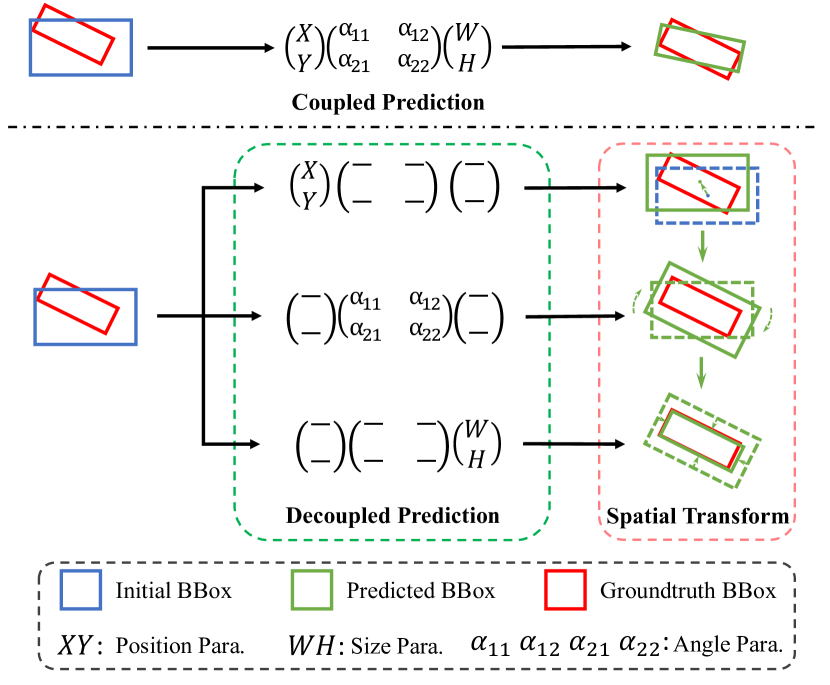
Vision Transformers (ViTs) have achieved remarkable success in computer vision tasks. However, their potential in rotation-sensitive scenarios has not been fully explored, and this limitation may be inherently attributed to the lack of spatial invariance in the data-forwarding process. In this study, we present a novel approach, termed Spatial Transform Decoupling (STD), providing a simple-yet-effective solution for oriented object detection with ViTs. Built upon stacked ViT blocks, STD utilizes separate network branches to predict the position, size, and angle of bounding boxes, effectively harnessing the spatial transform potential of ViTs in a divide-and-conquer fashion. Moreover, by aggregating cascaded activation masks (CAMs) computed upon the regressed parameters, STD gradually enhances features within regions of interest (RoIs), which complements the self-attention mechanism. Without bells and whistles, STD achieves state-of-the-art performance on the benchmark datasets including DOTA-v1.0 (82.24% mAP) and HRSC2016 (98.55% mAP), which demonstrates the effectiveness of the proposed method. Source code is available at https://github.com/yuhongtian17/Spatial-Transform-Decoupling.
Motivation & Objective
- Address rotation-sensitive detection in remote sensing using Vision Transformers (ViTs).
- Propose a decoupled, multi-branch prediction head to estimate position, size, and angle separately.
- Enhance feature refinement via cascaded activation masks that guide self-attention on RoIs.
- Demonstrate generalizability of STD across ViT-based detectors and benchmarks.
Proposed method
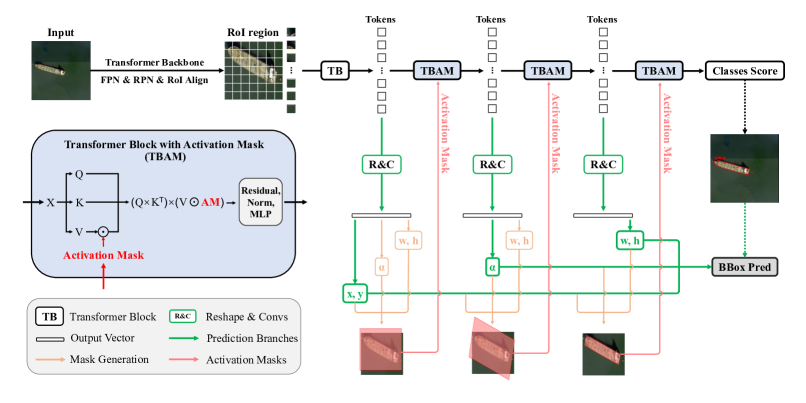
- Use a multi-branch network where each branch predicts a different spatial transform parameter (x,y), angle alpha, (w,h), and class score from progressively deeper Transformer blocks.
- Decouple feature extraction by assigning distinct feature maps from different Transformer blocks to each parameter. Introduce CAMs (cascaded activation masks) to provide pixel-level supervision and steer self-attention toward foreground regions.
- Compute CAMs by affine transforming a unit activation mask according to the predicted box parameters and apply them inside TBAM (Transformer Block with Activation Mask) to modulate V.
- Train within a Faster R-CNN framework (and also show compatibility with Oriented RCNN), using ViT-based backbones pre-trained with MAE.
- Optionally pre-train MAEBBoxHead and then apply STD to achieve progressive refinement across 4 Transformer layers.
Experimental results
Research questions
- RQ1Can decoupled, parameter-specific feature maps improve orientation regression over coupled heads in ViT-based detectors?
- RQ2Do cascaded activation masks provide dense, stage-wise guidance that improves RoI feature refinement and overall mAP for oriented object detection?
- RQ3Is STD generalizable across different ViT backbones and RoI extraction methods while maintaining or improving accuracy?
- RQ4What is the impact of the parameter prediction order and CAM integration on STD performance?
- RQ5How does STD perform on standard oriented-object benchmarks such as DOTA-v1.0 and HRSC2016 compared to state-of-the-art methods?
Key findings
- STD achieves state-of-the-art performance on DOTA-v1.0 and HRSC2016 benchmarks (e.g., 82.24% mAP on DOTA-v1.0 and 98.55% mAP on HRSC2016 for STD-O).
- A hierarchical, layer-wise decoupling of bounding-box parameters (x,y) -> alpha -> (w,h) improves orientation accuracy over single-feature-head baselines.
- CAMs provide dense guidance that aligns attention maps with the semantic meaning of predicted parameters, enhancing foreground focus and reducing background confusion.
- STD demonstrates strong compatibility with multiple backbones (ViT-S/ViT-B/HiViT-B) and detectors (Faster RCNN, Oriented RCNN), delivering consistent gains across setups.
- Ablation studies confirm the effectiveness of decoupled parameter prediction and CAM integration, with specific order (xy -> alpha -> wh) yielding the best results.
Read this paper
Open the full text in the Nubint reader and ask about any passage as you read.
Read this paper on NubintThis review was generated by AI from the original paper. Please check the paper before citing it.