
[Paper Review] Spatio-Temporal Graph Neural Networks for Predictive Learning in Urban Computing: A Survey
A comprehensive survey of Spatio-Temporal Graph Neural Networks (STGNNs) for predictive learning in urban computing, covering data construction, architectures, domains, datasets, and future directions.
With recent advances in sensing technologies, a myriad of spatio-temporal data has been generated and recorded in smart cities. Forecasting the evolution patterns of spatio-temporal data is an important yet demanding aspect of urban computing, which can enhance intelligent management decisions in various fields, including transportation, environment, climate, public safety, healthcare, and others. Traditional statistical and deep learning methods struggle to capture complex correlations in urban spatio-temporal data. To this end, Spatio-Temporal Graph Neural Networks (STGNN) have been proposed, achieving great promise in recent years. STGNNs enable the extraction of complex spatio-temporal dependencies by integrating graph neural networks (GNNs) and various temporal learning methods. In this manuscript, we provide a comprehensive survey on recent progress on STGNN technologies for predictive learning in urban computing. Firstly, we provide a brief introduction to the construction methods of spatio-temporal graph data and the prevalent deep-learning architectures used in STGNNs. We then sort out the primary application domains and specific predictive learning tasks based on existing literature. Afterward, we scrutinize the design of STGNNs and their combination with some advanced technologies in recent years. Finally, we conclude the limitations of existing research and suggest potential directions for future work.
Motivation & Objective
- Motivate predictive learning on vast urban spatio-temporal data and review STGNNs as a solution.
- Categorize STGNN applications by urban domains and predictive tasks.
- Analyze STGNN architectures (spatial, temporal, and fusion) and integration with advanced techniques.
- Summarize public datasets, benchmarks, limitations, and future research directions.
Proposed method
- Describe how spatio-temporal graphs are constructed (topology-, distance-, similarity-, interaction-based).
- Survey fundamental STGNN architectures: spatial GCNs, spectral GCNs, GATs, RNNs/TCNs/TSANs for temporal learning, and STGNN data flow (DPM, STGLM, TPM).
- Classify STGNN designs by spatial learning, temporal learning, and spatio-temporal fusion, plus enhanced and advanced hybrid methods.
- Discuss integration of STGNNs with other learning frameworks and emerging techniques.
Experimental results
Research questions
- RQ1What are the primary methods for constructing spatio-temporal graphs in urban computing?
- RQ2How are STGNN architectures designed to capture spatial, temporal, and spatio-temporal dependencies?
- RQ3What are the main urban application domains and predictive tasks addressed by STGNNs?
- RQ4What datasets and benchmarks are commonly used, and what are the key limitations and future directions for STGNNs in urban predictive learning?
Key findings
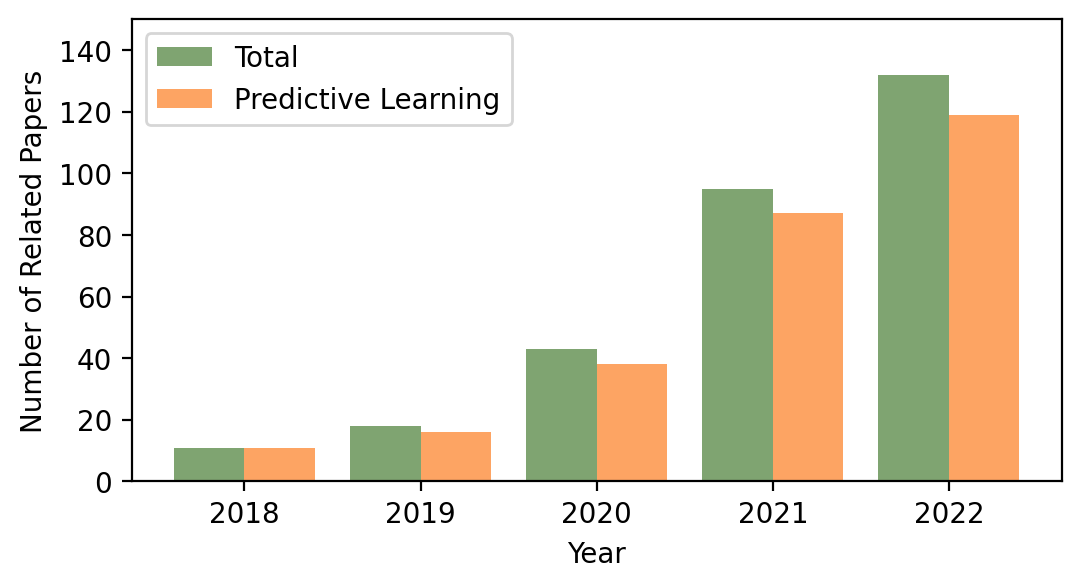
- STGNNs are increasingly applied across transportation, environment, public safety, and public health, with transportation comprising over 60% of literature.
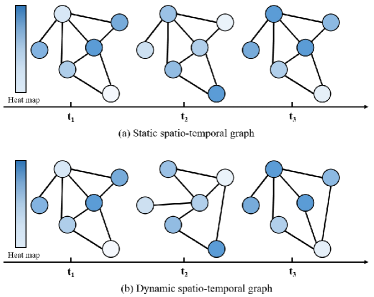
- There are four main spatio-temporal graph construction strategies: topology-based, distance-based, similarity-based, and interaction-based, plus adaptive graph learning approaches.
- STGNNs typically follow a data processing module, a spatio-temporal graph learning module, and a task-aware prediction module.
- Fundamental neural architectures for STGNNs include spatial GCNs (spectral and spatial variants) and graph attention networks, combined with temporal learners like RNNs, LSTMs/GRUs, TCNs, and TSANs.
- The survey provides a taxonomy, discusses datasets/benchmarks, and outlines challenges and future directions for predictive learning in urban contexts.
Better researchstarts right now
From paper design to paper writing, dramatically reduce your research time.
No credit card · Free plan available
This review was created by AI and reviewed by human editors.