
[Paper Review] Speech Robust Bench: A Robustness Benchmark For Speech Recognition
Introduces Speech Robust Bench (SRB), a comprehensive robustness benchmark for ASR assessing 69 perturbations and providing metrics to compare models, including subgroup fairness analyses.
As Automatic Speech Recognition (ASR) models become ever more pervasive, it is important to ensure that they make reliable predictions under corruptions present in the physical and digital world. We propose Speech Robust Bench (SRB), a comprehensive benchmark for evaluating the robustness of ASR models to diverse corruptions. SRB is composed of 114 input perturbations which simulate an heterogeneous range of corruptions that ASR models may encounter when deployed in the wild. We use SRB to evaluate the robustness of several state-of-the-art ASR models and observe that model size and certain modeling choices such as the use of discrete representations, or self-training appear to be conducive to robustness. We extend this analysis to measure the robustness of ASR models on data from various demographic subgroups, namely English and Spanish speakers, and males and females. Our results revealed noticeable disparities in the model's robustness across subgroups. We believe that SRB will significantly facilitate future research towards robust ASR models, by making it easier to conduct comprehensive and comparable robustness evaluations.
Motivation & Objective
- Motivate robust evaluation of ASR models in real-world corruptions.
- Define a comprehensive perturbation bank covering non-adversarial and adversarial distortions.
- Propose metrics (NWER and WERV) for utility and stability of ASR predictions.
- Enable standardized, extensible robustness evaluation with open-source tools and datasets.
Proposed method
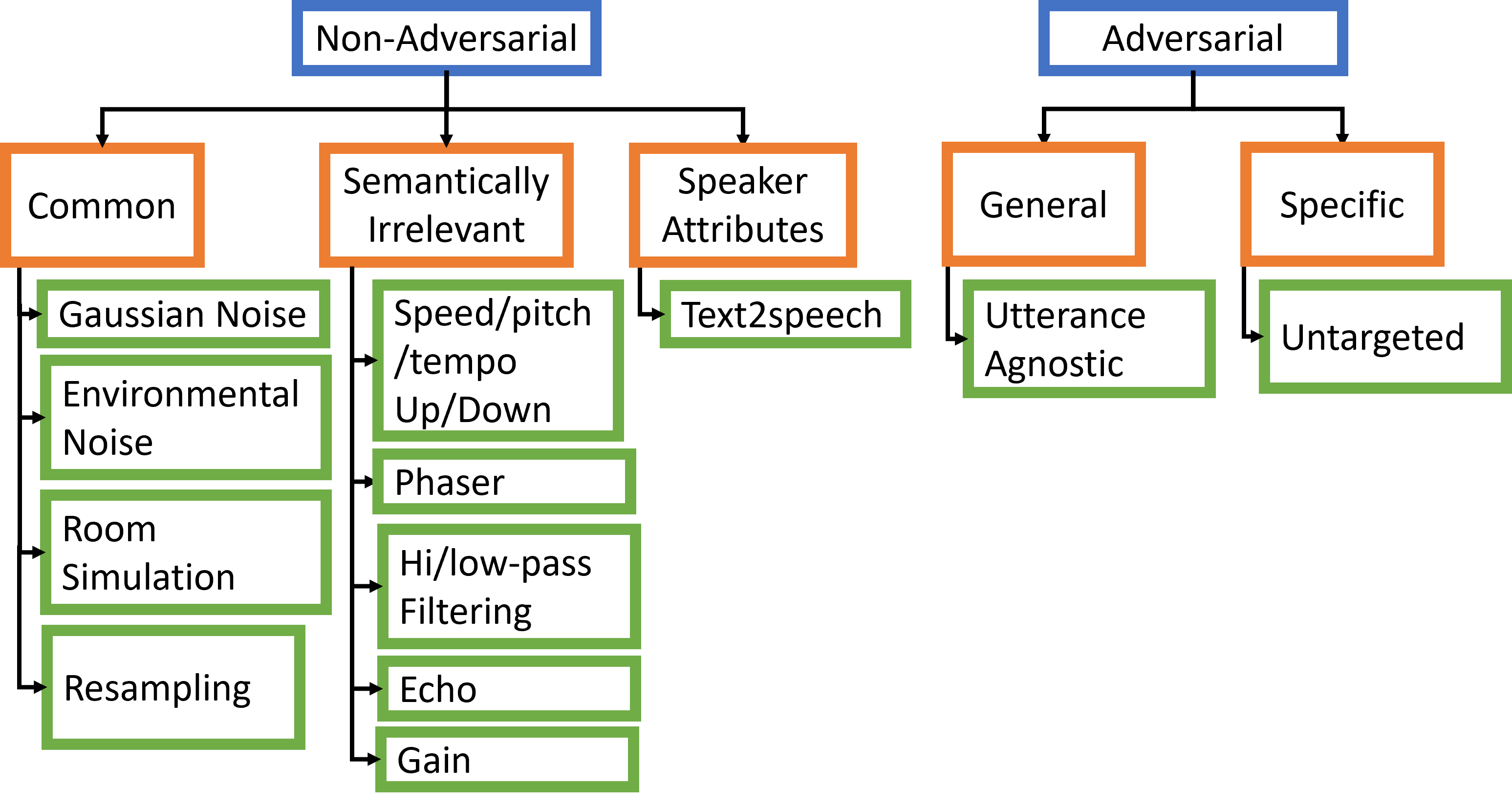
- Construct a perturbation bank covering environmental, speaker-related, semantic, and adversarial distortions at four severities.
- Transcribe perturbed audio with a target ASR model and a baseline model to compute metrics.
- Compute Normalized WER (NWER) by normalizing target WER with baseline WER to account for difficulty.
- Compute WER Variance (WERV) to measure prediction stability across multiple perturbation samples.
- Use Librispeech as the primary dataset and include Spanish subset data for multilingual analysis.
- Open-source SRB tooling and perturbed test sets to enable out-of-the-box robustness evaluations.

Experimental results
Research questions
- RQ1How robust are current ASR models to a broad set of real-world perturbations (non-adversarial and adversarial)?
- RQ2How does model size, architecture, and training data affect robustness across perturbations?
- RQ3Do robustness characteristics differ across population sub-groups such as language (English vs Spanish) and gender?
- RQ4Can SRB reveal fairness or bias gaps in ASR robustness across subgroups?
Key findings
- Larger models tend to be more robust on average, but smaller models trained with certain techniques can outperform on specific perturbations.
- Whisper large and Wav2Vec2.0 large variants generally show high robustness, but some perturbations favor smaller models (e.g., RIR, resampling, tempo reduction).
- Adversarial perturbations reveal distinct robustness profiles across models; some models resist utterance-agnostic attacks better, others resist general attacks more effectively.
- Spanish (non-English) robustness lags behind English for many models, with multilingual models often less robust on Spanish data.
- Gender disparities exist in robustness, with female speakers generally harder for several models, and this gap widening under certain perturbations and adversarial attacks.
- SRB enables detailed fairness analyses and exposes conditions where robustness varies by language and demographic subgroup.
Read this paper
Open the full text in the Nubint reader and ask about any passage as you read.
Read this paper on NubintThis review was generated by AI from the original paper. Please check the paper before citing it.