
[Paper Review] Speech2Vec: A Sequence-to-Sequence Framework for Learning Word Embeddings from Speech
This paper proposes Speech2Vec, a sequence-to-sequence RNN-based framework that learns semantic word embeddings directly from raw speech, bypassing transcription. By adapting Word2Vec's skipgram and continuous bag-of-words objectives to audio, it captures prosodic and semantic cues absent in text, outperforming text-based Word2Vec on 13 word similarity benchmarks, especially with 50-dimensional embeddings.
In this paper, we propose a novel deep neural network architecture, Speech2Vec, for learning fixed-length vector representations of audio segments excised from a speech corpus, where the vectors contain semantic information pertaining to the underlying spoken words, and are close to other vectors in the embedding space if their corresponding underlying spoken words are semantically similar. The proposed model can be viewed as a speech version of Word2Vec. Its design is based on a RNN Encoder-Decoder framework, and borrows the methodology of skipgrams or continuous bag-of-words for training. Learning word embeddings directly from speech enables Speech2Vec to make use of the semantic information carried by speech that does not exist in plain text. The learned word embeddings are evaluated and analyzed on 13 widely used word similarity benchmarks, and outperform word embeddings learned by Word2Vec from the transcriptions.
Motivation & Objective
- To develop a method for learning semantic word embeddings directly from raw speech without relying on text transcriptions.
- To overcome limitations of ASR-based word embedding pipelines, including transcription errors and loss of prosodic information.
- To extend the success of Word2Vec to speech by adapting its skipgram and continuous bag-of-words training objectives to audio sequences.
- To evaluate whether speech-derived embeddings capture richer semantic information than text-based counterparts.
- To analyze the stability and variability of learned embeddings across different word frequencies and training configurations.
Proposed method
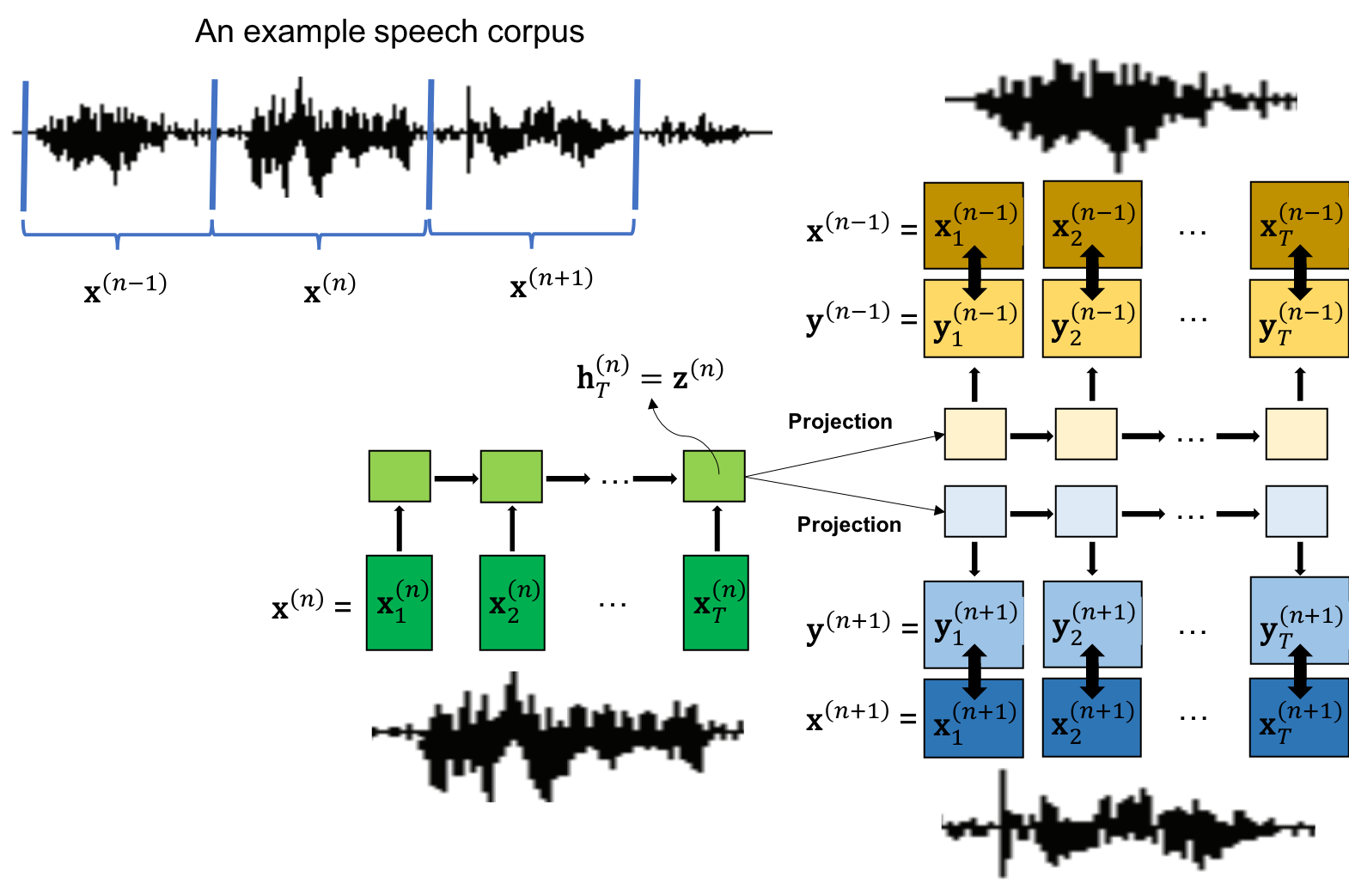
- Speech2Vec uses a bidirectional RNN encoder-decoder framework to map variable-length audio sequences (e.g., MFCCs) into fixed-length embeddings.
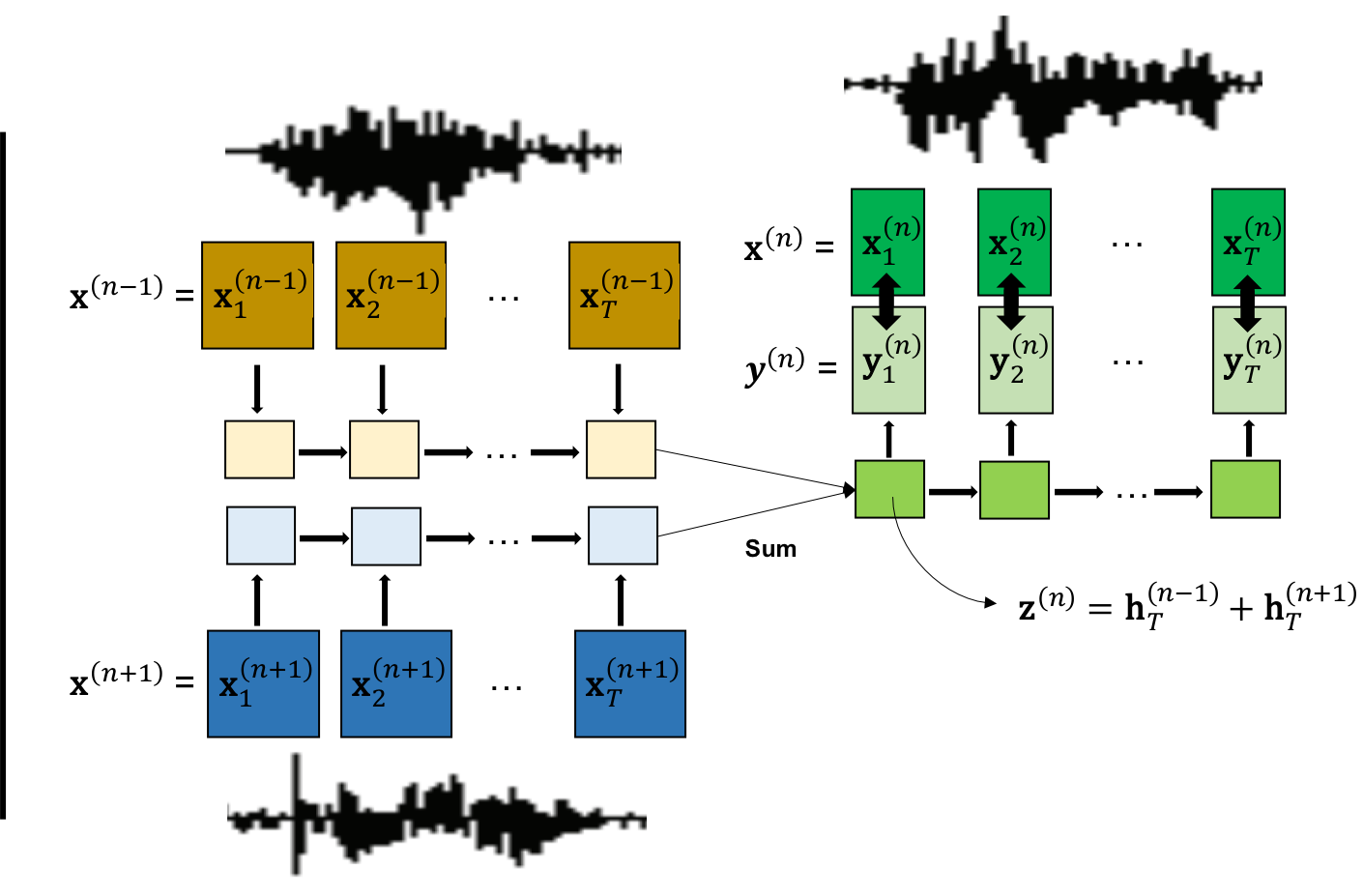
- The model is trained using either skipgram or continuous bag-of-words (CBOW) objectives, where the context of a target word segment is predicted from its embedding.
- For skipgram, the encoder processes a target word segment and the decoder predicts surrounding context segments; for CBOW, the encoder encodes multiple context segments to predict the target.
- Audio segments are padded to a fixed length and forced alignment is used to obtain word-level boundaries, enabling supervised segmentation.
- The model is trained end-to-end using cross-entropy loss to maximize the likelihood of predicting correct context segments.
- Word embeddings are derived from the final hidden state of the encoder and evaluated via word similarity benchmarks.
Experimental results
Research questions
- RQ1Can a sequence-to-sequence RNN framework learn meaningful semantic word embeddings directly from raw speech, without text transcriptions?
- RQ2Does learning embeddings from speech, which includes prosodic cues, yield better semantic representations than learning from transcribed text?
- RQ3How do the skipgram and CBOW variants of Speech2Vec compare in performance and stability across different word frequency levels?
- RQ4How does the variance of word embeddings change with the number of occurrences of a word in the training corpus?
- RQ5To what extent do the learned embeddings capture semantic relationships such as synonymy and antonymy?
Key findings
- Skipgrams Speech2Vec outperforms both CBOW Speech2Vec and text-based Word2Vec on 8 out of 13 word similarity benchmarks, demonstrating superior semantic representation learning from speech.
- Speech2Vec with 50-dimensional embeddings achieves the best performance on most benchmarks, indicating that smaller embedding sizes are sufficient when learning from raw audio.
- The performance of Speech2Vec improves significantly with larger training corpora, with notable gains when increasing from 10% to full training data.
- Skipgrams Speech2Vec shows lower variance in word embeddings as word frequency increases, suggesting greater stability and robustness for high-frequency words.
- t-SNE visualizations confirm that the learned embeddings capture semantic structure, with antonyms (positive/negative words) spatially separated and synonyms grouped together.
- The model’s ability to capture prosodic and contextual cues in speech leads to better semantic generalization than text-based Word2Vec, even when transcriptions are used as input.
Read this paper
Open the full text in the Nubint reader and ask about any passage as you read.
Read this paper on NubintThis review was generated by AI from the original paper. Please check the paper before citing it.