
[Paper Review] SpeechGPT: Empowering Large Language Models with Intrinsic Cross-Modal Conversational Abilities
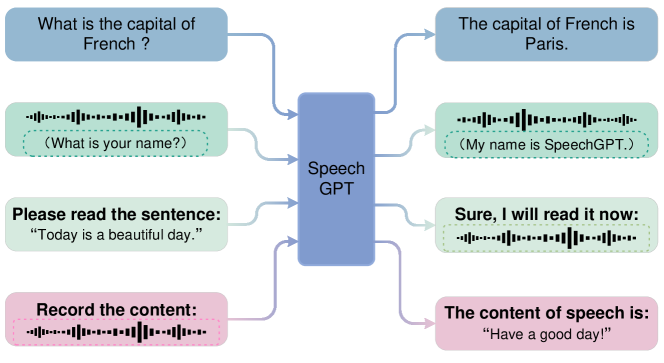
SpeechGPT introduces a large language model with intrinsic cross-modal conversational abilities by integrating discrete speech representations into the LLM's vocabulary, enabling end-to-end perception and generation of speech and text. The model achieves strong performance in multi-modal instruction following and spoken dialogue through a three-stage training process and a novel speech-text instruction dataset, SpeechInstruct.
Multi-modal large language models are regarded as a crucial step towards Artificial General Intelligence (AGI) and have garnered significant interest with the emergence of ChatGPT. However, current speech-language models typically adopt the cascade paradigm, preventing inter-modal knowledge transfer. In this paper, we propose SpeechGPT, a large language model with intrinsic cross-modal conversational abilities, capable of perceiving and generating multi-model content. With discrete speech representations, we first construct SpeechInstruct, a large-scale cross-modal speech instruction dataset. Additionally, we employ a three-stage training strategy that includes modality-adaptation pre-training, cross-modal instruction fine-tuning, and chain-of-modality instruction fine-tuning. The experimental results demonstrate that SpeechGPT has an impressive capacity to follow multi-modal human instructions and highlight the potential of handling multiple modalities with one model. Demos are shown in https://0nutation.github.io/SpeechGPT.github.io/.
Motivation & Objective
- Address the limitation of cascade-based speech-language models that fail to enable bidirectional knowledge transfer between speech and text modalities.
- Overcome the challenge of integrating continuous speech signals into discrete-token-based large language models.
- Develop a unified framework for intrinsic cross-modal conversational abilities in LLMs, supporting both speech comprehension and generation.
- Create a large-scale, high-quality speech-text instruction dataset to enable effective instruction tuning for multi-modal LLMs.
- Demonstrate the feasibility of training a single model to handle diverse cross-modal tasks, including unimodal, cross-modal, and spoken dialogue tasks.
Proposed method
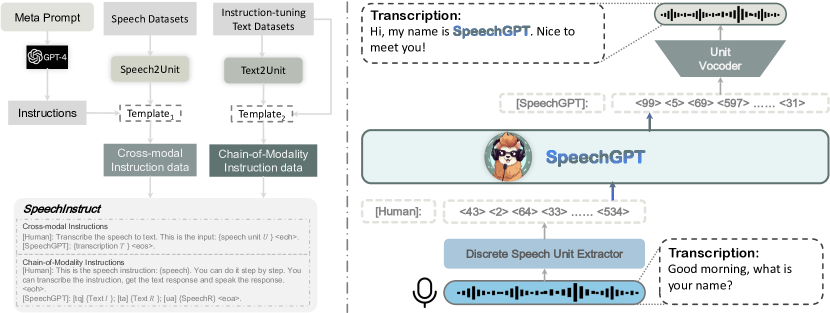
- Use a self-supervised speech model to convert raw speech into discrete units, which are then integrated into the LLM’s vocabulary space.
- Construct SpeechInstruct, a large-scale speech-text cross-modal instruction dataset by pairing discrete speech tokens with natural language instructions derived from ASR datasets and GPT-4-generated instructions.
- Design chain-of-modality instruction data, where the model receives a speech input, reasons in text, and generates a speech output, to enhance modality alignment.
- Implement a three-stage training strategy: modality-adaptation pre-training (speech unit next-token prediction), cross-modal instruction fine-tuning (SpeechInstruct), and chain-of-modality fine-tuning using LoRA for parameter efficiency.
- Employ decoding hyperparameters including temperature 0.8, top-k sampling (k=60), and top-p sampling (p=0.8) to generate diverse and coherent responses.
- Use LLaMA-13B as the backbone model and train on A100 GPUs with increasing batch sizes and steps across stages to optimize convergence and performance.
Experimental results
Research questions
- RQ1Can a large language model be inherently equipped with cross-modal conversational abilities that support both speech perception and generation?
- RQ2How effective is the integration of discrete speech tokens into the LLM’s vocabulary for enabling end-to-end multi-modal instruction following?
- RQ3To what extent can a unified model handle diverse tasks, including unimodal, cross-modal, and spoken dialogue interactions?
- RQ4What is the impact of a three-stage training paradigm on cross-modal alignment and instruction-following performance?
- RQ5Can a newly constructed speech-text instruction dataset (SpeechInstruct) significantly improve the model’s ability to follow complex, naturalistic human instructions across modalities?
Key findings
- SpeechGPT demonstrates strong performance in following multi-modal human instructions, successfully generating accurate and contextually appropriate responses across various tasks.
- Human evaluations confirm that SpeechGPT adheres to the HHH criteria (Harmless, Helpful, Honest) in spoken dialogue interactions, indicating robust and safe response generation.
- The model achieves effective cross-modal understanding and generation, as evidenced by its ability to interpret speech inputs and produce relevant speech responses without relying on external ASR or TTS modules.
- The three-stage training process significantly improves cross-modal alignment, with the chain-of-modality fine-tuning stage enhancing modality transfer and reasoning capabilities.
- SpeechInstruct, the first large-scale speech-text cross-modal instruction dataset, enables effective fine-tuning and supports diverse instruction types, including task-oriented and open-ended queries.
- Despite limitations in paralinguistic signal handling and multi-turn dialogue support, SpeechGPT establishes a strong baseline for end-to-end multi-modal LLMs using discrete speech representations.
Read this paper
Open the full text in the Nubint reader and ask about any passage as you read.
Read this paper on NubintThis review was generated by AI from the original paper. Please check the paper before citing it.