
[Paper Review] SpeechLM: Enhanced Speech Pre-Training with Unpaired Textual Data
This paper proposes SpeechLM, a cross-modal speech and language model that unifies speech and text pre-training using a shared discrete representation space via phoneme-unit or hidden-unit tokenizers. By leveraging unpaired text data through masked unit prediction and sequence reconstruction tasks with a random swapping mechanism, SpeechLM significantly improves automatic speech recognition and speech translation performance over speech-only baselines.
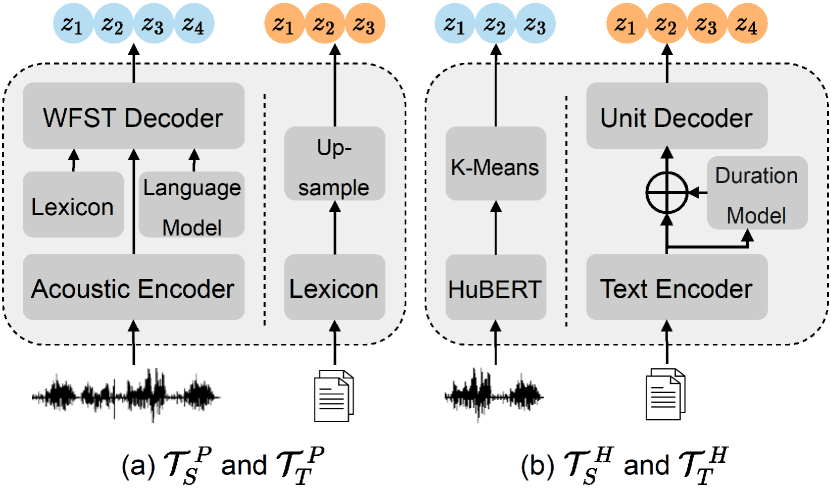
How to boost speech pre-training with textual data is an unsolved problem due to the fact that speech and text are very different modalities with distinct characteristics. In this paper, we propose a cross-modal Speech and Language Model (SpeechLM) to explicitly align speech and text pre-training with a pre-defined unified discrete representation. Specifically, we introduce two alternative discrete tokenizers to bridge the speech and text modalities, including phoneme-unit and hidden-unit tokenizers, which can be trained using a small amount of paired speech-text data. Based on the trained tokenizers, we convert the unlabeled speech and text data into tokens of phoneme units or hidden units. The pre-training objective is designed to unify the speech and the text into the same discrete semantic space with a unified Transformer network. We evaluate SpeechLM on various spoken language processing tasks including speech recognition, speech translation, and universal representation evaluation framework SUPERB, demonstrating significant improvements on content-related tasks. Code and models are available at https://aka.ms/SpeechLM.
Motivation & Objective
- To address the challenge of improving speech pre-training using unpaired textual data, which is underutilized due to modality differences.
- To design a unified interface between speech and text modalities that enables effective cross-modal alignment and representation learning.
- To develop interpretable and learnable discrete tokenizers—phoneme-unit and hidden-unit—that bridge speech and text into a shared semantic space.
- To demonstrate that text-augmented pre-training with minimal paired data can significantly boost speech model performance on downstream spoken language tasks.
Proposed method
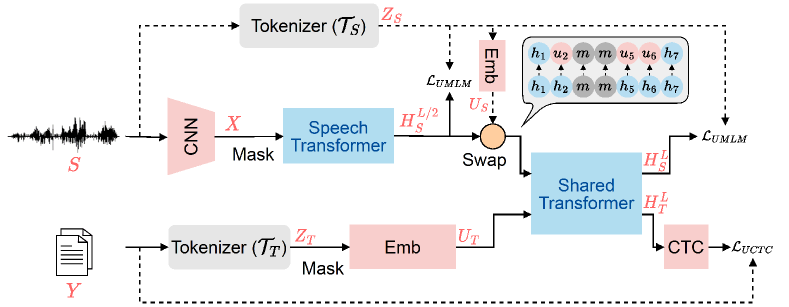
- Proposes two discrete tokenizers—phoneme-unit and hidden-unit—that convert speech and text into a shared semantic space using a small amount of paired speech-text data or a pre-existing phoneme lexicon.
- Introduces Unit-based Masked Language Modeling (UMLM) to predict masked unit tokens from speech inputs, enabling self-supervised learning on unpaired data.
- Employs Unit-based Connectionist Temporal Classification (UCTC) to reconstruct full text sequences from masked unit sequences, strengthening sequence-level alignment.
- Applies a random swapping mechanism that exchanges intermediate representations between speech and text modality before feeding them into the shared Transformer encoder, enhancing cross-modal alignment.
- Uses a unified Transformer network to jointly encode both modalities in the shared discrete space, simplifying the architecture and improving generalization.
- Trains the model end-to-end with a combination of UMLM and UCTC objectives, enabling joint optimization of speech and text representations.
Experimental results
Research questions
- RQ1Can unpaired textual data be effectively leveraged to improve speech representation learning without requiring extensive paired speech-text data?
- RQ2How do phoneme-unit and hidden-unit tokenizers compare in their ability to unify speech and text into a shared semantic space for pre-training?
- RQ3What is the impact of the random swapping mechanism on cross-modal alignment and downstream performance in speech and language modeling?
- RQ4How much textual data is necessary to achieve optimal performance in text-augmented speech pre-training?
- RQ5Does the use of a shared discrete representation space lead to better generalization on diverse spoken language tasks such as ASR and speech translation?
Key findings
- SpeechLM achieves a 9.1 WER on LibriSpeech test-other without language model, which degrades significantly to 8.1 WER when the random swapping mechanism is applied, confirming its critical role in cross-modal alignment.
- The performance of SpeechLM-P (phoneme-unit tokenizer) and SpeechLM-H (hidden-unit tokenizer) is comparable on ASR tasks, indicating both tokenizers are effective for unifying speech and text representations.
- Using unpaired text data with 40K sentences achieves near-optimal performance, suggesting that lexical-level modeling is sufficient with relatively small text corpora.
- Performance degrades when using a text-only tokenizer trained without paired data, showing that paired data are essential for accurate modality alignment.
- Layer-wise visualization confirms that speech and text representations are progressively aligned into a shared semantic space as they pass through deeper layers of the shared Transformer.
- SpeechLM significantly outperforms speech-only baselines on multiple tasks, including automatic speech recognition, speech translation, and the SUPERB benchmark, demonstrating strong generalization and transfer capabilities.
Read this paper
Open the full text in the Nubint reader and ask about any passage as you read.
Read this paper on NubintThis review was generated by AI from the original paper. Please check the paper before citing it.