
[Paper Review] SpeechPrompt v2: Prompt Tuning for Speech Classification Tasks
SpeechPrompt v2 uses prompt tuning with a learnable verbalizer to perform a wide range of speech classification tasks with minimal trainable parameters, achieving competitive or state-of-the-art results across multiple languages and tasks.
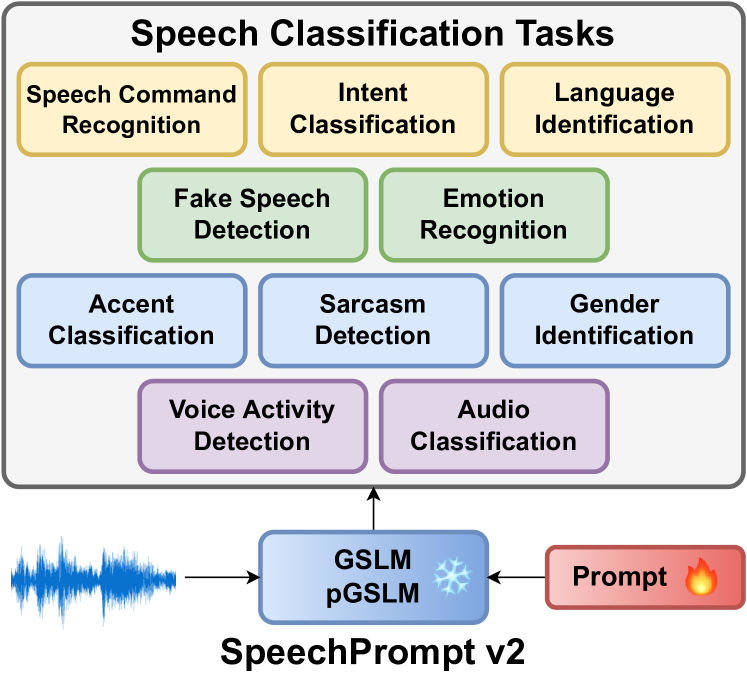
Prompt tuning is a technology that tunes a small set of parameters to steer a pre-trained language model (LM) to directly generate the output for downstream tasks. Recently, prompt tuning has demonstrated its storage and computation efficiency in both natural language processing (NLP) and speech processing fields. These advantages have also revealed prompt tuning as a candidate approach to serving pre-trained LM for multiple tasks in a unified manner. For speech processing, SpeechPrompt shows its high parameter efficiency and competitive performance on a few speech classification tasks. However, whether SpeechPrompt is capable of serving a large number of tasks is unanswered. In this work, we propose SpeechPrompt v2, a prompt tuning framework capable of performing a wide variety of speech classification tasks, covering multiple languages and prosody-related tasks. The experiment result shows that SpeechPrompt v2 achieves performance on par with prior works with less than 0.15M trainable parameters in a unified framework.
Motivation & Objective
- Motivate the need for parameter-efficient, unified speech classification with prompting.
- Develop a prompting framework that works across content and prosody tasks and multiple languages.
- Reduce trainable parameters while maintaining competitive performance.
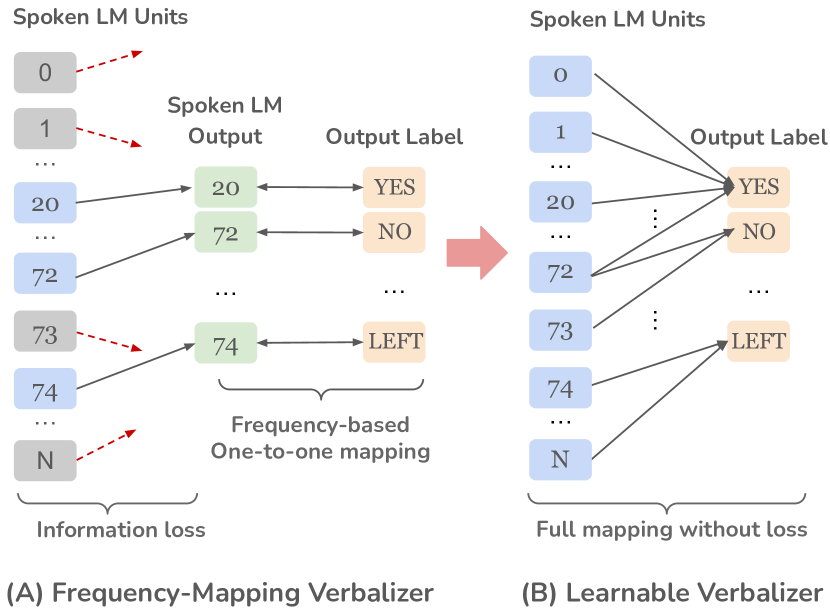
- Introduce a learnable verbalizer to improve mapping from LM outputs to task labels.
- Evaluate generalization and limitations across a broad task suite.
Proposed method
- Use fixed pre-trained spoken LMs (GSLM and pGSLM) as backbones with frozen parameters.
- Learn small task-specific prompt vectors that are concatenated with input embeddings and used in deep prompting of Transformer layers.
- Apply a learnable verbalizer (a linear model) to map LM output distributions to task labels, jointly trained with prompts.
- No task-specific hyperparameter tuning; fixed prompt length (l=5) and prompt size (~0.128M parameters).
- Evaluate on 10 speech classification tasks from 14 datasets spanning multiple languages and speech properties.
- Compare with SOTA under fully supervised and pre-train/fine-tune paradigms.
Experimental results
Research questions
- RQ1Can SpeechPrompt v2 achieve competitive performance across a wide range of speech classification tasks with minimal trainable parameters?
- RQ2Does a learnable verbalizer consistently improve prompting performance in speech LMs?
- RQ3How does SpeechPrompt v2 perform across content-related vs. prosody-related tasks and across languages?
- RQ4What are the limitations and stability concerns of prompt tuning in non-English or diverse speech datasets?
Key findings
- SpeechPrompt v2 achieves competitive performance and, in some cases, state-of-the-art results on several tasks (e.g., Lithuanian SCR, Arabic SCR, Sarcasm Detection).
- The framework is highly parameter-efficient, with under 0.1% of the spoken-LM parameters trainable per task (~0.15M).
- A learnable verbalizer improves performance in most tasks with GSLM, and generally helps explainability via SHAP analyses of unit-to-label mappings.
- Prompt tuning shows some instability and performance variance, especially on non-English or highly diverse speech data; no per-task hyperparameter optimization was performed.
- Prompting enables a unified, simplified pipeline that can approach or match SOTA on a wide suite of speech classification tasks, though some tasks still lag behind fully supervised or pre-train/fine-tune methods.
Read this paper
Open the full text in the Nubint reader and ask about any passage as you read.
Read this paper on NubintThis review was generated by AI from the original paper. Please check the paper before citing it.