
[Paper Review] Speeding up quantum circuits simulation using ZX-Calculus
This paper proposes a novel method to drastically reduce the classical simulation cost of quantum circuits by optimizing their tensor network representation using ZX-calculus. By converting circuits into graph-like ZX-diagrams and applying local complementation and simplification rules, the authors achieve an average 1,180-fold reduction in contraction cost—up to 4,200-fold at peak—for Sycamore circuits of depth 20, significantly outperforming state-of-the-art order-finding methods.
We present a simple and efficient way to reduce the contraction cost of a tensor network to simulate a quantum circuit. We start by interpreting the circuit as a ZX-diagram. We then use simplification and local complementation rules to sparsify it. We find that optimizing graph-like ZX-diagrams improves existing state of the art contraction cost by several order of magnitude. In particular, we demonstrate an average contraction cost 1180 times better for Sycamore circuits of depth 20, and up to 4200 times better at peak performance.
Motivation & Objective
- To reduce the classical simulation cost of quantum circuits by optimizing tensor network contraction order.
- To explore whether ZX-calculus rewriting rules can simplify tensor networks before contraction, improving efficiency.
- To evaluate the performance of a ZX-based pre-processing heuristic against state-of-the-art order-finding algorithms.
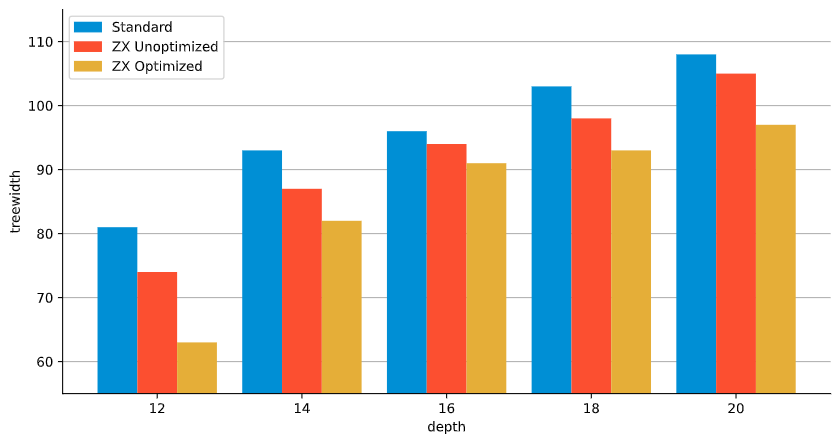
- To demonstrate that graph-like ZX-diagrams enable significant treewidth reduction, leading to lower contraction complexity.
- To enable faster simulation of large-scale quantum circuits, such as Sycamore circuits, by minimizing FLOP counts and sub-task counts.
Proposed method
- The quantum circuit is first translated into a graph-like ZX-diagram, representing it as a tensor network with Z- and X-spiders.
- Simplification and local complementation rules from ZX-calculus are applied to reduce the diagram’s complexity and sparsify the tensor network.
- A heuristic based on graph theory operations is used to optimize the ZX-diagram, minimizing a proxy score related to treewidth.
- The optimized ZX-diagram is then contracted using the AC-QDP algorithm, with contraction order determined by the simplified structure.
- The method uses a pivot-based heuristic to guide the optimization, aiming to minimize the treewidth of the underlying graph.
- The approach is evaluated on random Sycamore circuits of increasing depth (12 to 20 qubits), comparing FLOP counts and sub-task counts to AC-QDP.

Experimental results
Research questions
- RQ1Can ZX-calculus rewriting rules be used to reduce the treewidth of tensor networks derived from quantum circuits?
- RQ2Does optimizing ZX-diagrams before contraction lead to measurable improvements in contraction cost compared to state-of-the-art methods?
- RQ3To what extent can graph-like ZX-diagrams be simplified using local complementation and other rules to improve simulation efficiency?
- RQ4How does the performance of the proposed method scale with increasing circuit depth, particularly for large circuits like Sycamore at depth 20?
- RQ5Can the proxy score based on treewidth effectively guide the optimization of contraction order in tensor networks?
Key findings
- For Sycamore circuits of depth 20, the proposed method reduces the average contraction cost by a factor of 1,180 compared to the AC-QDP method.
- At peak performance, the contraction cost is reduced by up to 4,200-fold for the largest circuits tested.
- The method reduces the number of required sub-tasks by up to 32 times compared to AC-QDP, significantly improving slicing efficiency.
- The optimization step completes in minutes, transforming a potentially year-long simulation into a day-scale computation for depth-20 circuits.
- The average contraction cost for depth-20 circuits is reduced from 2.23×10^26 FLOPs (AC-QDP) to 1.89×10^23 FLOPs (our method).
- The method achieves a 10,168-fold reduction in contraction cost at peak performance for depth-16 circuits, demonstrating strong scalability.
Read this paper
Open the full text in the Nubint reader and ask about any passage as you read.
Read this paper on NubintThis review was generated by AI from the original paper. Please check the paper before citing it.