
[Paper Review] SPG-VTON: Semantic Prediction Guidance for Multi-pose Virtual Try-on
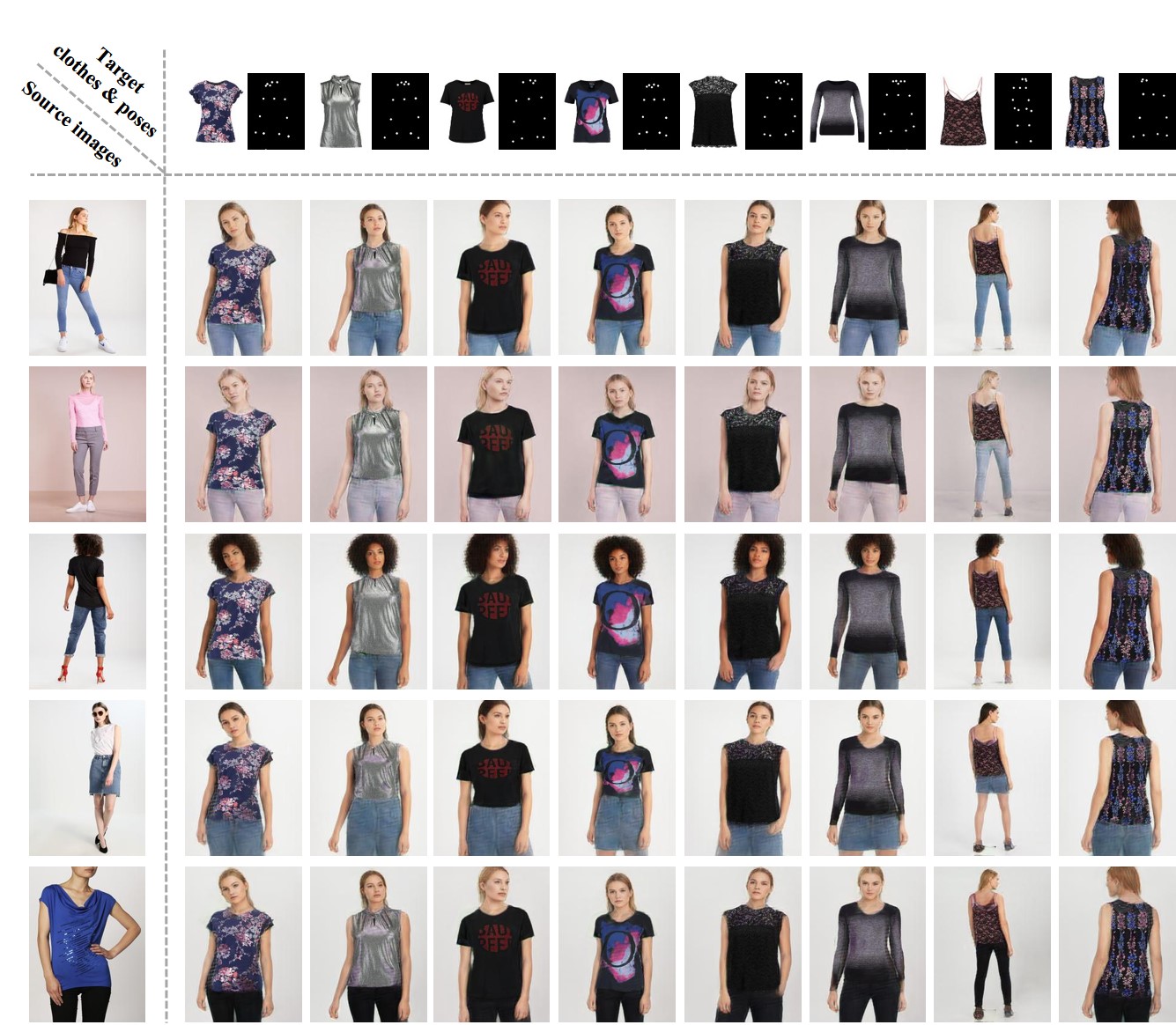
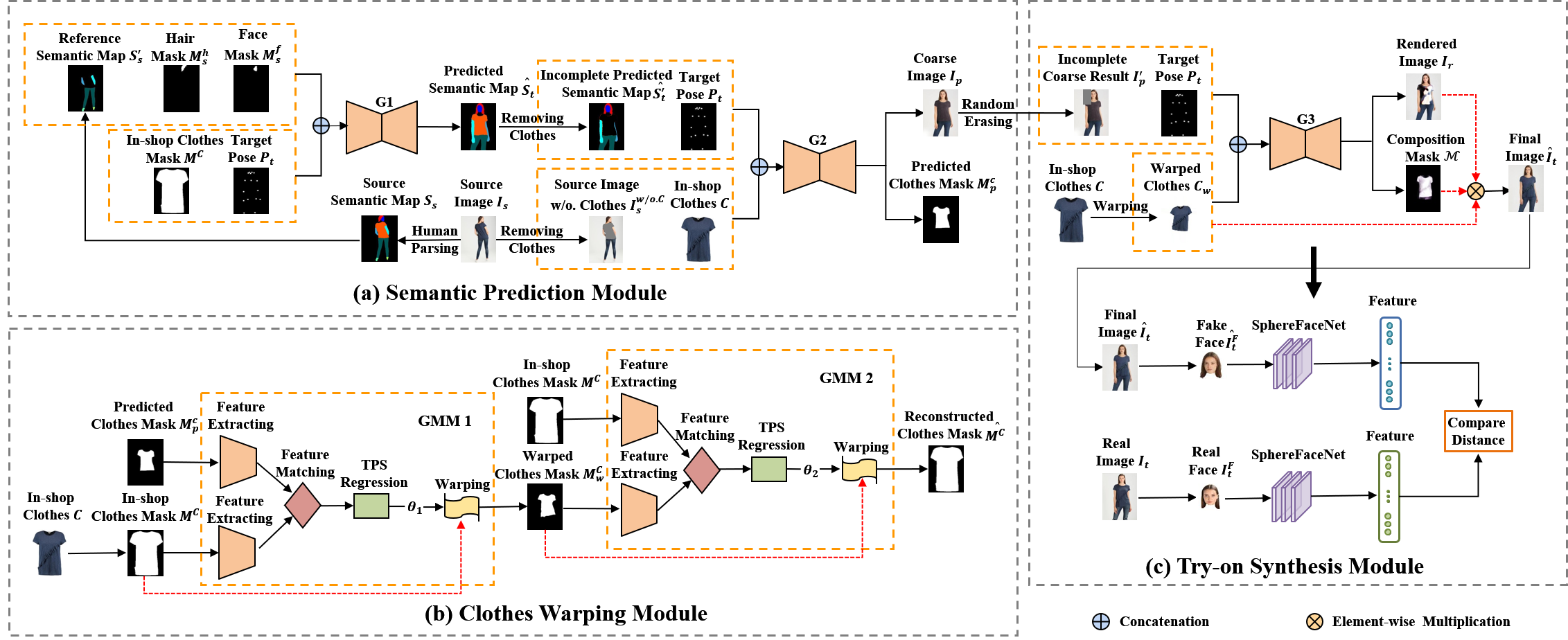
SPG-VTON proposes an end-to-end semantic prediction guidance network for multi-pose virtual try-on, leveraging a semantic prediction module (SPM), clothes warping module (CWM) with conductible cycle consistency loss, and try-on synthesis module (TSM) to generate photo-realistic results. It outperforms SOTA methods on MPV and DeepFashion, showing robustness to pose variations, background noise, and accessories.
Image-based virtual try-on is challenging in fitting a target in-shop clothes into a reference person under diverse human poses. Previous works focus on preserving clothing details ( e.g., texture, logos, patterns ) when transferring desired clothes onto a target person under a fixed pose. However, the performances of existing methods significantly dropped when extending existing methods to multi-pose virtual try-on. In this paper, we propose an end-to-end Semantic Prediction Guidance multi-pose Virtual Try-On Network (SPG-VTON), which could fit the desired clothing into a reference person under arbitrary poses. Concretely, SPG-VTON is composed of three sub-modules. First, a Semantic Prediction Module (SPM) generates the desired semantic map. The predicted semantic map provides more abundant guidance to locate the desired clothes region and produce a coarse try-on image. Second, a Clothes Warping Module (CWM) warps in-shop clothes to the desired shape according to the predicted semantic map and the desired pose. Specifically, we introduce a conductible cycle consistency loss to alleviate the misalignment in the clothes warping process. Third, a Try-on Synthesis Module (TSM) combines the coarse result and the warped clothes to generate the final virtual try-on image, preserving details of the desired clothes and under the desired pose. Besides, we introduce a face identity loss to refine the facial appearance and maintain the identity of the final virtual try-on result at the same time. We evaluate the proposed method on the most massive multi-pose dataset (MPV) and the DeepFashion dataset. The qualitative and quantitative experiments show that SPG-VTON is superior to the state-of-the-art methods and is robust to the data noise, including background and accessory changes, i.e., hats and handbags, showing good scalability to the real-world scenario.
Motivation & Objective
- To address the limitations of existing multi-pose virtual try-on methods, which suffer from misalignment, poor detail preservation, and lack of end-to-end training.
- To improve fitting accuracy and realism when transferring clothes across arbitrary human poses using semantic prior knowledge.
- To reduce error accumulation and human intervention by enabling end-to-end training and inference.
- To maintain facial identity and appearance realism through a dedicated face identity loss.
- To enhance robustness to noisy data, including background clutter and accessories like hats and handbags.
Proposed method
- The semantic prediction module (SPM) generates a predicted semantic map for the target person, providing spatial and semantic guidance for clothing region localization.
- The clothes warping module (CWM) deforms the in-shop clothing based on the predicted semantic map and target pose, using a conductible cycle consistency loss to reduce warping misalignment.
- The try-on synthesis module (TSM) fuses the warped clothing and coarse result to generate the final photo-realistic try-on image, using global and local discriminators for shape and texture fidelity.
- A face identity loss is applied to preserve facial identity and enhance realism in the generated face region.
- The entire network is trained end-to-end with five hyperparameters balancing reconstruction, perceptual, cycle consistency, and identity losses.
- The conductible cycle consistency loss ensures structural consistency between the warped clothing and target body shape, improving deformation accuracy.
Experimental results
Research questions
- RQ1Can an end-to-end framework with semantic prediction improve multi-pose virtual try-on performance compared to multi-stage baselines?
- RQ2How effective is conductible cycle consistency loss in reducing clothing warping misalignment under arbitrary poses?
- RQ3To what extent does semantic map prediction accuracy affect the final try-on quality?
- RQ4Can the model maintain facial identity and realism under pose variations and noisy inputs?
- RQ5How robust is the method to background clutter and accessories such as hats and handbags?
Key findings
- SPG-VTON achieves state-of-the-art performance on the MPV and DeepFashion datasets, with the highest SSIM/Mask-SSIM and Mask-IS scores among compared methods.
- Ablation studies show that removing any of the five hyperparameters (λ₁ to λ₅) leads to significant performance degradation, confirming their necessity.
- The model maintains high-quality results even when trained on noisy data, with only a slight drop in metrics, and generalizes well to unseen noisy test images.
- Using real semantic maps at test time yields higher scores than predicted maps, but end-to-end training improves predicted map accuracy, reducing the gap.
- The conductible cycle consistency loss is critical—removing it causes complete loss of clothing details in the output.
- The face identity loss significantly improves facial realism, with ablation showing less natural facial regions when disabled.
Read this paper
Open the full text in the Nubint reader and ask about any passage as you read.
Read this paper on NubintThis review was generated by AI from the original paper. Please check the paper before citing it.