
[Paper Review] Spin-coupled molecular orbitals: chemical intuition meets quantum chemistry
This paper introduces a generalized molecular orbital theory that integrates spin-coupled radical states to overcome the limitations of traditional MO theory in describing strong electron correlation, particularly during bond breaking. By combining delocalized molecular orbitals with localized, spin-coupled configurations, the approach enables a chemically intuitive, compact representation of electronic wavefunctions that is highly suitable for quantum computing algorithms, offering a scalable route to accurate reference states for quantum phase estimation.
Molecular orbital theory is powerful both as a conceptual tool for understanding chemical bonding, and as a theoretical framework for ab initio quantum chemistry. Despite its undoubted success, MO theory has well documented shortcomings, most notably that it fails to correctly describe diradical states and homolytic bond fission. In this contribution, we introduce a generalised MO theory that includes spin-coupled radical states. We show through archetypical examples that when bonds break, the electronic state transitions between a small number of valence configurations, characterised by occupation of both delocalised molecular orbitals and spin-coupled localised orbitals. Our theory provides a model for chemical bonding that is both chemically intuitive and qualitatively accurate when combined with ab initio theory. Although exploitation of our theory presents significant challenges for classical computing, the predictable structure of spin-coupled states is ideally suited to algorithms that exploit quantum computers. Our approach provides a systematic route to overcoming the initial state overlap problem and unlocking the potential of quantum computational chemistry.
Motivation & Objective
- To address the well-known failure of standard molecular orbital theory in describing diradical states and homolytic bond fission.
- To develop a chemically intuitive framework that captures strong electron correlation through spin-coupled configurations without requiring large multi-reference expansions.
- To provide a compact, structured representation of electronic wavefunctions that is amenable to efficient quantum circuit implementation.
- To enable practical fault-tolerant quantum algorithms by constructing high-quality reference states with minimal variational parameters.
Proposed method
- The theory combines delocalized molecular orbitals with localized, spin-coupled configurations (CSFs) to describe valence states during bond dissociation.
- Each electronic state is represented as a superposition of a small number of configurations, each characterized by a specific spin-coupling pattern and orbital occupation.
- Spin eigenfunctions (CSFs) are constructed using Clebsch-Gordan coupling coefficients to ensure proper symmetry and spin quantum numbers (S, M).
- The method uses non-orthogonal configuration state functions (CSFs) to represent strongly correlated states, avoiding the exponential cost of traditional determinant expansions.
- The approach leverages the predictable entanglement structure of spin-coupled states to enable low-depth quantum circuit preparation on quantum processors.
- Ab initio integrals and wavefunction overlaps are computed using PySCF and custom Python codes, with visualization via VMD.
Experimental results
Research questions
- RQ1Can a generalized molecular orbital theory that includes spin-coupled configurations accurately describe bond breaking without large multi-reference expansions?
- RQ2How do spin-coupled configurations compare to standard MO-based configurations in capturing strong electron correlation in diradicals?
- RQ3Can the entanglement structure of spin-coupled states be efficiently encoded in quantum circuits for use in quantum phase estimation?
- RQ4What is the minimal number of configurations required to describe the electronic structure of bond dissociation using this approach?
- RQ5Does the proposed framework allow for a systematic, chemically intuitive construction of reference states for quantum computational chemistry?
Key findings
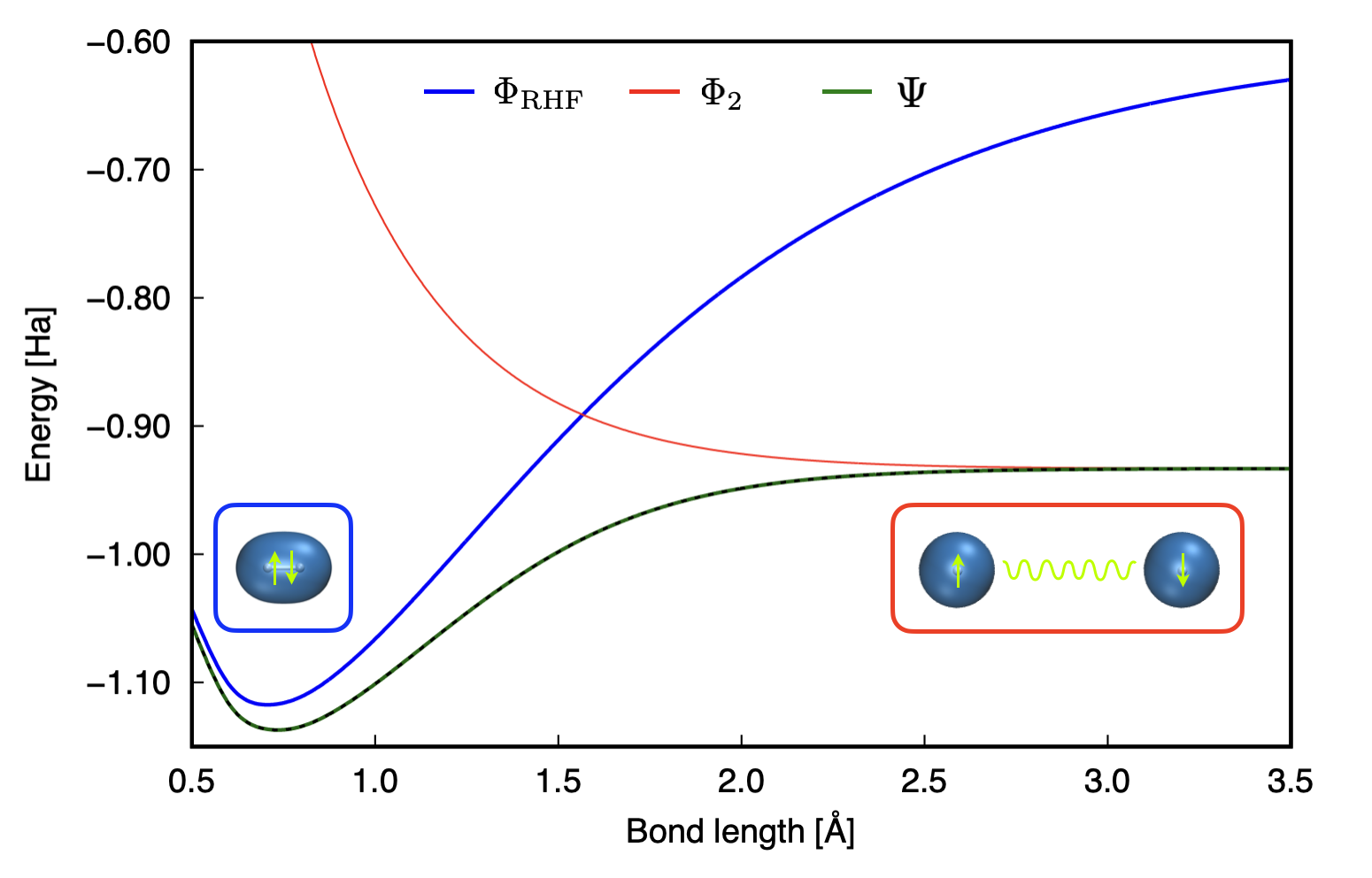
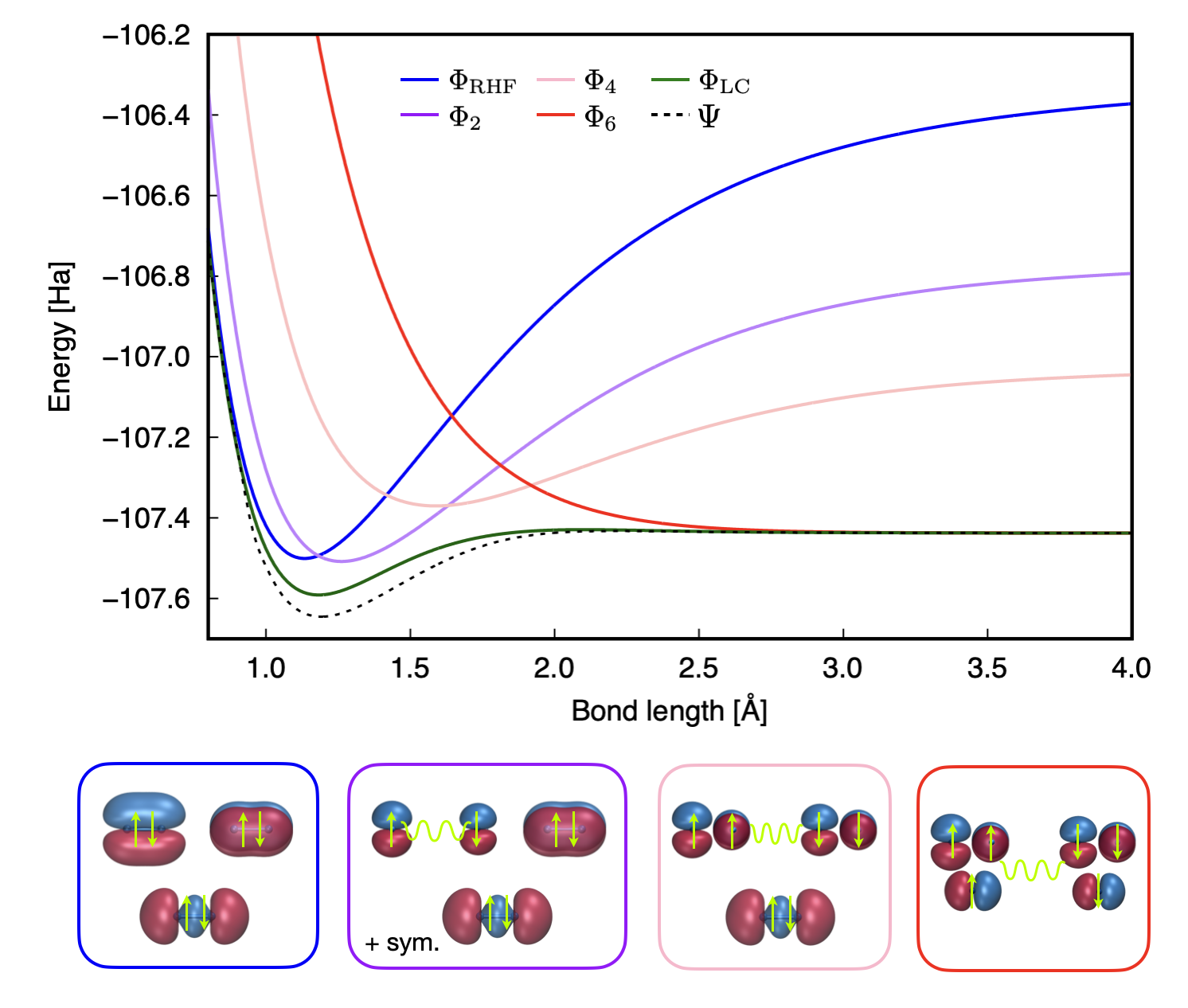
- The electronic state during bond breaking transitions between only a small number of valence configurations, each with a well-defined spin-coupled structure, rather than requiring exponentially large multi-configurational expansions.
- The spin-coupled configuration state functions (CSFs) encode strong correlation through prescribed patterns of entanglement, which are naturally suited to quantum algorithms.
- The method achieves accurate descriptions of dissociation curves for H2 and other diradicals using a minimal number of configurations, avoiding the need for large-scale multi-reference calculations.
- The wavefunction structure revealed by the theory enables low-depth quantum circuit preparation, making it ideal for fault-tolerant quantum algorithms like quantum phase estimation.
- The approach provides a systematic, chemically intuitive route to constructing high-quality reference states with only a few variational parameters and a mean-field calculation.
- The theory successfully maps chemical intuition—such as covalent vs. ionic character—onto a compact, ab initio-computable wavefunction representation that remains accurate across bond dissociation.
Read this paper
Open the full text in the Nubint reader and ask about any passage as you read.
Read this paper on NubintThis review was generated by AI from the original paper. Please check the paper before citing it.