
[Paper Review] Spin glass theory and its new challenge: structured disorder
This paper proposes a new direction in spin glass theory—structured disorder—by extending traditional statistical physics frameworks to model real-world data with long-range correlations, hierarchical structures, and effective dimensionality. It argues that deep learning inference problems can be framed as disordered systems, and advances a theoretical foundation for analyzing deep networks through analytically tractable ensembles of structured, correlated disorder.
This paper first describes, from a high level viewpoint, the main challenges that had to be solved in order to develop a theory of spin glasses in the last fifty years. It then explains how important inference problems, notably those occurring in machine learning, can be formulated as problems in statistical physics of disordered systems. However, the main questions that we face in the analysis of deep networks require to develop a new chapter of spin glass theory, which will address the challenge of structured data.
Motivation & Objective
- Address the limitations of traditional spin glass theory, which assumes i.i.d. disorder, in modeling real-world data with complex structures.
- Formulate machine learning and deep network inference as problems in statistical physics of disordered systems.
- Develop a new theoretical framework for spin glasses that incorporates structured data features such as long-range correlations, combinatorial hierarchies, and effective dimensionality.
- Enable analytic control over high-dimensional representations in deep networks by identifying minimal, statistically meaningful order parameters.
- Bridge the gap between spin glass theory and practical deep learning by incorporating structural ingredients found in real datasets like images, text, and proteins.
Proposed method
- Frame inference problems in machine learning as statistical physics problems involving disordered systems with quenched disorder.
- Introduce the concept of 'structured disorder' to generalize spin glass models beyond i.i.d. couplings, incorporating long-range correlations and hierarchical features.
- Define 'effective dimension' as a key parameter to quantify the complexity of data manifolds in high-dimensional spaces.
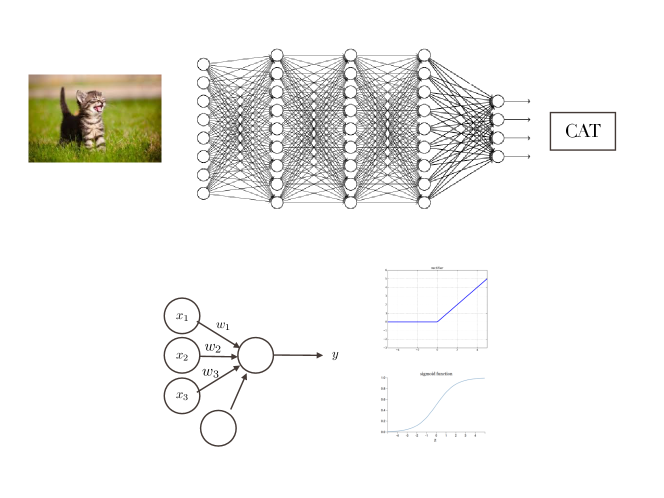
- Model combinatorial and hierarchical data structures using layered network mappings, where lower layers detect local features and higher layers integrate them into global representations.
- Use mean-field approximations and renormalization group ideas to analyze systems with structured disorder, extending Parisi’s solution to the SK model.
- Explore simple nonlinear ensembles with hierarchical and combinatorial properties to model realistic data distributions in deep learning.
Experimental results
Research questions
- RQ1How can spin glass theory be extended to describe systems with structured, correlated disorder rather than i.i.d. couplings?
- RQ2What role do long-range correlations in data play in shaping the loss landscape and generalization in deep neural networks?
- RQ3How can hierarchical and combinatorial structures in data (e.g., in images or text) be captured within a statistical physics framework?
- RQ4What is the significance of 'effective dimension' in characterizing the complexity of data distributions in high-dimensional inference problems?
- RQ5Can a minimal set of order parameters describe the collective behavior of deep networks trained on structured data, analogous to spin glass order parameters?
Key findings
- Traditional spin glass theory, based on i.i.d. disorder, fails to capture key structural features of real-world data such as long-range correlations and hierarchical organization.
- The attention mechanism in transformers implicitly captures long-range dependencies, mirroring the role of long-range correlations in structured disordered systems.
- Combinatorial and hierarchical data structures—evident in images, text, and proteins—can be modeled as layered representations in deep networks, analogous to feature hierarchies in the visual cortex.
- Simple nonlinear ensembles with hierarchical and combinatorial properties are beginning to be analytically explored, offering a path toward controlled models of structured data.
- The concept of 'effective dimension' emerges as a critical parameter for characterizing the statistical complexity of data manifolds in high-dimensional inference.
- A new chapter of spin glass theory is needed—one focused on structured disorder—to provide a theoretical foundation for deep learning that ensures explainability, control, and worst-case analysis.
Read this paper
Open the full text in the Nubint reader and ask about any passage as you read.
Read this paper on NubintThis review was generated by AI from the original paper. Please check the paper before citing it.