
[Paper Review] Splicing ViT Features for Semantic Appearance Transfer
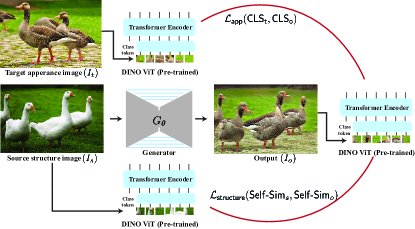
This paper proposes Splice, a novel method for semantic appearance transfer that generates high-resolution images by splicing visual appearance from a target image onto the structure of a source image, using only a single image pair. It leverages a pre-trained DINO-ViT model as an external semantic prior, extracting appearance via the [CLS] token and structure via self-attention key similarities in deep features, enabling accurate, adversarial-free, and segmentation-free generation with strong layout preservation.
We present a method for semantically transferring the visual appearance of one natural image to another. Specifically, our goal is to generate an image in which objects in a source structure image are "painted" with the visual appearance of their semantically related objects in a target appearance image. Our method works by training a generator given only a single structure/appearance image pair as input. To integrate semantic information into our framework - a pivotal component in tackling this task - our key idea is to leverage a pre-trained and fixed Vision Transformer (ViT) model which serves as an external semantic prior. Specifically, we derive novel representations of structure and appearance extracted from deep ViT features, untwisting them from the learned self-attention modules. We then establish an objective function that splices the desired structure and appearance representations, interweaving them together in the space of ViT features. Our framework, which we term "Splice", does not involve adversarial training, nor does it require any additional input information such as semantic segmentation or correspondences, and can generate high-resolution results, e.g., work in HD. We demonstrate high quality results on a variety of in-the-wild image pairs, under significant variations in the number of objects, their pose and appearance.
Motivation & Objective
- To enable semantic appearance transfer between two natural images without requiring user guidance, segmentation, or correspondences.
- To address the challenge of transferring visual appearance across objects with significant pose, shape, and appearance variations.
- To develop a method that preserves the structural layout of the source image while transferring the target's visual appearance in a semantically meaningful way.
- To demonstrate the effectiveness of using a pre-trained Vision Transformer (DINO-ViT) as an external semantic prior for generative image synthesis.
- To enable high-resolution (HD) generation using only a single image pair, avoiding the need for large-scale paired datasets.
Proposed method
- The method uses a pre-trained, fixed DINO-ViT model to extract deep features as an external semantic prior.
- Appearance is represented by the [CLS] token from the final ViT layer, capturing global visual and semantic content.
- Structure is modeled via the self-similarity of keys from the same ViT layer, encoding spatial relationships and object layouts.
- A generator is trained using a multi-component loss function that splices the desired structure and appearance representations in the ViT feature space.
- The loss function includes appearance loss (matching [CLS] tokens), structure loss (matching key self-similarities), and identity loss to preserve fine details.
- The framework avoids adversarial training and does not require segmentation maps, correspondences, or additional data beyond a single image pair.
Experimental results
Research questions
- RQ1Can a pre-trained Vision Transformer serve as an effective external semantic prior for semantic appearance transfer without additional supervision?
- RQ2How can structure and appearance be disentangled and recombined in the feature space of a Vision Transformer for high-fidelity image generation?
- RQ3Can high-resolution (HD) image generation be achieved with only a single image pair and without adversarial training?
- RQ4To what extent can ViT features preserve semantic layout during appearance transfer across diverse object categories and poses?
- RQ5How does the method perform under distribution shifts, such as non-realistic or out-of-domain images?
Key findings
- Splice outperforms GAN-based, style transfer, and semantic-aware methods on perceptual evaluation, achieving 83.1% favorability on Wild-Pairs and 95% IoU on semantic layout preservation.
- The method achieves a mean IoU of 0.95±0.10 on the mountains dataset, outperforming SA and STROTSS and approaching WCT 2’s high layout fidelity.
- Abllation studies show that removing the appearance loss leads to failure in appearance transfer, while removing the structure loss causes significant structural distortion.
- The identity loss improves fine-grained detail preservation, such as texture on avocados and pears, even without explicit supervision.
- The method fails when DINO-ViT’s representation cannot capture semantic associations, such as mapping rings on a cat or a bird to an airplane.
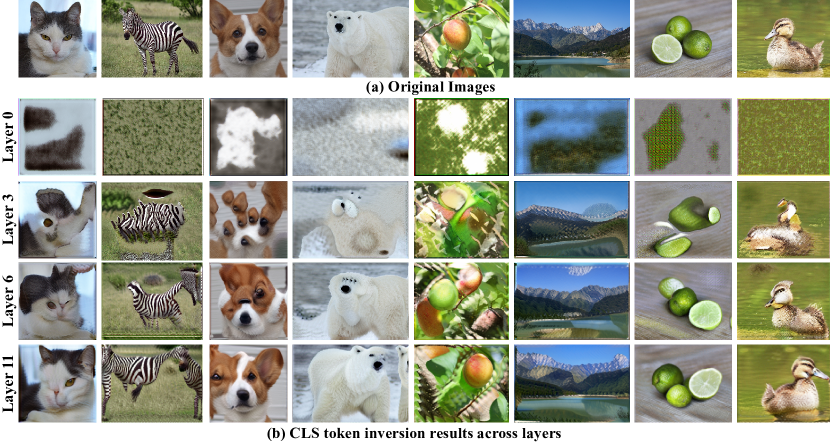
- Feature inversion analysis confirms that the [CLS] token encodes rich appearance and object-part information, while ViT features allow high-resolution image reconstruction with semantic granularity.
Read this paper
Open the full text in the Nubint reader and ask about any passage as you read.
Read this paper on NubintThis review was generated by AI from the original paper. Please check the paper before citing it.