
[Paper Review] SSPP-DAN: Deep Domain Adaptation Network for Face Recognition with Single Sample Per Person
This paper proposes SSPP-DAN, a deep domain adaptation network that jointly performs feature learning, domain adaptation, and classification using domain-adversarial training to address single-sample-per-person (SSPP) face recognition under heterogeneous imaging conditions. By synthesizing diverse pose variations from a 3D face model and applying unsupervised domain adaptation, the method achieves a 19.31% accuracy gain over baseline methods on a real-world SSPP dataset and state-of-the-art performance on LFW-SSPP.
Real-world face recognition using a single sample per person (SSPP) is a challenging task. The problem is exacerbated if the conditions under which the gallery image and the probe set are captured are completely different. To address these issues from the perspective of domain adaptation, we introduce an SSPP domain adaptation network (SSPP-DAN). In the proposed approach, domain adaptation, feature extraction, and classification are performed jointly using a deep architecture with domain-adversarial training. However, the SSPP characteristic of one training sample per class is insufficient to train the deep architecture. To overcome this shortage, we generate synthetic images with varying poses using a 3D face model. Experimental evaluations using a realistic SSPP dataset show that deep domain adaptation and image synthesis complement each other and dramatically improve accuracy. Experiments on a benchmark dataset using the proposed approach show state-of-the-art performance. All the dataset and the source code can be found in our online repository (https://github.com/csehong/SSPP-DAN).
Motivation & Objective
- Address the challenge of face recognition when only one gallery image per person is available (SSPP), especially under significant domain shift between gallery (stable) and probe (unconstrained) images.
- Overcome the data scarcity issue in SSPP by generating synthetic face images with varied poses using a 3D face model to augment the source domain.
- Bridge the domain gap between stable gallery images and noisy, blurred, pose-varying probe images through unsupervised domain adaptation using adversarial training.
- Demonstrate the complementary effect of image synthesis and domain adaptation in improving recognition accuracy under real-world deployment constraints.
- Establish a new benchmark dataset (EK-LFH) with realistic gallery and probe sets captured under vastly different conditions to evaluate SSPP methods.
Proposed method
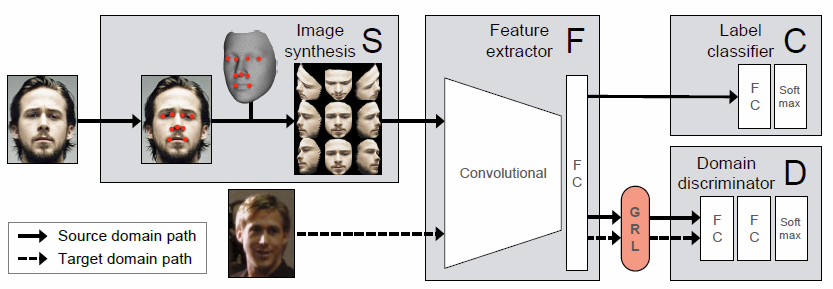
- Propose a unified deep neural network architecture that jointly performs feature extraction, domain adaptation, and classification using domain-adversarial training with a gradient reversal layer (GRL).
- Generate synthetic face images with diverse poses from a single 3D face model-based reconstruction of the original gallery image to increase training data diversity.
- Use the synthesized images as augmented training samples in the source domain to improve model generalization and mitigate overfitting due to limited real samples.
- Apply unsupervised domain adaptation by training a domain discriminator to distinguish between source (synthesized/stable) and target (real/probe) domain features, encouraging domain-invariant representations.
- Train the entire network in an end-to-end fashion using back-propagation, enabling joint optimization of feature learning and domain alignment.
- Leverage pre-trained VGG-Face features as a backbone for transfer learning and fine-tune the model on the target domain for semi-supervised and fully supervised settings.
Experimental results
Research questions
- RQ1Can combining synthetic data generation with deep domain adaptation significantly improve recognition accuracy in SSPP face recognition under domain shift?
- RQ2How effective is domain-adversarial training in aligning feature distributions between stable gallery images and unconstrained probe images without requiring labeled probe data?
- RQ3To what extent does data augmentation via 3D face model-based image synthesis improve model performance when only one real sample per person is available?
- RQ4Does the synergy between image synthesis and domain adaptation lead to better performance than either technique applied in isolation?
- RQ5Can the proposed method generalize to benchmark datasets like LFW-SSPP and achieve state-of-the-art performance in real-world heterogeneous settings?
Key findings
- On the proposed EK-LFH dataset, SSPP-DAN achieved a 19.31 percentage point improvement in accuracy over the source-only baseline when no labels were used for the target domain.
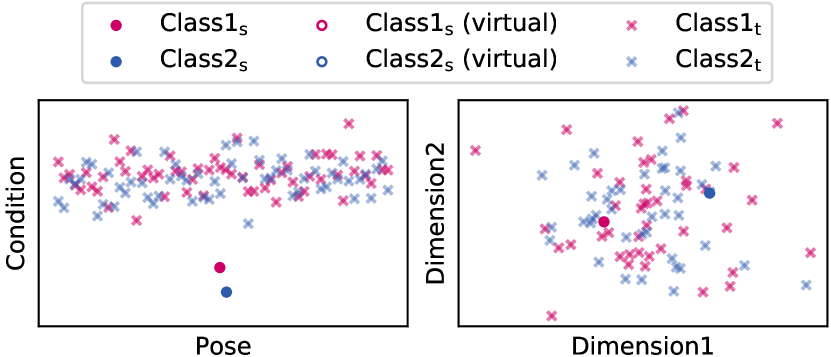
- The combination of synthetic image generation and unsupervised domain adaptation yielded a 27.42 percentage point performance boost compared to training only on the source domain with synthetic data.
- Adding synthetic images to the source-only baseline degraded performance, indicating that image synthesis alone is insufficient without domain adaptation to address domain shift.
- In semi-supervised settings with only three labeled examples per person in the target domain, SSPP-DAN achieved 72.08% accuracy, significantly outperforming the semi-supervised DAN baseline (67.28%).
- On the LFW-SSPP benchmark, SSPP-DAN achieved 97.91% recognition accuracy, surpassing previous state-of-the-art methods and demonstrating strong generalization to 'wild' data distributions.
Read this paper
Open the full text in the Nubint reader and ask about any passage as you read.
Read this paper on NubintThis review was generated by AI from the original paper. Please check the paper before citing it.