
[Paper Review] Stabilizing Transformer Training by Preventing Attention Entropy Collapse
This paper identifies attention entropy collapse—pathologically low entropy in self-attention scores—as a root cause of training instability in Transformers. It proposes $\sigma$ Reparam, a spectral normalization-based reparameterization of linear layers with a learnable scalar, which stabilizes training across vision, speech, and language tasks, enabling robust training without warmup, weight decay, or adaptive optimizers.
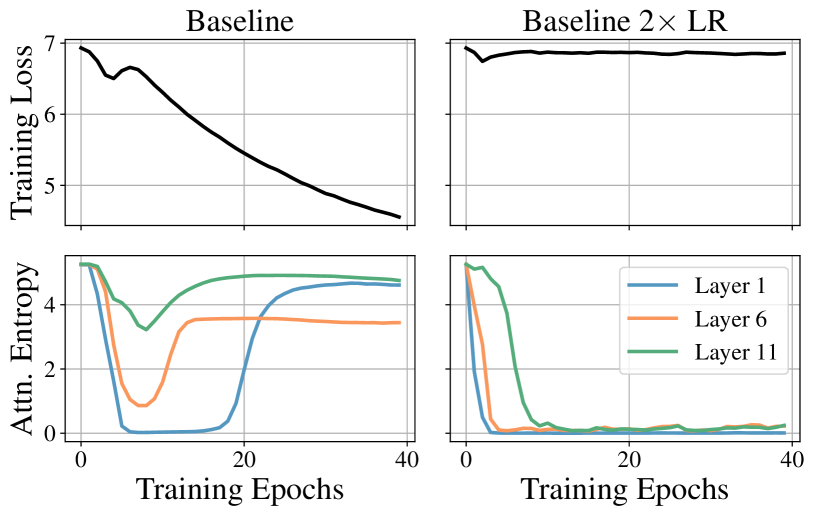
Training stability is of great importance to Transformers. In this work, we investigate the training dynamics of Transformers by examining the evolution of the attention layers. In particular, we track the attention entropy for each attention head during the course of training, which is a proxy for model sharpness. We identify a common pattern across different architectures and tasks, where low attention entropy is accompanied by high training instability, which can take the form of oscillating loss or divergence. We denote the pathologically low attention entropy, corresponding to highly concentrated attention scores, as $ extit{entropy collapse}$. As a remedy, we propose $σ$Reparam, a simple and efficient solution where we reparametrize all linear layers with spectral normalization and an additional learned scalar. We demonstrate that $σ$Reparam successfully prevents entropy collapse in the attention layers, promoting more stable training. Additionally, we prove a tight lower bound of the attention entropy, which decreases exponentially fast with the spectral norm of the attention logits, providing additional motivation for our approach. We conduct experiments with $σ$Reparam on image classification, image self-supervised learning, machine translation, speech recognition, and language modeling tasks. We show that $σ$Reparam provides stability and robustness with respect to the choice of hyperparameters, going so far as enabling training (a) a Vision Transformer {to competitive performance} without warmup, weight decay, layer normalization or adaptive optimizers; (b) deep architectures in machine translation and (c) speech recognition to competitive performance without warmup and adaptive optimizers. Code is available at \url{https://github.com/apple/ml-sigma-reparam}.
Motivation & Objective
- To investigate the root causes of training instability in Transformers by analyzing attention entropy dynamics.
- To identify a common pattern where low attention entropy correlates with loss oscillation or divergence.
- To develop a general, efficient solution to prevent attention entropy collapse across diverse architectures and tasks.
- To demonstrate that $\sigma$ Reparam enables stable training with minimal hyperparameter tuning.
Proposed method
- Track attention entropy as a proxy for model sharpness across attention heads, layers, and training steps.
- Introduce $\sigma$ Reparam: reparameterize all linear layers using spectral normalization and a learnable scalar $\sigma$.
- Apply $\sigma$ Reparam to the query, key, and value projections in self-attention mechanisms.
- Prove a tight lower bound on attention entropy that decreases exponentially with the spectral norm of attention logits.
- Use controlled interventions (e.g., temperature scaling) to establish causal links between entropy collapse and training instability.
- Evaluate $\sigma$ Reparam across image classification, self-supervised learning, machine translation, speech recognition, and language modeling.
Experimental results
Research questions
- RQ1Is there a consistent correlation between low attention entropy and training instability in Transformers?
- RQ2Can attention entropy collapse be causally linked to loss divergence or oscillation?
- RQ3Does $\sigma$ Reparam effectively prevent entropy collapse and stabilize training across diverse tasks?
- RQ4Can $\sigma$ Reparam eliminate the need for common regularization techniques like weight decay, warmup, and adaptive optimizers?
- RQ5What is the theoretical relationship between spectral norm of attention logits and attention entropy?
Key findings
- Attention entropy collapse—defined as near-zero entropy in attention scores—coincides with training divergence or oscillation in ViT, NLP, and ASR models.
- $\sigma$ Reparam successfully prevents entropy collapse, enabling stable training of Vision Transformers without warmup, weight decay, layer normalization, or adaptive optimizers.
- In machine translation, $\sigma$ Reparam allows training of deep Transformer architectures that otherwise fail to converge.
- For speech recognition, $\sigma$ Reparam achieves competitive performance without warmup or adaptive optimizers, matching baseline results.
- Theoretical analysis shows that attention entropy has a tight lower bound that decreases exponentially with the spectral norm of the attention logits.
- Experiments confirm that $\sigma$ Reparam is robust to hyperparameter choices and enables simplified training recipes across vision, speech, and language tasks.

Read this paper
Open the full text in the Nubint reader and ask about any passage as you read.
Read this paper on NubintThis review was generated by AI from the original paper. Please check the paper before citing it.