
[Paper Review] Stable Diffusion-based Data Augmentation for Federated Learning with Non-IID Data
Gen-FedSD uses a pre-trained Stable Diffusion model to generate client-specific synthetic data, making local FL data closer to IID and improving performance and convergence under non-IID distributions.
The proliferation of edge devices has brought Federated Learning (FL) to the forefront as a promising paradigm for decentralized and collaborative model training while preserving the privacy of clients' data. However, FL struggles with a significant performance reduction and poor convergence when confronted with Non-Independent and Identically Distributed (Non-IID) data distributions among participating clients. While previous efforts, such as client drift mitigation and advanced server-side model fusion techniques, have shown some success in addressing this challenge, they often overlook the root cause of the performance reduction - the absence of identical data accurately mirroring the global data distribution among clients. In this paper, we introduce Gen-FedSD, a novel approach that harnesses the powerful capability of state-of-the-art text-to-image foundation models to bridge the significant Non-IID performance gaps in FL. In Gen-FedSD, each client constructs textual prompts for each class label and leverages an off-the-shelf state-of-the-art pre-trained Stable Diffusion model to synthesize high-quality data samples. The generated synthetic data is tailored to each client's unique local data gaps and distribution disparities, effectively making the final augmented local data IID. Through extensive experimentation, we demonstrate that Gen-FedSD achieves state-of-the-art performance and significant communication cost savings across various datasets and Non-IID settings.
Motivation & Objective
- Motivate federated learning as a privacy-preserving decentralized training paradigm under non-IID data distributions.
- Address the root cause of FL performance degradation by aligning each client’s data distribution with the global distribution through synthetic data generation.
- Propose Gen-FedSD to synthesize high-quality, class-conditioned images tailored to each client’s data gaps.
- Demonstrate that per-client diffusion-model data augmentation yields IID-like local data and improves FL benchmarks on standard datasets.
Proposed method
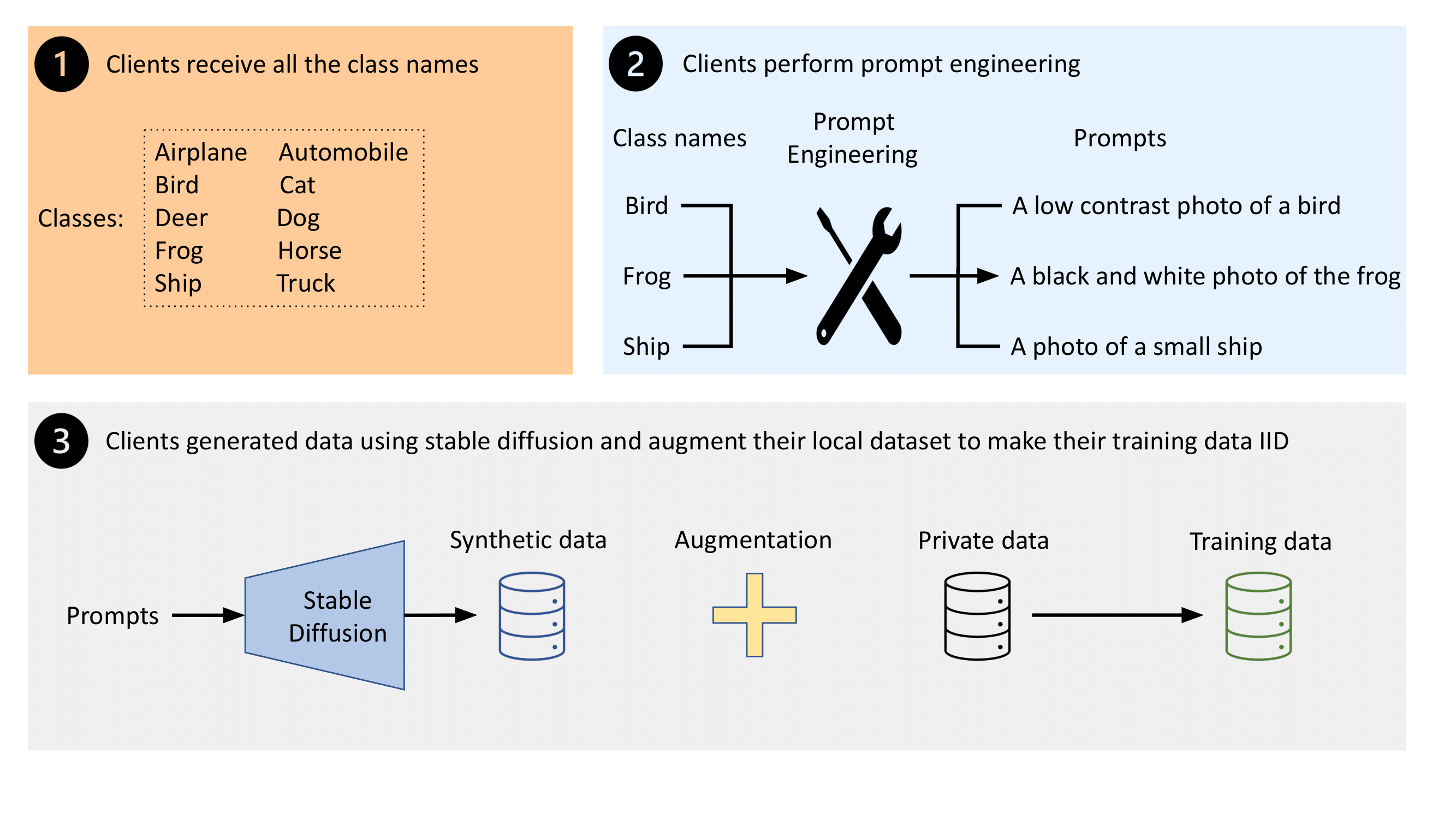
- Clients receive the global class labels from the server and generate text prompts describing each class.
- Use a pre-trained Stable Diffusion model to synthesize class-conditioned images from the prompts.
- For each client, generate synthetic data to equalize per-class counts, yielding an augmented local dataset that is IID with respect to the global distribution.
- Augmented data is combined with local data and used to train the FL model, reducing client drift.
- Evaluate different prompt designs (standard vs. diverse prompts) to study the impact of prompt diversity on performance.
- Compare Gen-FedSD against standard FL baselines (FedAvg, FedProx, FedNova, Scaffold).
Experimental results
Research questions
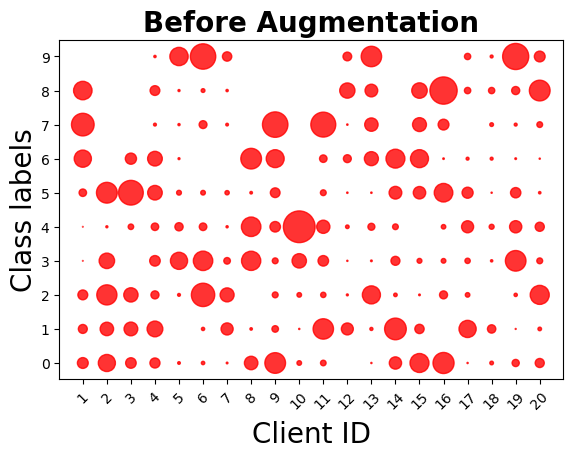
- RQ1Can per-client diffusion-based data augmentation align local client distributions with the global data distribution to mitigate non-IID effects in FL?
- RQ2How does prompt design (diverse vs. fixed prompts) affect the quality of synthetic data and FL performance?
- RQ3What are the accuracy gains and communication-cost implications of Gen-FedSD across CIFAR-10 and CIFAR-100 under varying non-IID settings?
- RQ4Does Gen-FedSD preserve privacy while enabling on-device inference of diffusion models?
Key findings
- Gen-FedSD substantially increases accuracy for FL baselines under non-IID settings (e.g., at least 12% on CIFAR-10 and 6% on CIFAR-100 under mild heterogeneity).
- Under extreme non-IIDness, Gen-FedSD yields accuracy gains of at least 20% (CIFAR-10) and 7% (CIFAR-100).
- Gen-FedSD accelerates convergence and reduces communication costs across evaluated datasets.
- Prompt diversity further enhances Gen-FedSD performance compared to fixed prompts.
- Gen-FedSD improves performance for several baselines, sometimes surpassing FedAvg when augmentation is applied.
Read this paper
Open the full text in the Nubint reader and ask about any passage as you read.
Read this paper on NubintThis review was generated by AI from the original paper. Please check the paper before citing it.