
[Paper Review] Stable LM 2 1.6B Technical Report
Stable LM 2 1.6B is an open decoder-only language model with 1.6B parameters, trained on a transparent multilingual data mix and released with quantized and edge-device throughput capabilities, plus fine-tuning and evaluation results.
We introduce StableLM 2 1.6B, the first in a new generation of our language model series. In this technical report, we present in detail the data and training procedure leading to the base and instruction-tuned versions of StableLM 2 1.6B. The weights for both models are available via Hugging Face for anyone to download and use. The report contains thorough evaluations of these models, including zero- and few-shot benchmarks, multilingual benchmarks, and the MT benchmark focusing on multi-turn dialogues. At the time of publishing this report, StableLM 2 1.6B was the state-of-the-art open model under 2B parameters by a significant margin. Given its appealing small size, we also provide throughput measurements on a number of edge devices. In addition, we open source several quantized checkpoints and provide their performance metrics compared to the original model.
Motivation & Objective
- Explain the data collection and training procedure used to build Stable LM 2 1.6B.
- Describe the pre-training architecture, tokenizer, and optimization setup.
- Detail the fine-tuning, alignment, and self-knowledge techniques used to improve conversational abilities.
- Present comprehensive evaluations across few-shot, multilingual, and multi-turn dialogue benchmarks.
- Provide information on inference, quantization options, throughput on edge devices, and environmental impact.
Proposed method
- Train a 1.6B decoder-only Transformer with 4096 token context using FlashAttention-2 and mixed precision.
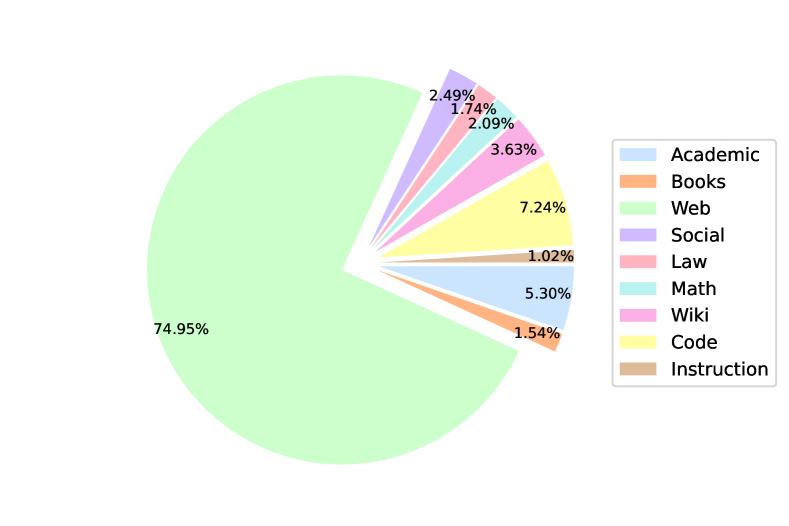
- Use a multilingual data mix totaling around 2 trillion tokens with explicit sampling weights for domains and languages (Table 1).
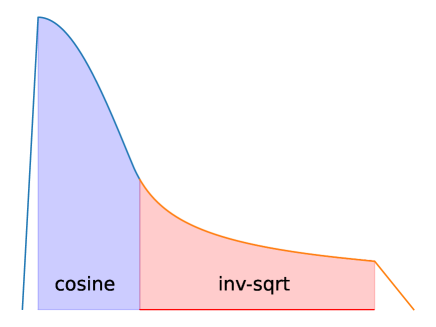
- Apply a multi-stage learning rate schedule with warm-up, cosine and rsqrt decay, followed by a linear cooldown.
- Perform supervised fine-tuning on instruction datasets from the Hugging Face Hub, followed by Direct Preference Optimization and a self-knowledge training loop.
- Provide and release quantized checkpoints in Q4_0, Q4_1, Q5_K_M GGUF, and INT4 formats for various inference frameworks.
Experimental results
Research questions
- RQ1How does Stable LM 2 1.6B perform on standard few-shot and zero-shot benchmarks compared to similarly sized open models?
- RQ2What is the impact of multilingual pre-training data on non-English and multilingual benchmarks?
- RQ3How do SFT, DPO, and self-knowledge training affect conversational quality and alignment?
- RQ4What are the on-device throughput and quantization trade-offs for edge deployments?
- RQ5What are the environmental impacts and societal considerations of releasing an open-weight model?
Key findings
- Stable LM 2 1.6B outperforms other base models of similar size on multiple English benchmarks and approaches larger models on MT-Bench in conversational settings.
- The model demonstrates strong multilingual capabilities across German, Spanish, French, Italian, Portuguese, and Dutch in non-English evaluation setups.
- The instruction-tuned variant (stablelm-2-1_6b-dpo) improves over Phi-1.5 and compares favorably with Phi-2 on several metrics.
- Quantized checkpoints (Q4_0, Q4_1, Q5_K_M GGUF, INT4) are provided and enable efficient on-device or framework-specific deployment.
- Throughput measurements show substantial gains when using lower precision on edge devices, with illustrative figures for various frameworks.
- Training required about 92,000 GPU-hours and produced an estimated carbon footprint of 11 tCO2eq.
Read this paper
Open the full text in the Nubint reader and ask about any passage as you read.
Read this paper on NubintThis review was generated by AI from the original paper. Please check the paper before citing it.