
[Paper Review] Stable Neural Stochastic Differential Equations in Analyzing Irregular Time Series Data
The paper introduces three stable classes of Neural SDEs (Langevin-type SDE, Linear Noise SDE, and Geometric SDE) with a controlled path to handle irregular time series, proves existence/uniqueness, and demonstrates robustness to distribution shift and missing data via extensive experiments.
Irregular sampling intervals and missing values in real-world time series data present challenges for conventional methods that assume consistent intervals and complete data. Neural Ordinary Differential Equations (Neural ODEs) offer an alternative approach, utilizing neural networks combined with ODE solvers to learn continuous latent representations through parameterized vector fields. Neural Stochastic Differential Equations (Neural SDEs) extend Neural ODEs by incorporating a diffusion term, although this addition is not trivial, particularly when addressing irregular intervals and missing values. Consequently, careful design of drift and diffusion functions is crucial for maintaining stability and enhancing performance, while incautious choices can result in adverse properties such as the absence of strong solutions, stochastic destabilization, or unstable Euler discretizations, significantly affecting Neural SDEs' performance. In this study, we propose three stable classes of Neural SDEs: Langevin-type SDE, Linear Noise SDE, and Geometric SDE. Then, we rigorously demonstrate their robustness in maintaining excellent performance under distribution shift, while effectively preventing overfitting. To assess the effectiveness of our approach, we conduct extensive experiments on four benchmark datasets for interpolation, forecasting, and classification tasks, and analyze the robustness of our methods with 30 public datasets under different missing rates. Our results demonstrate the efficacy of the proposed method in handling real-world irregular time series data.
Motivation & Objective
- Motivate robust handling of irregular time series with missing data using Neural SDEs.
- Propose three stable Neural SDE classes to ensure well-posedness and stability.
- Incorporate a controlled path into the drift to improve sequential observation modeling.
- Theoretically analyze robustness under distribution shift and missing data.
- Empirically validate on interpolation, forecasting, and classification tasks across multiple datasets.
Proposed method
- Define Langevin-type Neural LSDE with drift gamma and diffusion sigma; prove existence/uniqueness under Lipschitz and growth assumptions.
- Define Linear Noise Neural LNSDE with linear multiplicative diffusion; analyze stability properties.
- Define Geometric Neural GSDE with geometric form; show nonnegativity and absorbing state properties.
- Impose Assumptions 3.1–3.3 on neural components to ensure well-posed SDE solutions.
- Incorporate a controlled path z̄(t)=zeta(t,z(t),X(t);θζ) into drift, replacing z(t) with z̄(t) in drift terms.
- Provide robustness results (Theorems 3.5 and 3.6) giving non-asymptotic bounds on output distribution differences under input perturbations.
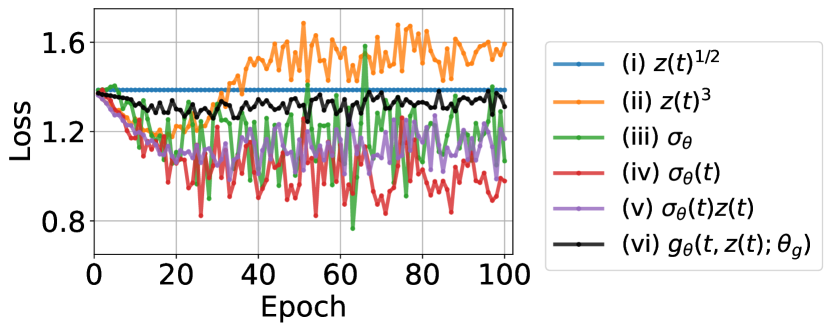
- Conduct ablation studies and compare diffusion nonlinearities and controlled paths (ζ and diffusion σ).
Experimental results
Research questions
- RQ1Can stable Neural SDEs be designed to maintain performance under distribution shift and missing data?
- RQ2Do Langevin-type, Linear Noise, and Geometric SDE formulations provide theoretical guarantees of existence, uniqueness, and robustness?
- RQ3Does incorporating a controlled path into the drift improve empirical performance on irregular time series?
- RQ4How do different diffusion architectures (affine vs nonlinear) affect stability and accuracy?
- RQ5What is the empirical effectiveness of the proposed models across interpolation, forecasting, and classification tasks under missingness?
Key findings
- Three stable Neural SDE classes (LSDE, LNSDE, GSDE) are proposed and shown to have unique strong solutions under reasonable assumptions.
- Neural GSDE exhibits nonnegativity and absorbing state properties linking to deep ReLU networks.
- Theoretical results show robustness to distribution shift and missing data, with non-asymptotic bounds on output distribution changes that decay with depth T.
- Empirical results across four benchmarks for interpolation, forecasting, and classification show the proposed methods outperform baselines under various missing rates.
- Ablation studies confirm the benefit of incorporating a controlled path and a nonlinear diffusion function for performance.
- Across 30 public datasets with varying missing rates, the proposed Neural LSDE, LNSDE, and GSDE achieve top-tier accuracy and robustness compared to traditional RNNs, Neural CDEs, and other Neural SDE variants.
Read this paper
Open the full text in the Nubint reader and ask about any passage as you read.
Read this paper on NubintThis review was generated by AI from the original paper. Please check the paper before citing it.