
[Paper Review] Stable radiation field positron acceleration in a micro-tube
This paper proposes a novel, stable positron acceleration mechanism using a relativistic electron beam injected into a plasma micro-tube to excite continuous mid-infrared radiation fields with gradients up to hundreds of GV/m. The method enables 1 GeV energy gain in 140 ps with only 1.56% energy spread, achieving up to 40% efficiency for multiple simultaneous bunches, offering a compact, high-gradient solution for antimatter acceleration.
Nowadays, there is a desperate need for an ultra-acceleration-gradient method for antimatter particles, which holds great significance in exploring the origin of matter, CP violation, astrophysics, and medical physics. Compared to traditional accelerators with low gradients and a limited acceleration region for positrons in laser-driven charge separation fields, we propose an innovative high-gradient positron acceleration mechanism with implementation advantages. Injecting a relativistic electron beam into a dense plasma micro-tube generates a stable and periodic high-intensity mid-infrared radiation (mid-IR) field, reaching tens of GV/m. This field, propagating synchronously with the electron beam, achieves a 1 GeV energy gain for the positron bunch within 140 picoseconds with a minimal energy spread-approximately 1.56% during a stable phase. By utilizing continuous mid-IR, the efficiency of energy transfer from the electron beam to either a single positron bunch or three positron bunches simultaneously could reach up to 20% and 40%, respectively. This acceleration scheme can achieve cascaded acceleration for a single positron bunch and series acceleration for multiple positron bunches in a continuous, stable, and efficient manner.
Motivation & Objective
- Address the urgent need for high-gradient, stable acceleration of antimatter particles like positrons to study CP violation, matter-antimatter asymmetry, and enable advanced medical and astrophysical applications.
- Overcome limitations of traditional accelerators and existing plasma wakefield schemes, which suffer from low gradients, beam instability, and poor control over energy spread and emittance in positron acceleration.
- Develop a continuous, uniform acceleration field using stable mid-infrared radiation generated by electron beam-driven surface-nanometer film oscillations in a micro-tube.
- Enable cascaded and simultaneous acceleration of multiple positron bunches with high efficiency and beam quality, suitable for practical applications.
- Demonstrate robustness to transverse injection misalignment and validate the scheme through high-fidelity 2D particle-in-cell simulations.
Proposed method
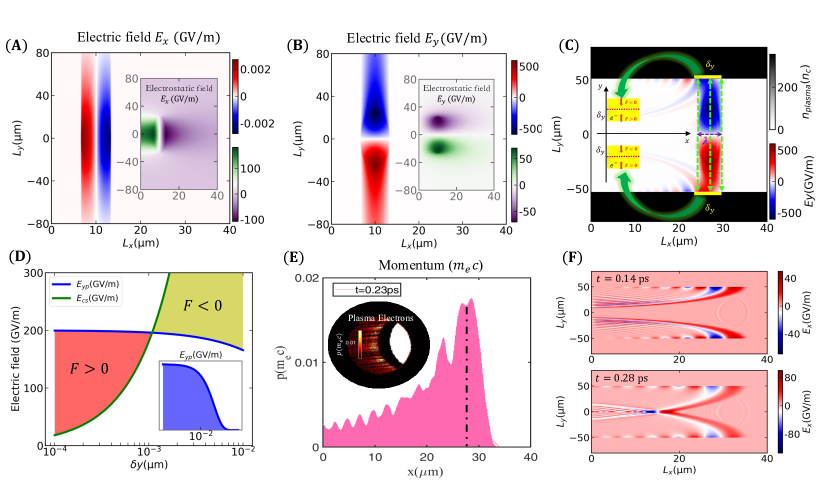
- Utilize a relativistic electron beam (1 GeV, 3.402 nC) injected into a dense plasma micro-tube (radius 50 µm, density 10²⁸ m⁻³) to excite stable, periodic mid-infrared radiation fields via surface-nanometer electron film oscillations.
- Generate a continuous, uniform longitudinal electric field in the mid-IR range (wavelength ~24 µm) that synchronizes with the electron beam, enabling sustained acceleration of positrons.
- Employ 2D cylindrical geometry simulations using the SMILEI PIC code with a moving window (51.2 µm × 100 µm), Perfectly Matched Layer (PML) boundaries, and binomial current filtering to reduce numerical noise.
- Simulate positron witness bunches (0.111 nC, 1–5 GeV) with Gaussian transverse and longitudinal profiles, using 20 macro-particles per cell, to assess energy gain, energy spread, and transverse stability.
- Investigate transverse injection misalignment (up to a few microns) and series acceleration of multiple bunches using extended simulation domains (204.8 µm × 160 µm) with 2048 × 640 cells.
- Analyze energy transfer efficiency, beam quality (energy spread, emittance), and field stability over time, validating results across multiple PIC resolution tests (PPC = 50 to 400).
Experimental results
Research questions
- RQ1Can a stable, continuous mid-infrared radiation field be generated in a plasma micro-tube via relativistic electron beam excitation to enable high-gradient positron acceleration?
- RQ2What is the maximum achievable acceleration gradient and energy gain for positrons in this scheme, and how does it compare to conventional plasma wakefield methods?
- RQ3To what extent can transverse injection misalignment be tolerated without degrading beam quality or energy transfer efficiency?
- RQ4Can multiple positron bunches be accelerated simultaneously with high efficiency and low energy spread using this continuous field structure?
- RQ5How does the beam quality (energy spread, emittance) evolve over time, and what role does electron beam energy loss and breakup play in transverse focusing dynamics?
Key findings
- The mid-infrared radiation field achieves a stable acceleration gradient of up to several tens of GV/m, reaching hundreds of GV/m with a 3.402 nC electron beam, enabling high-gradient acceleration.
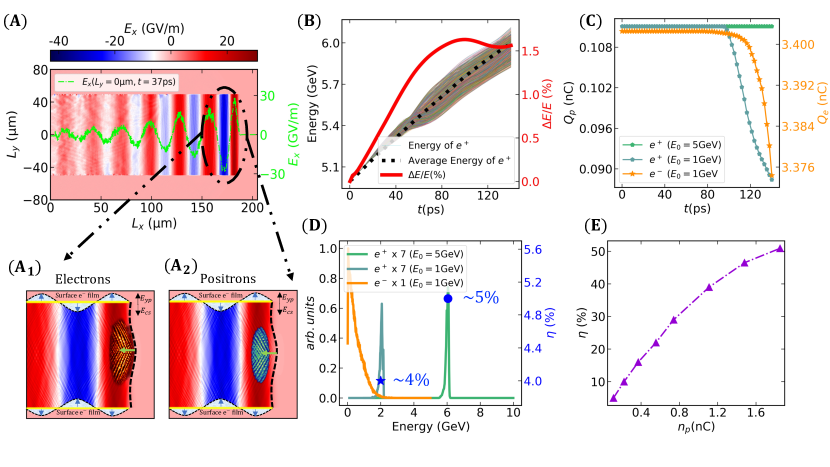
- A single positron bunch achieves a 1 GeV energy gain in just 140 picoseconds with a minimal energy spread of 1.56%, demonstrating high beam quality.
- Energy transfer efficiency reaches up to 20% for a single bunch and 40% for three simultaneous bunches, indicating high efficiency for multi-bunch operation.
- Transverse focusing of the positron bunch occurs within the first 21 ps due to the $E_y - cB_z$ field, followed by weak defocusing as the electron beam loses energy and breaks up.
- Transverse injection misalignment of up to a few microns causes only a 10% relative loss in energy transfer efficiency, with negligible impact on final energy and energy spread.
- The scheme supports cascaded and series acceleration of multiple positron bunches in a continuous, stable, and efficient manner, enabling scalable antimatter beam production.
Better researchstarts right now
From reading papers to final review, dramatically reduce your research time.
No credit card · Free plan available
This review was created by AI and reviewed by human editors.