
[Paper Review] Stable Video Diffusion: Scaling Latent Video Diffusion Models to Large Datasets
The paper presents Stable Video Diffusion (SVD), a latent video diffusion model trained with a three-stage data strategy on a curated, large-scale video dataset to achieve state-of-the-art text-to-video and image-to-video synthesis, with strong motion and multi-view priors.
We present Stable Video Diffusion - a latent video diffusion model for high-resolution, state-of-the-art text-to-video and image-to-video generation. Recently, latent diffusion models trained for 2D image synthesis have been turned into generative video models by inserting temporal layers and finetuning them on small, high-quality video datasets. However, training methods in the literature vary widely, and the field has yet to agree on a unified strategy for curating video data. In this paper, we identify and evaluate three different stages for successful training of video LDMs: text-to-image pretraining, video pretraining, and high-quality video finetuning. Furthermore, we demonstrate the necessity of a well-curated pretraining dataset for generating high-quality videos and present a systematic curation process to train a strong base model, including captioning and filtering strategies. We then explore the impact of finetuning our base model on high-quality data and train a text-to-video model that is competitive with closed-source video generation. We also show that our base model provides a powerful motion representation for downstream tasks such as image-to-video generation and adaptability to camera motion-specific LoRA modules. Finally, we demonstrate that our model provides a strong multi-view 3D-prior and can serve as a base to finetune a multi-view diffusion model that jointly generates multiple views of objects in a feedforward fashion, outperforming image-based methods at a fraction of their compute budget. We release code and model weights at https://github.com/Stability-AI/generative-models .
Motivation & Objective
- Identify effective data curation strategies for large-scale video diffusion pretraining.
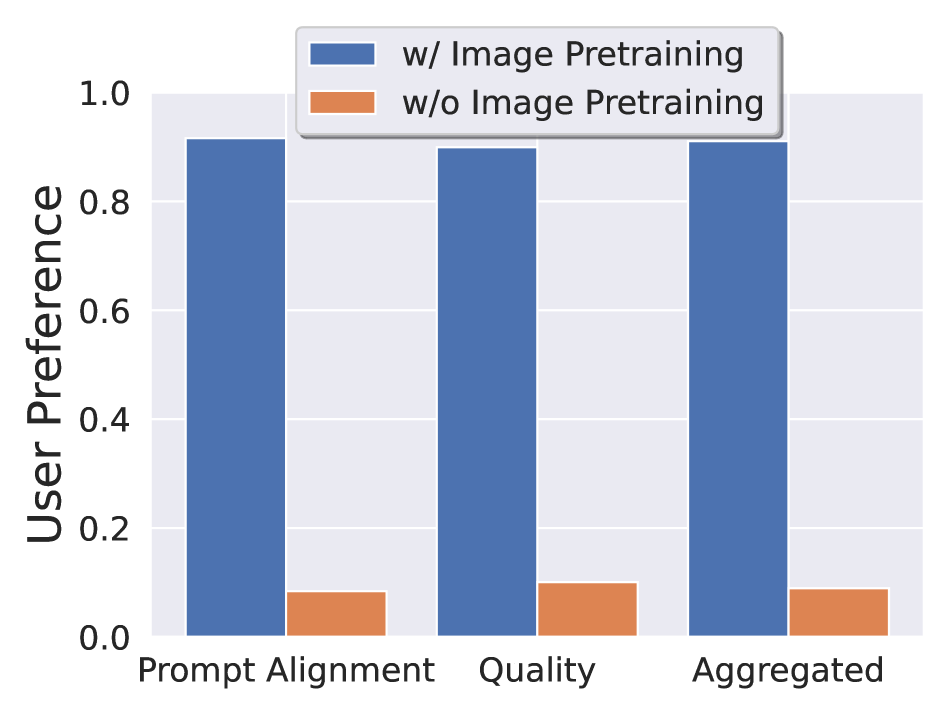
- Propose and validate a three-stage training regime (image pretraining, video pretraining, high-quality finetuning) for video LDMs.
- Demonstrate that curated pretraining yields strong motion representations and benefits downstream tasks including text-to-video, image-to-video, and multi-view generation.
- Show that the base model serves as a robust motion prior and can be finetuned for varied tasks with efficiency (e.g., LoRA for camera motion).
Proposed method
- Use a latent video diffusion model with temporal layers inserted into a pretrained image diffusion backbone.
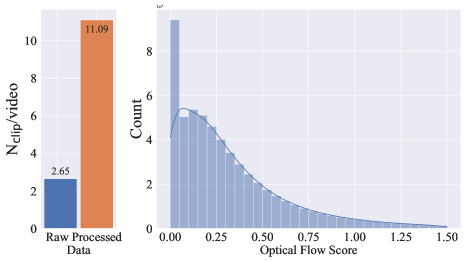
- Develop a systematic data curation workflow including cut detection, synthetic captions, optical flow filtering, OCR, and CLIP-based aesthetics and similarity metrics.
- Train in three stages: (i) image pretraining on a 2D diffusion model, (ii) large-scale video pretraining at low resolution, (iii) high-quality finetuning at high resolution on a smaller dataset.
- Shift the EDM noise schedule toward higher noise values to improve high-resolution finetuning.
- Enable motion control via micro-conditioning on frame rate and via LoRA modules for camera motion.
- Demonstrate multi-view generation by finetuning on multi-view datasets to create consistent multi-view outputs, leveraging the learned motion prior.
Experimental results
Research questions
- RQ1Does careful data curation of a large video corpus improve final video model performance after finetuning?
- RQ2What is the impact of the three-stage training regime on high-quality text-to-video and image-to-video synthesis?
- RQ3Can the base video model provide a strong motion representation and a usable 3D/multi-view prior for downstream tasks?
- RQ4How does a video diffusion model pretrained on curated data compare to state-of-the-art multi-view/synthesis methods in terms of quality and efficiency?
Key findings
- Pretraining on well-curated video data yields significant performance gains that persist after high-quality finetuning.
- A base model pretrained with curated data achieves strong zero-shot text-to-video performance, outperforming several baselines on UCF-101.
- Finetuning on high-quality data yields competitive high-resolution text-to-video and image-to-video results against closed-source models.
- The base model provides a powerful motion representation and serves as a strong prior for downstream multi-view generation, outperforming methods like Zero123XL and SyncDreamer in multi-view tasks.
- Using LoRA modules enables explicit camera-motion control in image-to-video generation.
- The three-stage training strategy scales effectively to large datasets (~600M samples) and enables efficient multi-view fine-tuning with limited compute.
Read this paper
Open the full text in the Nubint reader and ask about any passage as you read.
Read this paper on NubintThis review was generated by AI from the original paper. Please check the paper before citing it.