
[Paper Review] Stance Reasoner: Zero-Shot Stance Detection on Social Media with Explicit Reasoning
Stance Reasoner introduces a zero-shot stance detection framework for social media that leverages chain-of-thought in-context learning with a pre-trained language model to generate explicit, interpretable reasoning over background knowledge. It outperforms state-of-the-art models on three Twitter datasets, including fully supervised methods, while enabling better generalization to unseen targets through transparent, knowledge-grounded reasoning steps.
Social media platforms are rich sources of opinionated content. Stance detection allows the automatic extraction of users' opinions on various topics from such content. We focus on zero-shot stance detection, where the model's success relies on (a) having knowledge about the target topic; and (b) learning general reasoning strategies that can be employed for new topics. We present Stance Reasoner, an approach to zero-shot stance detection on social media that leverages explicit reasoning over background knowledge to guide the model's inference about the document's stance on a target. Specifically, our method uses a pre-trained language model as a source of world knowledge, with the chain-of-thought in-context learning approach to generate intermediate reasoning steps. Stance Reasoner outperforms the current state-of-the-art models on 3 Twitter datasets, including fully supervised models. It can better generalize across targets, while at the same time providing explicit and interpretable explanations for its predictions.
Motivation & Objective
- To address the challenge of zero-shot stance detection on social media, where models must generalize to unseen targets without fine-tuning.
- To overcome limitations of supervised models that overfit to training targets and lack interpretability.
- To improve generalization by combining pre-trained language models with structured reasoning over background knowledge.
- To generate explicit, human-readable explanations for stance predictions, enabling error detection and model debugging.
- To develop a method that generalizes across diverse topics and domains without requiring task-specific fine-tuning.
Proposed method
- The method uses in-context learning with optimized prompts to guide a pre-trained language model in generating intermediate reasoning steps for stance prediction.
- It incorporates background knowledge about targets (e.g., @POTUS = US President) through explicit prompt engineering.
- Chain-of-thought (CoT) prompting is applied to generate structured reasoning chains that move from premise to conclusion.
- The model is not fine-tuned; instead, it relies on few-shot demonstrations with diverse reasoning strategies to guide inference.
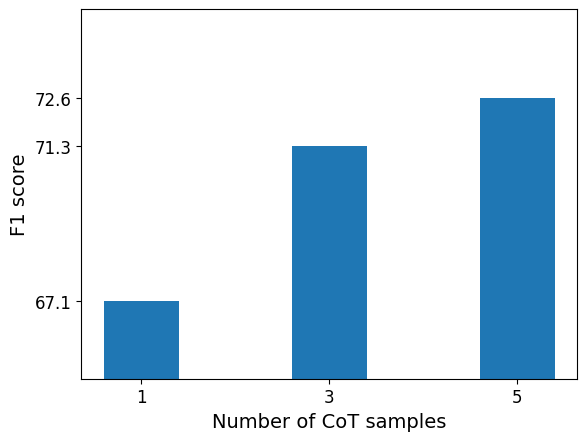
- Multiple reasoning chains are generated per input, and predictions are aggregated via majority voting to improve robustness.
- The framework is designed to be interpretable, with reasoning steps that can be manually verified and used to detect annotation errors.
Experimental results
Research questions
- RQ1Can explicit reasoning over background knowledge improve zero-shot stance detection performance on unseen targets?
- RQ2How does the diversity of reasoning strategies in in-context examples affect model generalization?
- RQ3Can a non-fine-tuned, prompt-based approach outperform fully supervised state-of-the-art models in zero-shot stance detection?
- RQ4To what extent can generated reasoning chains improve model interpretability and error detection?
- RQ5How well does the method generalize across different domains and text types beyond short social media posts?
Key findings
- Stance Reasoner outperforms all baseline models, including fully supervised state-of-the-art methods, on three public Twitter stance detection datasets.
- The model demonstrates superior generalization to unseen targets, indicating effective transfer of reasoning strategies across topics.
- Generated reasoning chains are interpretable and can be used to identify annotation errors and ambiguous examples.
- Performance improves with diverse reasoning strategies in in-context examples, highlighting the importance of reasoning diversity.
- The method maintains high performance without fine-tuning, relying solely on prompt engineering and in-context learning.
- The model’s reasoning is faithful in many cases, though faithfulness is not guaranteed, and manual verification remains essential for complex cases like sarcasm.
Read this paper
Open the full text in the Nubint reader and ask about any passage as you read.
Read this paper on NubintThis review was generated by AI from the original paper. Please check the paper before citing it.