
[Paper Review] Statistical inference using machine learning and classical techniques based on accumulated local effects (ALE)
This paper introduces bootstrapped confidence intervals and novel ALE effect size measures (ALED, ALER, NALED, NALER) to enable reliable statistical inference from Accumulated Local Effects (ALE) in machine learning, especially for small datasets. It enhances interpretability by combining global effect summaries with confidence regions that reveal non-linear, heterogeneous relationships without oversimplification.
Accumulated Local Effects (ALE) is a model-agnostic approach for global explanations of the results of black-box machine learning (ML) algorithms. There are at least three challenges with conducting statistical inference based on ALE: ensuring the reliability of ALE analyses, especially in the context of small datasets; intuitively characterizing a variable's overall effect in ML; and making robust inferences from ML data analysis. In response, we introduce innovative tools and techniques for statistical inference using ALE, establishing bootstrapped confidence intervals tailored to dataset size and introducing ALE effect size measures that intuitively indicate effects on both the outcome variable scale and a normalized scale. Furthermore, we demonstrate how to use these tools to draw reliable statistical inferences, reflecting the flexible patterns ALE adeptly highlights, with implementations available in the 'ale' package in R. This work propels the discourse on ALE and its applicability in ML and statistical analysis forward, offering practical solutions to prevailing challenges in the field.
Motivation & Objective
- Address the lack of reliable statistical inference in ALE-based model interpretation, particularly for small datasets where overfitting risks are high.
- Develop intuitive, model-agnostic effect size measures that quantify variable effects on both the outcome scale and a normalized scale for cross-dataset comparison.
- Enable nuanced statistical inference by combining global effect summaries with confidence regions that highlight where effects are significant or heterogeneous.
- Provide computationally efficient tools that build directly on existing ALE computations, ensuring practical usability in real-world analyses.
- Bridge the gap between interpretability and statistical rigor in machine learning by integrating classical inference techniques with modern model-agnostic explainability.
Proposed method
- Implement dataset-size-aware bootstrapping to generate confidence intervals for ALE, improving reliability in small-sample settings.
- Define ALE deviation (ALED) and ALE range (ALER) as global effect size measures reflecting the magnitude of variable effects on the outcome scale.
- Introduce normalized versions (NALED, NALER) to allow comparison of effect sizes across different datasets and outcome scales.
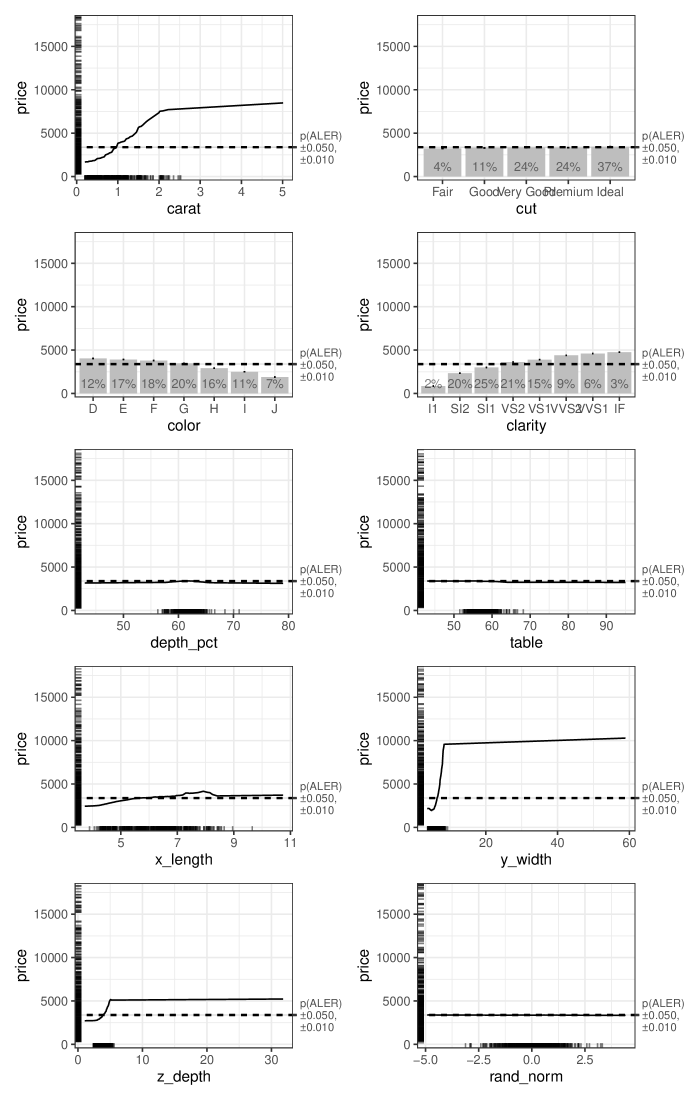
- Construct ALE confidence regions by bootstrapping ALE curves and identifying statistically significant intervals across the predictor domain.
- Use the 'ale' R package to implement and validate all methods, ensuring reproducibility and integration into standard ML workflows.
- Combine global effect measures with confidence regions to detect heterogeneous effects, such as spikes or non-linear patterns, that may be missed by single-value summaries.
Experimental results
Research questions
- RQ1How can bootstrapped confidence intervals be adapted to ALE to improve statistical inference reliability, especially in small datasets?
- RQ2What are effective, interpretable, and model-agnostic effect size measures for ALE that reflect both magnitude and direction of variable effects?
- RQ3How can confidence regions derived from ALE be used to detect and interpret non-linear, heterogeneous relationships that are obscured by global summaries?
- RQ4To what extent do the proposed effect size measures (ALED, ALER, NALED, NALER) improve interpretability and comparability across different datasets and models?
- RQ5Can the integration of ALE confidence regions with global effect measures enhance decision-making by identifying critical predictor ranges with significant impact?
Key findings
- Bootstrapped confidence intervals for ALE are computationally efficient and tailored to dataset size, significantly improving reliability in small-sample settings.
- The ALE deviation (ALED) and ALE range (ALER) measures provide intuitive, interpretable summaries of variable effects on the outcome scale, with normalized versions (NALED, NALER) enabling cross-dataset comparison.
- ALE confidence regions effectively highlight specific input ranges where predictor effects are statistically significant, revealing non-linear and heterogeneous patterns invisible to global summaries.
- Disparities between high ALE range and moderate ALE deviation are clarified by confidence regions, indicating that extreme effects may stem from specific data subranges rather than outliers.
- The proposed measures are computationally negligible once ALE values are computed, making them practical for routine use in model interpretation pipelines.
- The integration of global effect measures with confidence regions enables more robust and nuanced inference, supporting both rapid variable prioritization and targeted intervention planning.
Read this paper
Open the full text in the Nubint reader and ask about any passage as you read.
Read this paper on NubintThis review was generated by AI from the original paper. Please check the paper before citing it.