
[Paper Review] Statler: State-Maintaining Language Models for Embodied Reasoning
Statler introduces a framework where paired world-state reader and writer LLMs explicitly maintain and update an estimated world state to guide embodied robot planning, achieving strong gains over Code-as-Policies on long-horizon tasks in simulated and real robots.
There has been a significant research interest in employing large language models to empower intelligent robots with complex reasoning. Existing work focuses on harnessing their abilities to reason about the histories of their actions and observations. In this paper, we explore a new dimension in which large language models may benefit robotics planning. In particular, we propose Statler, a framework in which large language models are prompted to maintain an estimate of the world state, which are often unobservable, and track its transition as new actions are taken. Our framework then conditions each action on the estimate of the current world state. Despite being conceptually simple, our Statler framework significantly outperforms strong competing methods (e.g., Code-as-Policies) on several robot planning tasks. Additionally, it has the potential advantage of scaling up to more challenging long-horizon planning tasks.
Motivation & Objective
- Motivate and enable long-horizon robotic planning by explicitly maintaining a world state with LLMs.
- Develop a model-based approach that uses a world-state reader and writer to condition actions on the current state.
- Demonstrate robustness and scalability of state-maintenance across simulated tabletop domains and real robots.
Proposed method
- Prompt two specialized LLMs: a world-state reader that generates executable actions based on the query and current state, and a world-state writer that updates the state after executing actions.
- Maintain an external, JSON-formatted world-state representation that is read and updated across steps to track latent dynamics.
- Use demonstrations to train or steer the reader/writer prompts; optionally compare unified vs. split-reader/writer configurations.
- Evaluate statler against Code-as-Policies (CaP) and CaP with Chain-of-Thought prompts across multiple tabletop manipulation tasks.
- Exhibit ablations showing the contribution of separate reader/writer components and different state-maintenance strategies.
Experimental results
Research questions
- RQ1Can an explicit, maintained world state improve multi-step robotic planning compared to state-less policies?
- RQ2Do separate world-state reader and writer LLMs provide measurable gains over unified prompting in long-horizon tasks?
- RQ3How does Statler perform on simulated domains versus real-robot experiments when reasoning over past interactions?
- RQ4What is the impact of state-maintenance ablations on task success and per-step accuracy?
Key findings
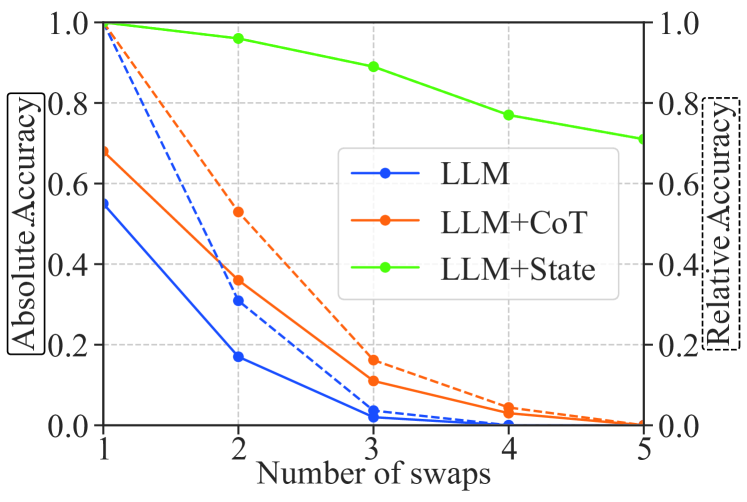
- Statler substantially outperforms CaP and CaP+CoT on pick-and-place, disinfection, and weight-reasoning tasks in simulation.
- Non-temporal queries are near-perfect for CaP, but temporal queries see CaP collapse; Statler maintains high performance on memory-based questions.
- In real-robot experiments, Statler achieves higher episode and step success rates than CaP, with LLM reasoning being a major source of failure (perception/manipulation also contribute).
- Ablations show that maintaining separate world-state reader and writer yields better performance than a unified model and that state maintenance is essential for episode completion.
- Statler demonstrates robustness across domains and promises scalability to longer-horizon planning tasks.
Read this paper
Open the full text in the Nubint reader and ask about any passage as you read.
Read this paper on NubintThis review was generated by AI from the original paper. Please check the paper before citing it.