
[Paper Review] STCrowd: A Multimodal Dataset for Pedestrian Perception in Crowded Scenes
This paper introduces STCrowd, a large-scale multimodal dataset with 219K 3D-annotated pedestrian instances in highly crowded scenes, featuring synchronized LiDAR point clouds and camera images. It proposes Density-aware Hierarchical Heatmap Aggregation (DHA), a novel method that enhances LiDAR-based pedestrian detection and tracking by leveraging spatial attention and multi-level heatmaps, achieving state-of-the-art performance on STCrowd and generalizing across backbones and tasks.
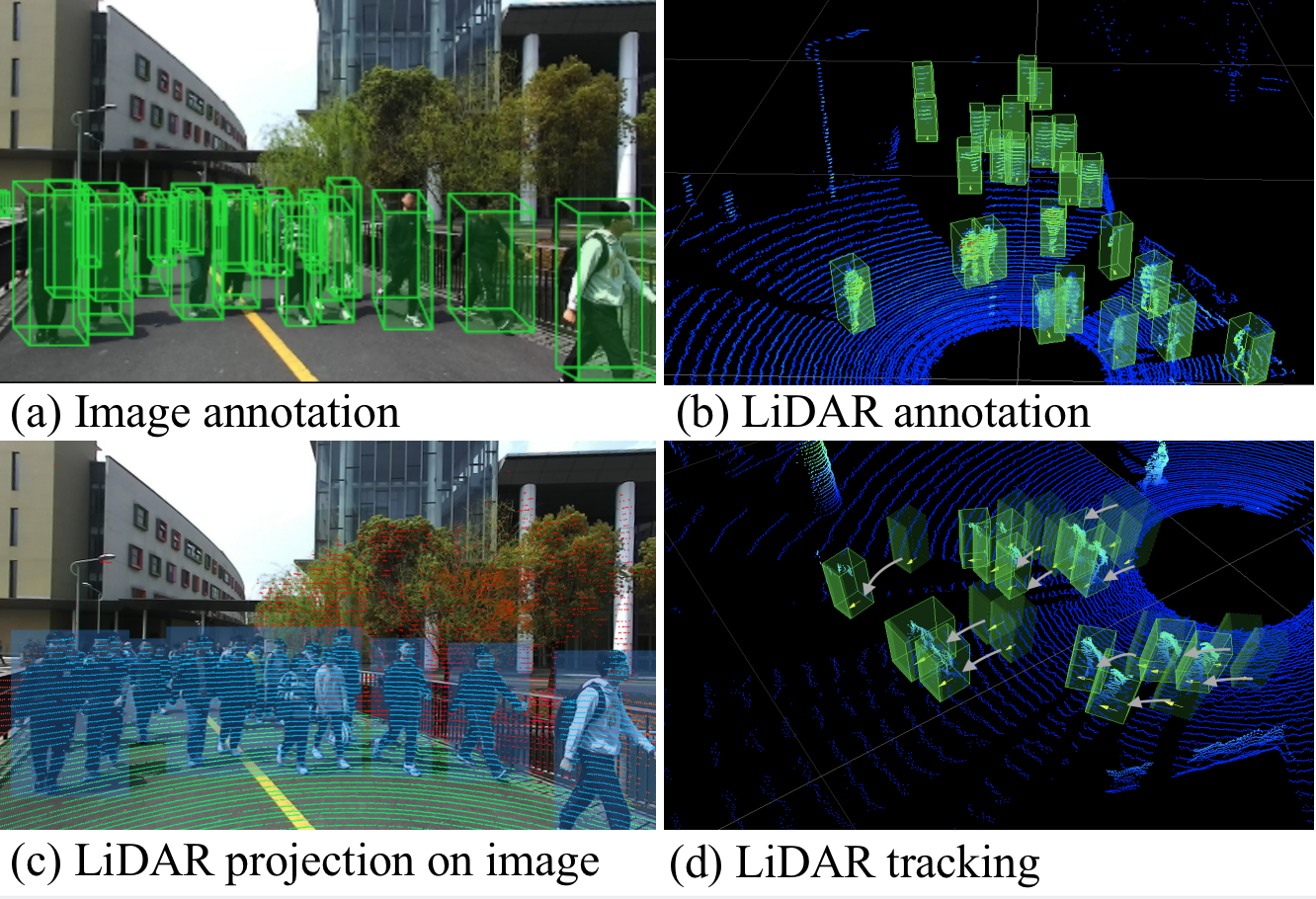
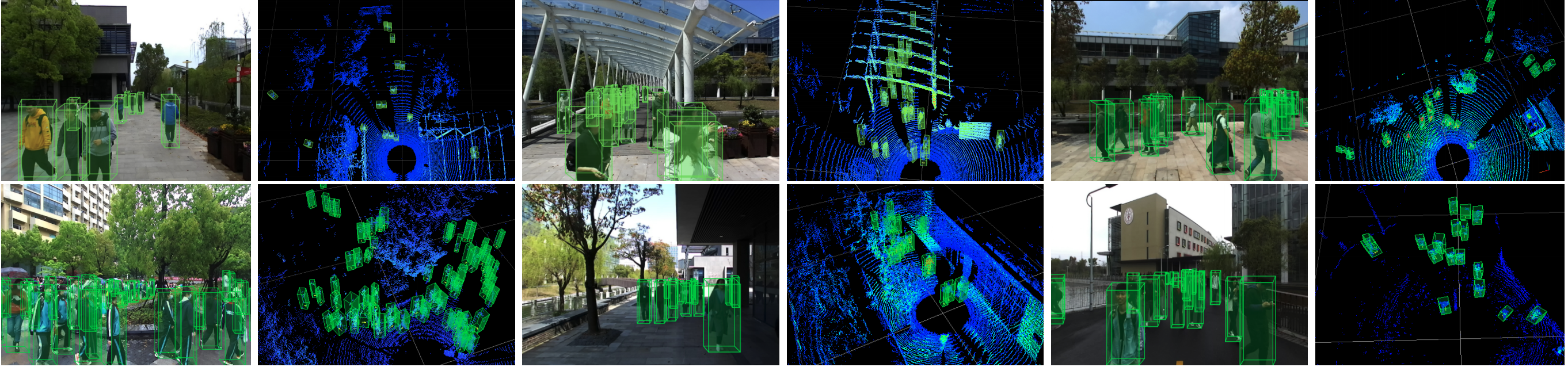
Accurately detecting and tracking pedestrians in 3D space is challenging due to large variations in rotations, poses and scales. The situation becomes even worse for dense crowds with severe occlusions. However, existing benchmarks either only provide 2D annotations, or have limited 3D annotations with low-density pedestrian distribution, making it difficult to build a reliable pedestrian perception system especially in crowded scenes. To better evaluate pedestrian perception algorithms in crowded scenarios, we introduce a large-scale multimodal dataset,STCrowd. Specifically, in STCrowd, there are a total of 219 K pedestrian instances and 20 persons per frame on average, with various levels of occlusion. We provide synchronized LiDAR point clouds and camera images as well as their corresponding 3D labels and joint IDs. STCrowd can be used for various tasks, including LiDAR-only, image-only, and sensor-fusion based pedestrian detection and tracking. We provide baselines for most of the tasks. In addition, considering the property of sparse global distribution and density-varying local distribution of pedestrians, we further propose a novel method, Density-aware Hierarchical heatmap Aggregation (DHA), to enhance pedestrian perception in crowded scenes. Extensive experiments show that our new method achieves state-of-the-art performance for pedestrian detection on various datasets.
Motivation & Objective
- To address the lack of large-scale, densely populated 3D pedestrian perception datasets with rich annotations for crowded scenes.
- To enable robust evaluation of pedestrian detection, tracking, and trajectory prediction in highly occluded, dense crowd environments.
- To develop a method that effectively handles the sparse global and density-varying local distribution of pedestrians in crowded scenes.
- To provide comprehensive baselines and metrics for LiDAR-only, image-only, and sensor-fusion-based perception tasks.
Proposed method
- Proposes Density-aware Hierarchical Heatmap Aggregation (DHA), a dual-module framework combining a Spatial Attention Module (SAM) and a Hierarchical Heatmap Aggregation (HH) module.
- Uses the Spatial Attention Module to focus network capacity on relevant foreground regions, improving attention to crowded and occluded areas.
- Employs Hierarchical Heatmap Aggregation to model pedestrian density variations across multiple spatial scales using multi-level feature maps.
- Integrates DHA into LiDAR-based detection backbones (e.g., Pillar-Center, Voxel-Center, PointAugmenting) for end-to-end training and inference.
- Adapts DHA for 3D tracking by incorporating velocity prediction head and evaluates performance on CenterPoint-based models.
- Extends the framework to trajectory prediction using standard models (LSTM, Social-LSTM, StarNet) on STCrowd data.
Experimental results
Research questions
- RQ1How can a multimodal dataset with dense 3D annotations improve the evaluation of pedestrian perception in highly crowded scenes?
- RQ2To what extent can a method designed for density-varying pedestrian distributions improve detection and tracking performance in occluded, crowded scenes?
- RQ3Can a learnable attention and hierarchical aggregation mechanism outperform standard detection backbones in dense crowd scenarios?
- RQ4How does the proposed DHA method generalize across different LiDAR-based detection and tracking architectures?
- RQ5What is the performance gain of multimodal fusion and DHA on trajectory prediction in complex crowd environments?
Key findings
- The proposed DHA method achieves a mean average precision (mAP) of 0.617 on the STCrowd validation set using a Pillar-Center backbone, outperforming the baseline by 5.6%.
- Ablation studies confirm that both the Spatial Attention Module and Hierarchical Heatmap components contribute significantly, with DHA improving mAP by 3.5% over baseline on Voxel-Center.
- In 3D tracking, DHA improves MOTA from 0.342 (Voxel-Center baseline) to 0.368, demonstrating strong generalization across tasks.
- The method achieves competitive performance even when using only LiDAR features, outperforming some sensor-fusion baselines, indicating its effectiveness in handling occlusions.
- On trajectory prediction, StarNet with STCrowd data achieves an FDE of 0.983 and MDE of 0.404, showing the dataset supports advanced modeling of crowd dynamics.
- The STCrowd dataset contains 219K pedestrian instances with an average of 20 persons per frame and up to 30+ in extreme crowds, significantly denser than nuScenes or KITTI.
Read this paper
Open the full text in the Nubint reader and ask about any passage as you read.
Read this paper on NubintThis review was generated by AI from the original paper. Please check the paper before citing it.