
[Paper Review] Steering Language Models With Activation Engineering
This paper introduces Activation Addition (ActAdd), a method to steer large language models at inference time by computing steering vectors from activation differences between prompt pairs, without optimization or labeled data. It enables natural language-controlled behavior modification—such as sentiment, topic, or style—while preserving model performance and scaling efficiently with model size.
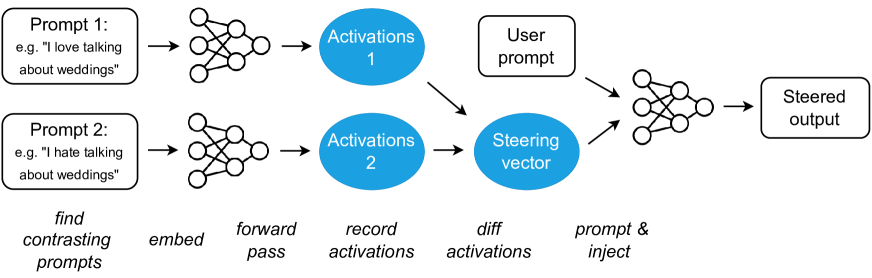
Prompt engineering and finetuning aim to maximize language model performance on a given metric (like toxicity reduction). However, these methods do not fully elicit a model's capabilities. To reduce this gap, we introduce activation engineering: the inference-time modification of activations in order to control (or steer) model outputs. Specifically, we introduce the Activation Addition (ActAdd) technique, which contrasts the intermediate activations on prompt pairs (such as "Love" versus "Hate") to compute a steering vector (Subramani et al. 2022). By tactically adding in e.g. the "Love" - "Hate" steering vector during the forward pass, we achieve SOTA on negative-to-positive sentiment shift and detoxification using models including LLaMA-3 and OPT. ActAdd yields inference-time control over high-level output properties (like topic and sentiment) while preserving performance on off-target tasks. ActAdd is lightweight: it does not require any machine optimization and works with a single pair of data points, which enables rapid iteration over steering. ActAdd demonstrates the power of activation engineering.
Motivation & Objective
- Address the challenge of reliably controlling large language models (LLMs) without computationally expensive fine-tuning or reinforcement learning.
- Enable user-friendly, natural language specification of desired model behaviors during inference.
- Develop a lightweight, scalable method for steering LLMs that avoids backward passes and labeled data.
- Preserve overall model performance while enabling targeted control over high-level output properties such as sentiment, topic, and style.
Proposed method
- Compute a steering vector as the difference between activations produced by two contrasting prompts (e.g., 'I love you' vs. 'I hate you').
- Apply the steering vector to the residual stream of the model during inference by adding it to activations at a specific layer.
- Scale the steering vector by a learnable coefficient to control the strength of the behavioral shift.
- Use only forward passes—no backward passes, fine-tuning, or labeled data are required to generate the steering vector.
- Apply the method at inference time on frozen LLMs, enabling real-time control without retraining.
- Select the layer and coefficient via ablation or heuristic search to maximize desired behavioral changes.
Experimental results
Research questions
- RQ1Can activation differences between natural language prompt pairs reliably generate effective steering vectors for inference-time control?
- RQ2Does ActAdd preserve the model's overall performance on out-of-distribution or non-targeted tasks?
- RQ3How does the method scale with model size and what is its computational overhead compared to fine-tuning or RLHF?
- RQ4Can ActAdd achieve monotonic or non-monotonic control over specific attributes like sentiment or topic, and what explains such behavior?
- RQ5Is the method robust across different models, such as GPT-2, Llama-13B, and GPT-J-6B, and does it generalize across diverse prompts?
Key findings
- ActAdd successfully steers GPT-2 on OpenWebText and ConceptNet to alter sentiment, topic, and style with minimal computational cost and no fine-tuning.
- The method preserves model performance on non-targeted tasks, demonstrating robustness and generalization.
- On GPT-2, ActAdd achieves significant control over output properties—e.g., shifting completions from 'hate' to 'love'—using only forward passes and no labeled data.
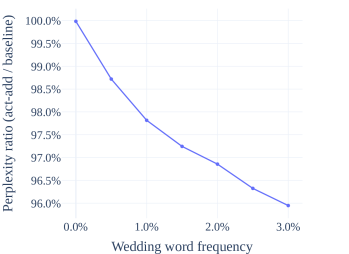
- Non-monotonic behavior was observed when modifying fractions of residual stream dimensions, suggesting complex feature representations and potential axis-alignment in activation space.
- The approach scales naturally with model size and is significantly easier to implement than other activation engineering methods requiring gradient-based optimization.
- Replication on Llama-13B shows similar success, though some prompts (e.g., Eiffel Tower fact) showed failed replication, indicating sensitivity to context and feature alignment.
Better researchstarts right now
From reading papers to final review, dramatically reduce your research time.
No credit card · Free plan available
This review was created by AI and reviewed by human editors.