
[Paper Review] Stochastic Approximation with Delayed Updates: Finite-Time Rates under Markovian Sampling
This paper provides the first finite-time convergence analysis of stochastic approximation (SA) with delayed updates under Markovian sampling, establishing exponential convergence to a noise ball around the fixed point. It introduces a novel inductive proof technique ensuring uniform boundedness of iterates, and proposes a delay-adaptive SA scheme that improves convergence by scaling the exponent with average delay τ_avg instead of maximum delay τ_max, enabling step-size tuning without prior knowledge of delays.
Motivated by applications in large-scale and multi-agent reinforcement learning, we study the non-asymptotic performance of stochastic approximation (SA) schemes with delayed updates under Markovian sampling. While the effect of delays has been extensively studied for optimization, the manner in which they interact with the underlying Markov process to shape the finite-time performance of SA remains poorly understood. In this context, our first main contribution is to show that under time-varying bounded delays, the delayed SA update rule guarantees exponentially fast convergence of the \emph{last iterate} to a ball around the SA operator's fixed point. Notably, our bound is \emph{tight} in its dependence on both the maximum delay $τ_{max}$, and the mixing time $τ_{mix}$. To achieve this tight bound, we develop a novel inductive proof technique that, unlike various existing delayed-optimization analyses, relies on establishing uniform boundedness of the iterates. As such, our proof may be of independent interest. Next, to mitigate the impact of the maximum delay on the convergence rate, we provide the first finite-time analysis of a delay-adaptive SA scheme under Markovian sampling. In particular, we show that the exponent of convergence of this scheme gets scaled down by $τ_{avg}$, as opposed to $τ_{max}$ for the vanilla delayed SA rule; here, $τ_{avg}$ denotes the average delay across all iterations. Moreover, the adaptive scheme requires no prior knowledge of the delay sequence for step-size tuning. Our theoretical findings shed light on the finite-time effects of delays for a broad class of algorithms, including TD learning, Q-learning, and stochastic gradient descent under Markovian sampling.
Motivation & Objective
- To address the lack of finite-time theoretical analysis for stochastic approximation (SA) with delayed updates under Markovian sampling, particularly in multi-agent and large-scale reinforcement learning settings.
- To close the gap between empirical success of delayed SA in asynchronous and multi-agent RL and the absence of theoretical justification under temporally correlated (Markovian) sampling.
- To develop a convergence analysis that accounts for both time-varying delays and the mixing time of the underlying Markov process.
- To propose and analyze a delay-adaptive SA scheme that improves convergence by depending on average delay τ_avg rather than maximum delay τ_max.
- To provide step-size tuning that does not require prior knowledge of the delay sequence, enhancing practical applicability.
Proposed method
- Develops a novel inductive proof technique that establishes uniform boundedness of iterates, enabling tight finite-time bounds under time-varying bounded delays.
- Analyzes the vanilla delayed SA update rule under Markovian sampling, deriving convergence rates that scale with max{τ_max, τ_mix}, where τ_mix is the mixing time of the Markov process.
- Introduces a delay-adaptive SA scheme that dynamically adjusts the update rule based on observed delays, reducing the dependence of convergence exponent on τ_max.
- Uses a recursive error bound analysis to show that the expected squared error decays exponentially with a rate dependent on τ_avg.
- Derives explicit step-size conditions under which the convergence rate is optimized, with the bound scaling as exp(−αμT/(4τ_avg + 4)) for T iterations.
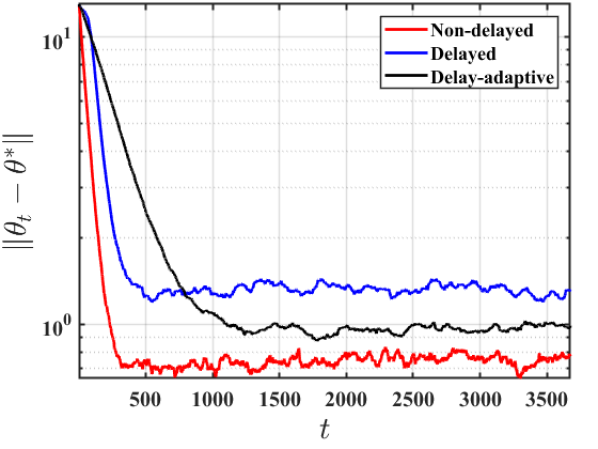
- Validates theoretical findings via simulations on TD(0) learning under Markovian sampling and random delays, comparing non-delayed, vanilla-delayed, and delay-adaptive algorithms.
Experimental results
Research questions
- RQ1How does the interplay between time-varying delays and the mixing time of a Markov process affect the finite-time convergence of stochastic approximation with delayed updates?
- RQ2Can a novel inductive proof technique that ensures uniform boundedness of iterates yield tighter convergence bounds than existing methods in the presence of delays and Markovian sampling?
- RQ3Does a delay-adaptive SA scheme exist that reduces convergence rate dependence on the maximum delay τ_max and instead scales with the average delay τ_avg?
- RQ4Can such a delay-adaptive scheme be designed without requiring prior knowledge of the delay sequence for step-size tuning?
- RQ5How do the theoretical convergence rates and noise ball sizes compare between vanilla delayed SA and the proposed delay-adaptive scheme in practice?
Key findings
- The vanilla delayed SA update rule achieves exponential convergence to a noise ball around the fixed point, with the convergence exponent scaled by max{τ_max, τ_mix}, where τ_mix is the mixing time of the underlying Markov process.
- The proposed inductive proof technique ensures uniform boundedness of iterates and yields a tight bound that is optimal in its dependence on both τ_max and τ_mix.
- For the delay-adaptive SA scheme, the convergence exponent scales with τ_avg instead of τ_max, significantly improving robustness to rare large delays.
- The delay-adaptive scheme achieves a smaller convergence noise ball compared to the vanilla delayed method under the same step size, due to reduced sensitivity to τ_max.
- The theoretical analysis is validated via simulations on TD(0) learning, showing that the delay-adaptive algorithm converges to a smaller noise ball than the vanilla delayed version, albeit with a slower rate, consistent with the theoretical trade-off.
- The delay-adaptive scheme allows for less conservative step-size selection, as it does not require tuning inversely proportional to τ_max, making it more practical for real-world applications.
Read this paper
Open the full text in the Nubint reader and ask about any passage as you read.
Read this paper on NubintThis review was generated by AI from the original paper. Please check the paper before citing it.