
[Paper Review] Stop Regressing: Training Value Functions via Classification for Scalable Deep RL
This paper proposes replacing mean squared error (MSE) regression with categorical cross-entropy classification for training value functions in deep reinforcement learning. By framing value prediction as a classification problem using histogram-based discretization (e.g., HL-Gauss), the method achieves substantial performance gains—up to 2.1× in multi-task Atari, 70% improvement in chess, and 67% in robotic manipulation—while improving robustness to noisy and non-stationary targets, enabling scalable training with large models like Transformers and MoEs.
Value functions are a central component of deep reinforcement learning (RL). These functions, parameterized by neural networks, are trained using a mean squared error regression objective to match bootstrapped target values. However, scaling value-based RL methods that use regression to large networks, such as high-capacity Transformers, has proven challenging. This difficulty is in stark contrast to supervised learning: by leveraging a cross-entropy classification loss, supervised methods have scaled reliably to massive networks. Observing this discrepancy, in this paper, we investigate whether the scalability of deep RL can also be improved simply by using classification in place of regression for training value functions. We demonstrate that value functions trained with categorical cross-entropy significantly improves performance and scalability in a variety of domains. These include: single-task RL on Atari 2600 games with SoftMoEs, multi-task RL on Atari with large-scale ResNets, robotic manipulation with Q-transformers, playing Chess without search, and a language-agent Wordle task with high-capacity Transformers, achieving state-of-the-art results on these domains. Through careful analysis, we show that the benefits of categorical cross-entropy primarily stem from its ability to mitigate issues inherent to value-based RL, such as noisy targets and non-stationarity. Overall, we argue that a simple shift to training value functions with categorical cross-entropy can yield substantial improvements in the scalability of deep RL at little-to-no cost.
Motivation & Objective
- Address the poor scalability of value-based deep RL methods when using mean-squared error (MSE) regression with large neural networks, such as Transformers and MoEs.
- Investigate whether reframing value function training as a classification problem—using categorical cross-entropy—can improve performance and scalability, mirroring successes in supervised learning.
- Demonstrate that classification-based training enables stable and effective learning in diverse RL domains, including single-task and multi-task Atari, robotic manipulation, chess, and language-agent tasks.
- Understand the underlying reasons for the observed performance gains by analyzing robustness to noisy targets, non-stationarity, and representation quality.
- Establish categorical cross-entropy as a simple, effective, and scalable alternative to MSE regression in value-based RL, suitable for integration into existing algorithms.
Proposed method
- Transform continuous value targets into discrete categorical bins using a histogram-based discretization method (e.g., HL-Gauss), enabling classification-based training.
- Train value networks using categorical cross-entropy loss instead of mean-squared error (MSE), allowing for more stable and expressive optimization.
- Apply the classification-based value function training to diverse architectures, including ResNets, Mixture-of-Experts (MoEs), and Transformers, across multiple RL benchmarks.
- Use target distribution smoothing and value distribution distillation techniques to stabilize learning, especially in offline and self-play settings.
- Perform ablation and diagnostic experiments, including linear probing, to compare representations learned under MSE vs. cross-entropy, and analyze optimization dynamics.
- Implement the method across multiple environments: Atari (single- and multi-task), robotic manipulation (Q-Transformer), chess (self-play without search), and a language-agent Wordle task with high-capacity Transformers.
Experimental results
Research questions
- RQ1Can replacing mean-squared error regression with categorical cross-entropy classification significantly improve the scalability and performance of value-based deep RL with large models?
- RQ2What are the key mechanisms by which cross-entropy loss improves training stability and performance in value-based RL, particularly under noisy or non-stationary targets?
- RQ3How does the representation quality of value networks trained with cross-entropy compare to those trained with MSE, especially in high-capacity architectures?
- RQ4Does the use of classification-based value training enable better generalization and sample efficiency in complex, high-dimensional control and decision-making tasks?
- RQ5To what extent do the benefits of cross-entropy transfer across different architectures (e.g., ResNets, MoEs, Transformers) and RL paradigms (online, offline, self-play)?
Key findings
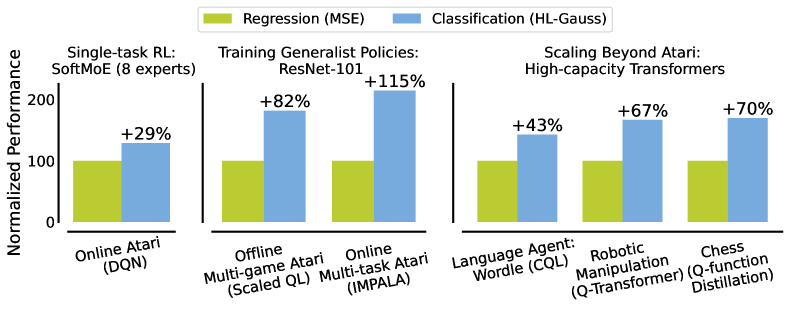
- Using categorical cross-entropy with HL-Gauss discretization leads to a 30% performance improvement when scaling Mixture-of-Experts (MoEs) in single-task Atari RL.
- In multi-task Atari RL with ResNet-101, the method achieves 1.8–2.1× higher performance compared to MSE regression, demonstrating strong scalability with large models.
- For playing chess without search using a 270M-parameter Transformer, the cross-entropy method achieves a 70% improvement in performance gap relative to the teacher Stockfish engine.
- In a high-capacity Transformer-based language-agent task (Wordle), the method achieves state-of-the-art results with a 40% performance gain over MSE-based training.
- Robotic manipulation tasks using Q-Transformers show a 67% improvement in performance when training value functions with cross-entropy instead of MSE.
- Diagnostic analysis reveals that cross-entropy loss improves robustness to noisy and non-stationary targets and enables better use of network capacity, leading to more expressive representations as shown by linear probing.

Read this paper
Open the full text in the Nubint reader and ask about any passage as you read.
Read this paper on NubintThis review was generated by AI from the original paper. Please check the paper before citing it.