
[Paper Review] Stop Words for Processing Software Engineering Documents: Do they Matter?
This study investigates the impact of stop word removal in software engineering (SE) text processing, demonstrating that domain-specific stop lists—generated from a 10,000-question Stack Overflow corpus using TF-IDF and Poisson-based methods—significantly outperform general stop lists. The SE-specific lists improved performance on 17 out of 19 evaluation metrics across three replicated SE tools, proving that context-aware stop word selection enhances NLP effectiveness in software engineering contexts.
Stop words, which are considered non-predictive, are often eliminated in natural language processing tasks. However, the definition of uninformative vocabulary is vague, so most algorithms use general knowledge-based stop lists to remove stop words. There is an ongoing debate among academics about the usefulness of stop word elimination, especially in domain-specific settings. In this work, we investigate the usefulness of stop word removal in a software engineering context. To do this, we replicate and experiment with three software engineering research tools from related work. Additionally, we construct a corpus of software engineering domain-related text from 10,000 Stack Overflow questions and identify 200 domain-specific stop words using traditional information-theoretic methods. Our results show that the use of domain-specific stop words significantly improved the performance of research tools compared to the use of a general stop list and that 17 out of 19 evaluation measures showed better performance. Online appendix: https://zenodo.org/record/7865748
Motivation & Objective
- To evaluate whether removing stop words from general stop lists improves the performance of existing software engineering (SE) research tools.
- To investigate whether stop word lists derived from SE-specific corpora can enhance downstream SE NLP tasks compared to general or non-SE domain lists.
- To identify and validate domain-specific stop words in software engineering using information-theoretic methods on a large SE corpus.
- To provide evidence that blind use of standard stop lists may harm model performance, and that context-aware stop word selection is critical in SE text processing.
Proposed method
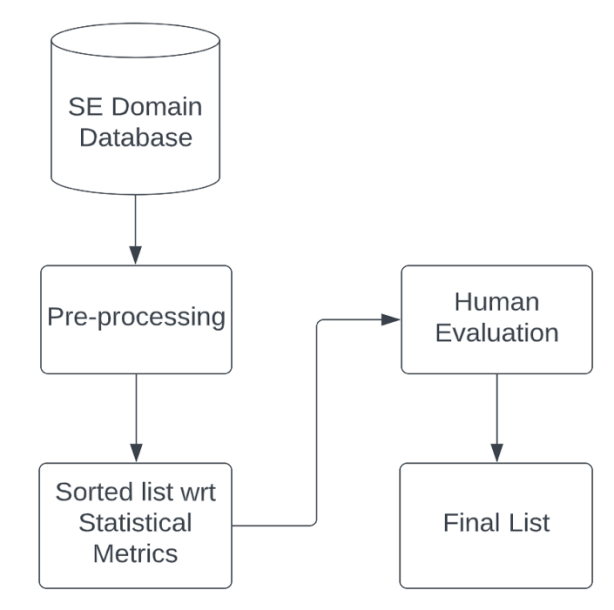
- Replicated three existing SE research tools using the same data and evaluation metrics to assess the impact of stop word removal.
- Constructed a domain-specific corpus of 10,000 Stack Overflow questions to extract SE-relevant stop words.
- Applied two information-theoretic methods—TF-IDF and Poisson distribution—to identify stop words from the SE corpus.
- Generated multiple stop lists: general (NLTK), technology domain, and SE domain-specific (via TF-IDF and Poisson).
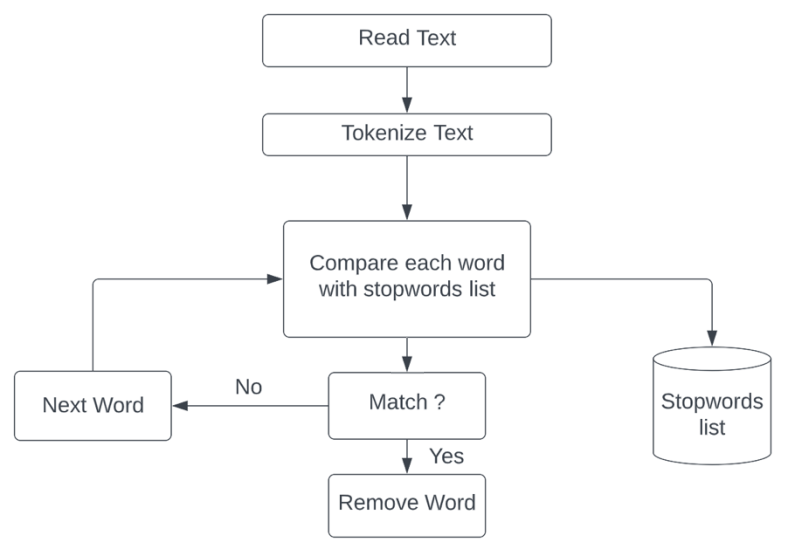
- Pre-processed the same text data using each stop list and measured performance changes across 19 evaluation metrics.
- Conducted comparative analysis across all stop lists to assess relative performance on downstream NLP tasks.
Experimental results
Research questions
- RQ1RQ1: Does removing stop words from general stop lists improve the performance of previously published software engineering research tools?
- RQ2RQ2: Can stop lists generated from the software engineering domain positively affect downstream tasks in their domain?
- RQ3RQ3: How do SE domain-specific stop word lists compare to general or non-SE domain stop lists in terms of performance impact?
- RQ4RQ4: What is the optimal size and method for generating stop word lists in the SE domain?
Key findings
- The SE domain-specific stop list generated using TF-IDF improved performance on 17 out of 19 evaluation metrics, significantly outperforming general stop lists.
- The TF-IDF-based SE stop list achieved an AUC of 0.602 on Query 5, compared to the original model’s 0.561, indicating a measurable performance gain.
- General stop lists, including the widely used NLTK list, had mixed effects—improving some metrics but degrading others, such as reducing recall in one tool.
- The small general stop list (174 words) performed better than larger ones, suggesting that list size matters and larger lists may include irrelevant terms.
- Stop word lists derived from non-SE corpora (e.g., technology domain) performed worse than general lists, indicating that even related domains may not be suitable for SE text.
- The study found that removing stop words without domain context can harm model performance, underscoring the need for context-aware stop word selection in SE NLP tasks.
Read this paper
Open the full text in the Nubint reader and ask about any passage as you read.
Read this paper on NubintThis review was generated by AI from the original paper. Please check the paper before citing it.