
[Paper Review] Strategic Reasoning with Language Models
The paper shows that pretrained language models can perform flexible strategic reasoning in matrix and negotiation games by using systematically generated prompts that structure search, value assignment, and belief tracking, enabling generalization to new games and objectives with few-shot demonstrations.
Strategic reasoning enables agents to cooperate, communicate, and compete with other agents in diverse situations. Existing approaches to solving strategic games rely on extensive training, yielding strategies that do not generalize to new scenarios or games without retraining. Large Language Models (LLMs), with their ability to comprehend and generate complex, context-rich language, could prove powerful as tools for strategic gameplay. This paper introduces an approach that uses pretrained LLMs with few-shot chain-of-thought examples to enable strategic reasoning for AI agents. Our approach uses systematically generated demonstrations of reasoning about states, values, and beliefs to prompt the model. Using extensive variations of simple matrix games, we show that strategies that are derived based on systematically generated prompts generalize almost perfectly to new game structures, alternate objectives, and hidden information. Additionally, we demonstrate our approach can lead to human-like negotiation strategies in realistic scenarios without any extra training or fine-tuning. Our results highlight the ability of LLMs, guided by systematic reasoning demonstrations, to adapt and excel in diverse strategic scenarios.
Motivation & Objective
- Motivate and address the generalization gap of AI agents in new strategic scenarios.
- Propose a prompt-based method to endow LLMs with strategic planning capabilities.
- Enable generalization to novel game structures, objectives, and partial information through few-shot demonstrations.
- Demonstrate human-like negotiation behavior without retraining in realistic scenarios.
Proposed method
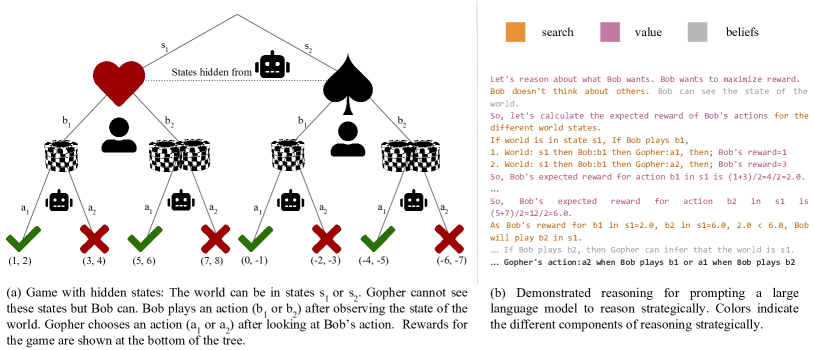
- Develop an automated prompt compiler that generates demonstrations of strategic reasoning (search, value assignment, belief tracking).
- Use in-context demonstrations to bias LLMs through chain-of-thought reasoning prompts before action selection.
- In matrix games, vary rewards, players, observability, and turns to test generalization.
- In negotiation games, annotate human demonstrations to guide the model in reasoning about values and beliefs.
- Incorporate tools (search and calculate) to manage large decision spaces and complex reasoning within context limits.
- Evaluate with multiple LLMs (code-davinci-002 and several text models) against baselines and ablations.
Experimental results
Research questions
- RQ1Can LLMs generalize strategic reasoning to new game structures and objectives using systematically generated prompts?
- RQ2Does factoring reasoning into search, value assignment, and belief tracking improve reliability over vanilla prompting?
- RQ3Can LLMs negotiate with humans in realistic settings without additional training and exhibit human-like behavior?
- RQ4How do partial observability and varying information impact the model’s strategic reasoning and belief formation?
Key findings
- Prompts that structure search, value assignment, and belief tracking enable generalization to new payoffs and game structures.
- Factored reasoning leads to near-perfect generalization to new game structures and partial information, outperforming baseline prompts and ablations.
- The approach supports negotiating behavior that is closer to human-like in realism and quality without retraining.
- LLMs can adapt to new objectives (e.g., maximizing welfare or a custom daxity metric) in a zero-shot manner with demonstrations.
- Iterated reasoning improves negotiation fairness metrics, outperforming models without belief formation in Deal or No Deal scenarios.

Read this paper
Open the full text in the Nubint reader and ask about any passage as you read.
Read this paper on NubintThis review was generated by AI from the original paper. Please check the paper before citing it.