
[Paper Review] Stream-K: Work-centric Parallel Decomposition for Dense Matrix-Matrix Multiplication on the GPU
Stream-K introduces a work-centric parallel decomposition for dense matrix-matrix multiplication (GEMM) on GPUs, distributing MAC-loop iterations evenly across streaming multiprocessors (SMs) rather than tiling output matrices. This achieves near-100% processor utilization across diverse problem shapes, delivering up to 14× peak speedup and 6.7× average performance gain over cuBLAS and CUTLASS, with a single kernel per precision instead of complex kernel ensembles.
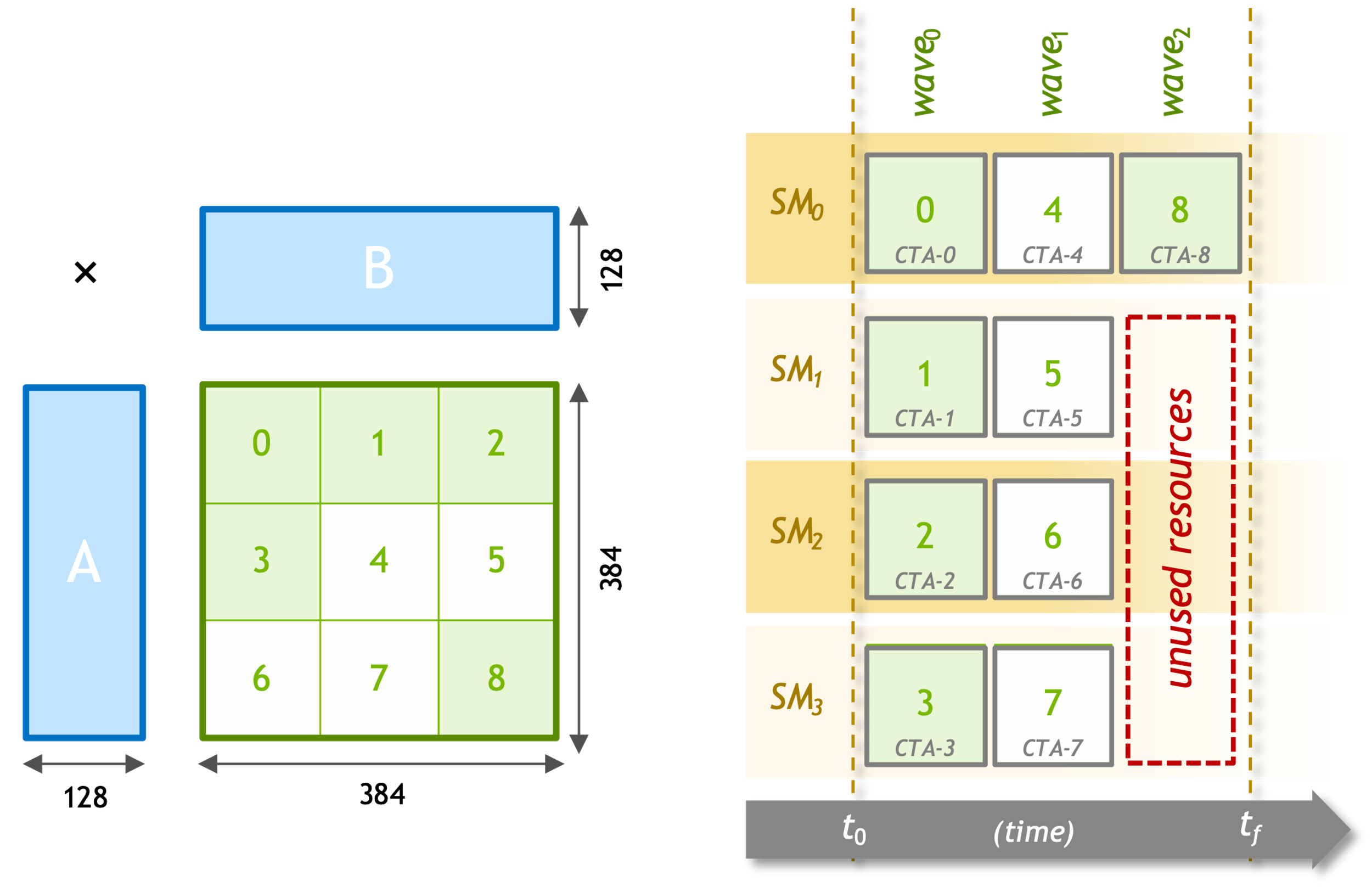
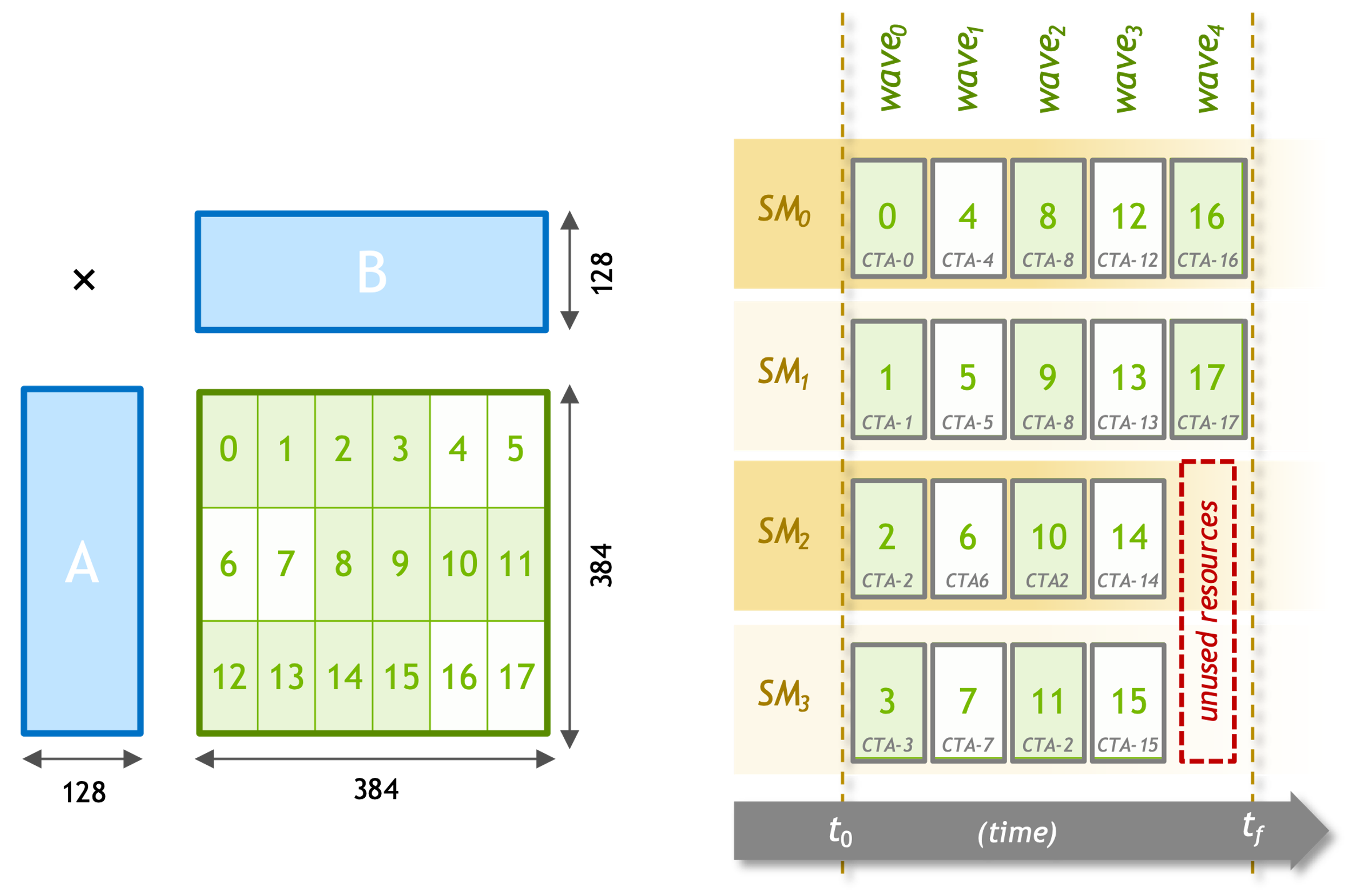
We introduce Stream-K, a work-centric parallelization of matrix multiplication (GEMM) and related computations in dense linear algebra. Whereas contemporary decompositions are primarily tile-based, our method operates by partitioning an even share of the aggregate inner loop iterations among physical processing elements. This provides a near-perfect utilization of computing resources, regardless of how efficiently the output tiling for any given problem quantizes across the underlying processing elements. On GPU processors, our Stream-K parallelization of GEMM produces a peak speedup of up to 14$ imes$ and 6.7$ imes$, and an average performance response that is both higher and more consistent across 32,824 GEMM problem geometries than state-of-the-art math libraries such as CUTLASS and cuBLAS. Furthermore, we achieve this performance from a single tile size configuration per floating-point precision, whereas today's math libraries employ complex kernel-selection heuristics to select from a large ensemble of kernel variants.
Motivation & Objective
- To address the performance degradation caused by quantization inefficiency in tile-based GEMM workloads on wide GPUs.
- To eliminate the need for complex kernel-selection heuristics in math libraries by enabling consistent, high-performance execution across diverse problem shapes.
- To achieve near-100% processor utilization regardless of problem size or shape by redefining workload quantization at the MAC-loop level.
- To reduce library bloat and maintenance complexity by replacing large kernel ensembles with a single, highly portable kernel per precision.
Proposed method
- Stream-K partitions the total number of multiply-accumulate (MAC) loop iterations evenly among GPU streaming multiprocessors (SMs), ensuring balanced workload distribution.
- It uses the MAC-loop iteration as the atomic unit of workload quantization, which has a constant and minimal cost compared to entire output tiles.
- The method dynamically creates O(p) splitting seams—where p is the number of SMs—scaling workload distribution with processor width rather than problem size.
- It employs a single, fixed blocking factor per floating-point precision, avoiding the need for multiple kernel variants or complex selection heuristics.
- The approach minimizes communication and synchronization overheads, which scale with the number of SMs rather than the problem size.
- It is implemented within CUTLASS 2.11 and supports FP64, FP16→FP32, and other precision formats with consistent performance.
Experimental results
Research questions
- RQ1Can a work-centric decomposition that quantizes at the MAC-loop level achieve higher and more consistent performance than tile-based GEMM on modern GPUs?
- RQ2To what extent can a single kernel per precision replace large kernel ensembles in math libraries like cuBLAS without sacrificing performance?
- RQ3How does Stream-K’s workload balancing compare to tile-based methods in terms of quantization efficiency across diverse problem geometries?
- RQ4What is the performance impact of eliminating kernel-selection heuristics in favor of a unified, work-centric decomposition?
Key findings
- Stream-K achieves up to 14× peak speedup and 6.7× average performance improvement over cuBLAS across 32,824 GEMM problem geometries.
- For FP64, Stream-K delivers 6% higher throughput than cuBLAS, and for FP16→FP32, it achieves 13% higher throughput.
- Stream-K's performance spread is narrower than both cuBLAS and an idealized CUTLASS oracle, indicating superior consistency and utilization.
- In compute-bound regimes (FP64 with >150 ops/byte, FP16→FP32 with >400 ops/byte), Stream-K consistently outperforms cuBLAS ensembles.
- Stream-K reduces distribution size by up to 20× compared to cuBLAS, achieving peak performance with a single kernel per precision instead of hundreds of specialized kernels.
- The method achieves near-100% processor utilization regardless of problem shape, eliminating the 75–90% theoretical ceiling seen in tile-based methods due to quantization inefficiency.
Read this paper
Open the full text in the Nubint reader and ask about any passage as you read.
Read this paper on NubintThis review was generated by AI from the original paper. Please check the paper before citing it.