
[Paper Review] Structural Neural Additive Models: Enhanced Interpretable Machine Learning
This paper proposes Structural Neural Additive Models (SNAMs), a novel interpretable deep learning framework that combines the predictive power of deep neural networks with the interpretability of generalized additive models by using sparse, spline-based activation layers. SNAMs achieve state-of-the-art performance comparable to fully connected DNNs while enabling direct interpretation of model parameters, uncertainty quantification via Bayesian confidence intervals, and efficient computation through Silverman kernel-based neural splines with learnable knots.
Deep neural networks (DNNs) have shown exceptional performances in a wide range of tasks and have become the go-to method for problems requiring high-level predictive power. There has been extensive research on how DNNs arrive at their decisions, however, the inherently uninterpretable networks remain up to this day mostly unobservable "black boxes". In recent years, the field has seen a push towards interpretable neural networks, such as the visually interpretable Neural Additive Models (NAMs). We propose a further step into the direction of intelligibility beyond the mere visualization of feature effects and propose Structural Neural Additive Models (SNAMs). A modeling framework that combines classical and clearly interpretable statistical methods with the predictive power of neural applications. Our experiments validate the predictive performances of SNAMs. The proposed framework performs comparable to state-of-the-art fully connected DNNs and we show that SNAMs can even outperform NAMs while remaining inherently more interpretable.
Motivation & Objective
- To address the interpretability limitations of deep neural networks (DNNs) in high-stakes domains like healthcare and finance.
- To overcome the parameter inefficiency and lack of uncertainty quantification in existing interpretable models like Neural Additive Models (NAMs).
- To develop a framework that enables not only visualization of feature effects but also direct interpretation of model parameters and confidence intervals.
- To achieve high predictive performance with extreme parameter sparsity through spline-based activation layers and learnable knots.
- To enable native handling of spatial and structured data through 2D generalization of spline-based layers.
Proposed method
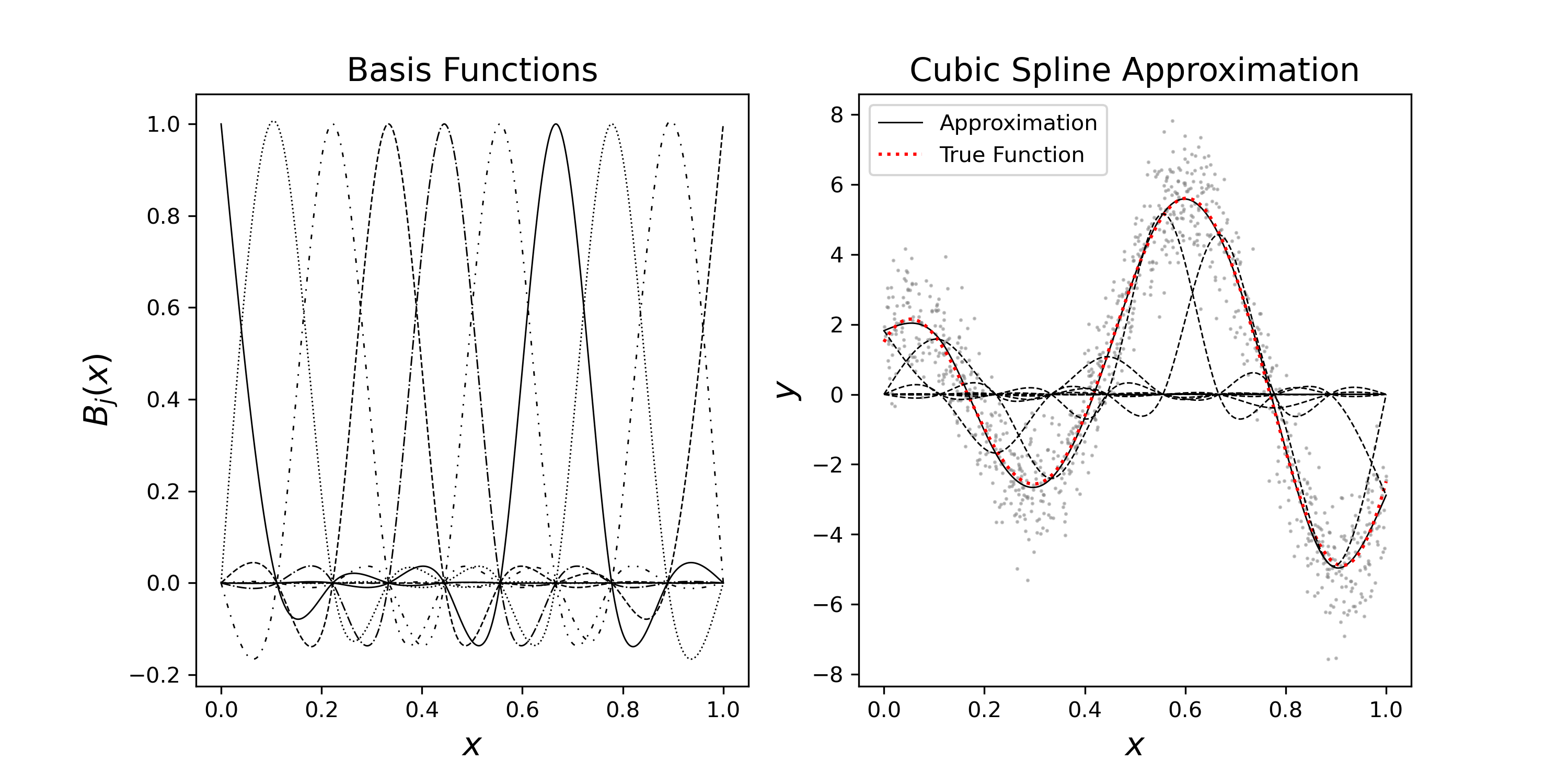
- Integrate cubic regression splines into neural networks as activation layers using basis expansion with knots, enabling flexible, low-parameter modeling of nonlinear feature effects.
- Propose a computationally efficient approximation of splines using the Silverman kernel to reduce training cost while preserving accuracy.
- Introduce learnable knots in the spline layers to adaptively capture complex, non-linear functional relationships without increasing parameter count.
- Use Bayesian inference to estimate model parameters and compute confidence intervals, enabling uncertainty quantification and enhanced interpretability beyond visualization.
- Construct a neural network architecture where each input feature is processed by a dedicated, sparse sub-network with shared spline-based activation functions.
- Enable generalization to higher-dimensional inputs (e.g., spatial data) by extending the spline layer to 2D, as demonstrated on the California Housing dataset.
Experimental results
Research questions
- RQ1Can a neural network architecture be designed to maintain high predictive performance while enabling direct interpretation of individual model parameters and uncertainty estimates?
- RQ2How can spline-based activation layers be made computationally efficient and scalable for deep learning without sacrificing modeling flexibility?
- RQ3To what extent can learnable knots in neural splines improve model expressivity while preserving parameter sparsity and interpretability?
- RQ4Can the proposed framework outperform existing interpretable models like NAMs in both predictive accuracy and interpretability?
- RQ5How well does the model generalize to structured and spatial data, such as geographical coordinates in housing price prediction?
Key findings
- SNAMs achieve predictive performance comparable to state-of-the-art fully connected deep neural networks across multiple benchmark datasets, including California Housing, FICO, and Insurance.
- SNAMs outperform NAMs in predictive performance while using significantly fewer parameters, demonstrating improved efficiency and generalization.
- The model enables full interpretability beyond visualization, including direct interpretation of learned parameters and construction of Bayesian confidence bands for uncertainty quantification.
- The use of Silverman kernel-based neural splines reduces computational cost while maintaining high accuracy, enabling fast training and inference.
- On the California Housing dataset, SNAMs show a substantial performance gain, attributed to their ability to jointly model spatial coordinates as a structured effect.
- The 2D generalization of spline layers allows native processing of spatial data, producing interpretable geographical heatmaps that highlight regions with positive or negative effects on house prices.

Better researchstarts right now
From reading papers to final review, dramatically reduce your research time.
No credit card · Free plan available
This review was created by AI and reviewed by human editors.