
[Paper Review] Structure-Preserving Deraining with Residue Channel Prior Guidance
This paper proposes SPDNet, a structure-preserving deraining network that leverages residue channel prior (RCP) guidance to reconstruct high-quality rain-free images with accurate structural details. By integrating a wavelet-based multi-level module, an interactive fusion module, and an iterative RCP refinement strategy, SPDNet achieves state-of-the-art performance on both synthetic and real-world deraining benchmarks without relying on rain-generating assumptions.
Single image deraining is important for many high-level computer vision tasks since the rain streaks can severely degrade the visibility of images, thereby affecting the recognition and analysis of the image. Recently, many CNN-based methods have been proposed for rain removal. Although these methods can remove part of the rain streaks, it is difficult for them to adapt to real-world scenarios and restore high-quality rain-free images with clear and accurate structures. To solve this problem, we propose a Structure-Preserving Deraining Network (SPDNet) with RCP guidance. SPDNet directly generates high-quality rain-free images with clear and accurate structures under the guidance of RCP but does not rely on any rain-generating assumptions. Specifically, we found that the RCP of images contains more accurate structural information than rainy images. Therefore, we introduced it to our deraining network to protect structure information of the rain-free image. Meanwhile, a Wavelet-based Multi-Level Module (WMLM) is proposed as the backbone for learning the background information of rainy images and an Interactive Fusion Module (IFM) is designed to make full use of RCP information. In addition, an iterative guidance strategy is proposed to gradually improve the accuracy of RCP, refining the result in a progressive path. Extensive experimental results on both synthetic and real-world datasets demonstrate that the proposed model achieves new state-of-the-art results. Code: https://github.com/Joyies/SPDNet
Motivation & Objective
- Address the challenge of preserving structural details in single-image deraining, especially in complex real-world scenarios where existing CNN-based methods often fail to recover accurate object structures.
- Overcome the limitations of prior CNN-based deraining methods that focus on predicting and removing rain streaks, which can lead to over- or under-removal and structural degradation.
- Explore and exploit a novel image prior—residue channel prior (RCP)—that retains clear structural information even in rainy images, enabling better structure preservation during deraining.
- Develop a progressive, iterative guidance mechanism that refines RCP estimates during reconstruction to enhance image quality step-by-step.
- Demonstrate the practical benefit of deraining via improved performance in downstream vision tasks such as object detection and recognition.
Proposed method
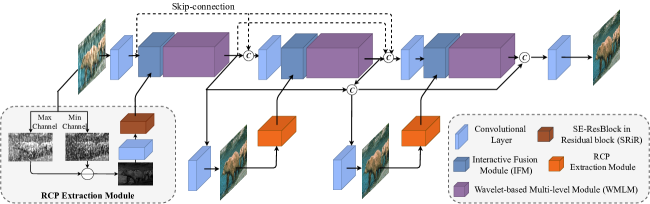
- Propose a Wavelet-based Multi-Level Module (WMLM) as the backbone to learn multi-scale background features from rainy images, enhancing representation of structural content.
- Design an RCP extraction module that computes the difference between the maximum and minimum channel values across RGB components, producing a prior that preserves structural edges even in rainy images.
- Introduce an Interactive Fusion Module (IFM) that dynamically fuses features from the WMLM and RCP to guide the network in reconstructing structurally accurate rain-free images.
- Implement an iterative guidance strategy where the RCP is re-estimated from intermediate deraining results, progressively refining the prior and improving reconstruction quality.
- Train the end-to-end SPDNet model using a combination of L1 and perceptual losses to ensure both pixel-level fidelity and structural consistency.
- Leverage the observation that RCP quality improves with image quality, enabling the iterative refinement loop to enhance both RCP and final output.
Experimental results
Research questions
- RQ1Can residue channel prior (RCP) serve as a reliable structural prior for deraining, even when extracted from rainy images?
- RQ2How does RCP-guided learning compare to conventional rain-streak prediction and removal in preserving object structures?
- RQ3Does an iterative refinement strategy that updates RCP based on intermediate results improve deraining performance and structural accuracy?
- RQ4To what extent does RCP guidance enhance downstream vision tasks such as object detection and recognition in rainy conditions?
- RQ5Can a wavelet-based multi-level feature extractor effectively capture structural details in rainy images without relying on explicit rain layer modeling?
Key findings
- SPDNet achieves state-of-the-art performance on both synthetic (DID-Enhance, SIDD) and real-world (Real-World Deraining Benchmark) deraining datasets, outperforming prior methods in PSNR, SSIM, and LPIPS metrics.
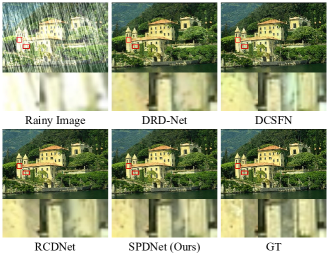
- The ablation study confirms that RCP guidance significantly improves structural fidelity, with visual results showing clearer and more accurate object boundaries compared to baselines.
- The iterative guidance strategy leads to a measurable performance gain: using RCP from intermediate outputs improves results over using only the original rainy image’s RCP, demonstrating the value of progressive refinement.
- On the COCO350 dataset, SPDNet’s deraining results achieve a mAP-50 of 0.692, significantly higher than DRDNet (0.551), DCSFN (0.652), RCDNet (0.658), and other SOTA methods, indicating enhanced detection performance.
- Google Vision API evaluation shows that SPDNet reduces the confidence of rain detection from 30 real-world rainy images to 0.18 on average, significantly lower than other methods, indicating more effective rain removal.
- Visual comparisons and qualitative results confirm that SPDNet reconstructs images with sharper edges, clearer textures, and more coherent structures, especially in complex scenes with dense rain streaks.
Read this paper
Open the full text in the Nubint reader and ask about any passage as you read.
Read this paper on NubintThis review was generated by AI from the original paper. Please check the paper before citing it.