
[Paper Review] Studying continuous, time-varying, and/or complex exposures using longitudinal modified treatment policies
The paper introduces longitudinal modified treatment policies (LMTPs), a unified causal-inference framework for complex, time-varying, or continuous exposures, with estimation strategies and a COVID-19 intubation timing case study using the lmtp R package.
This tutorial discusses methodology for causal inference using longitudinal modified treatment policies. This method facilitates the mathematical formalization, identification, and estimation of many novel parameters, and mathematically generalizes many commonly used parameters, such as the average treatment effect. Longitudinal modified treatment policies apply to a wide variety of exposures, including binary, multivariate, and continuous, and can accommodate time-varying treatments and confounders, competing risks, loss-to-follow-up, as well as survival, binary, or continuous outcomes. Longitudinal modified treatment policies can be seen as an extension of static and dynamic interventions to involve the natural value of treatment, and, like dynamic interventions, can be used to define alternative estimands with a positivity assumption that is more likely to be satisfied than estimands corresponding to static interventions. This tutorial aims to illustrate several practical uses of the longitudinal modified treatment policy methodology, including describing different estimation strategies and their corresponding advantages and disadvantages. We provide numerous examples of types of research questions which can be answered using longitudinal modified treatment policies. We go into more depth with one of these examples--specifically, estimating the effect of delaying intubation on critically ill COVID-19 patients' mortality. We demonstrate the use of the open-source R package lmtp to estimate the effects, and we provide code on https://github.com/kathoffman/lmtp-tutorial.
Motivation & Objective
- Motivate the need for causal questions involving continuous and time-varying exposures beyond static interventions.
- Present LMTPs as a general framework that encompasses static, dynamic, stochastic, and modified interventions.
- Explain identification via the generalized g-formula and discuss positivity and sequential randomization assumptions.
- Show practical estimation strategies (parametric g-computation, IPW, TMLE, SDR) including machine-learning possibilities.
- Provide a case study estimating the effect of delaying intubation on mortality in hospitalized COVID-19 patients, with reproducible code.
Proposed method
- Define longitudinal modified treatment policies (LMTPs) and how they extend static/dynamic interventions by allowing policy functions to depend on the natural value of treatment.
- Classify intervention functions d_t into static, dynamic, stochastic, and modified within LMTPs.
- State identification via the generalized g-formula under positivity and sequential randomization assumptions.
- Describe estimation approaches: parametric g-computation, inverse probability weighting (IPW), and non-parametric, machine-learning–based methods (TMLE, SDR, iTMLE).
- Discuss software implementation using the open-source R package lmtp and provide replication code and synthetic data.
Experimental results
Research questions
- RQ1What causal estimands can be defined and identified under LMTPs for time-varying and complex exposures?
- RQ2How can LMTPs address positivity violations and informative censoring in longitudinal settings?
- RQ3What are the properties and trade-offs of estimation strategies (g-computation, IPW, TMLE, SDR) within LMTPs?
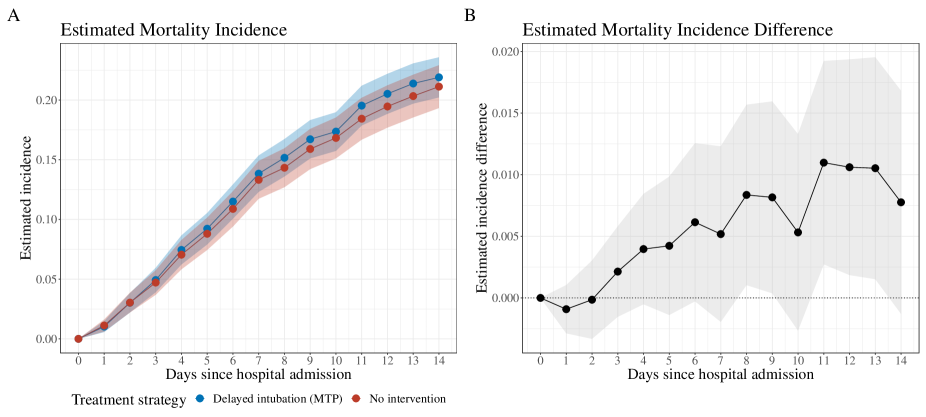
- RQ4How does delaying intubation in COVID-19 patients affect 14-day mortality under LMTP assumptions?
Key findings
- LMTPs provide a unified way to define, identify, and estimate causal effects for a wide range of exposures and outcomes, including time-varying, continuous, and multi-exposure settings.
- Positivity issues can be mitigated by designing interventions within observed support, with discussion of structural vs practical violations.
- Non-parametric estimators (TMLE, SDR, iTMLE) allow flexible modeling with valid uncertainty and double robustness properties; they can leverage machine learning.
- In the COVID-19 case study, 14-day mortality under no intervention was 0.211 (95% CI 0.193–0.229) and under a one-day delayed intubation LMTP was 0.219 (95% CI 0.202–0.236).
Read this paper
Open the full text in the Nubint reader and ask about any passage as you read.
Read this paper on NubintThis review was generated by AI from the original paper. Please check the paper before citing it.