
[Paper Review] StyleDiffusion: Controllable Disentangled Style Transfer via Diffusion Models
This paper proposes StyleDiffusion, a novel diffusion-based framework for controllable and disentangled style transfer that explicitly extracts content while implicitly learning complementary style. By leveraging CLIP-based loss and diffusion models for style removal and generation, it achieves state-of-the-art stylization quality with interpretable, user-controllable disentanglement of content and style.
Content and style (C-S) disentanglement is a fundamental problem and critical challenge of style transfer. Existing approaches based on explicit definitions (e.g., Gram matrix) or implicit learning (e.g., GANs) are neither interpretable nor easy to control, resulting in entangled representations and less satisfying results. In this paper, we propose a new C-S disentangled framework for style transfer without using previous assumptions. The key insight is to explicitly extract the content information and implicitly learn the complementary style information, yielding interpretable and controllable C-S disentanglement and style transfer. A simple yet effective CLIP-based style disentanglement loss coordinated with a style reconstruction prior is introduced to disentangle C-S in the CLIP image space. By further leveraging the powerful style removal and generative ability of diffusion models, our framework achieves superior results than state of the art and flexible C-S disentanglement and trade-off control. Our work provides new insights into the C-S disentanglement in style transfer and demonstrates the potential of diffusion models for learning well-disentangled C-S characteristics.
Motivation & Objective
- To address the limitations of existing style transfer methods that rely on implicit or hard-to-control definitions of style, such as Gram matrices or GAN-based learning.
- To achieve truly disentangled content and style representations without relying on supervised signals or predefined style assumptions.
- To enable interpretable and flexible control over style transfer by transforming disentanglement into content extraction control.
- To leverage the generative power of diffusion models to improve style transfer fidelity and detail preservation.
- To provide a new paradigm for disentangled representation learning in image generation using diffusion models.
Proposed method
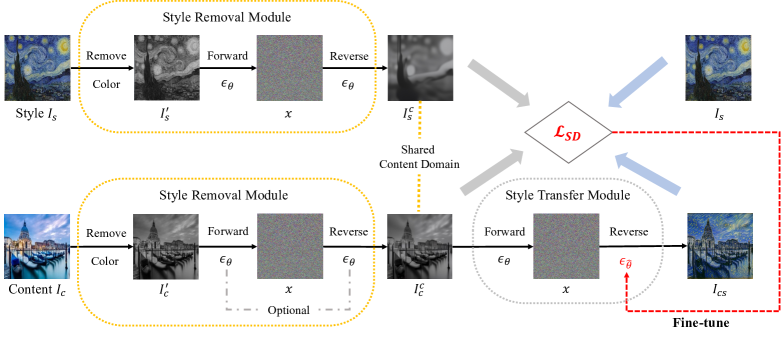
- Explicitly extract content features using a diffusion-based style removal module, which applies a color-removal operation to isolate content from both content and style images.
- Implicitly learn complementary style information through a diffusion-based style transfer module that generates stylized outputs.
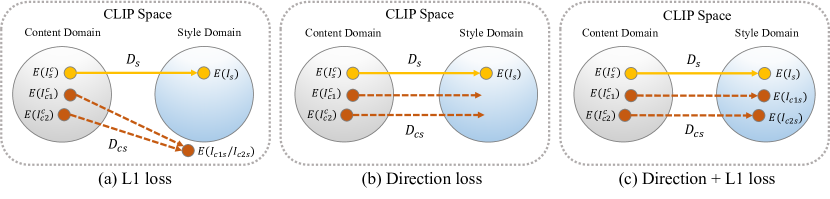
- Introduce a CLIP-based style disentanglement loss that aligns the image space mapping of content-to-stylized output for both content and style images in CLIP embedding space.
- Incorporate a style reconstruction prior to ensure faithful style transfer by encouraging the model to reconstruct the original style image during training.
- Use a two-stage training process: first, train the style removal and transfer modules with the CLIP loss and reconstruction prior; second, fine-tune the full pipeline for improved stylization.
- Leverage the strong generative capability of diffusion models to produce high-quality, detailed stylized images while preserving content structure.
Experimental results
Research questions
- RQ1Can we achieve more interpretable and controllable content and style disentanglement in style transfer without relying on explicit style definitions like Gram matrices?
- RQ2Can diffusion models be effectively used to disentangle content and style by removing style from images while preserving content?
- RQ3Can a CLIP-based loss function effectively guide disentangled style transfer by aligning content-to-stylized mappings in CLIP space?
- RQ4How does the proposed method compare to state-of-the-art methods in terms of stylization quality, content preservation, and disentanglement fidelity?
- RQ5What are the failure modes of the method, and how can they be mitigated through architectural or training modifications?
Key findings
- StyleDiffusion achieves state-of-the-art performance in style transfer, outperforming methods like Gatys [19], EFDM [95], TPFR [79], and ArtFlow [1] in qualitative comparisons.
- The method produces highly detailed stylizations with well-preserved content structures, as shown in zoomed-in comparisons across multiple datasets.
- The CLIP-based disentanglement loss significantly improves alignment between content and stylized outputs in CLIP embedding space, leading to more coherent and faithful style transfer.
- The style reconstruction prior enhances the faithfulness of transferred style, reducing deviations from the original style image's color and texture distribution.
- Failure cases include vanishing salient content (e.g., red carps) due to color-removal operations, which can be mitigated by using contrast-preserving decolorization techniques.
- Biased color distribution in stylized outputs can occur, especially with complex styles like pointillism, and can be reduced by increasing style reconstruction iterations at the cost of longer training time.
Read this paper
Open the full text in the Nubint reader and ask about any passage as you read.
Read this paper on NubintThis review was generated by AI from the original paper. Please check the paper before citing it.