
[Paper Review] StyleDrop: Text-to-Image Generation in Any Style
StyleDrop enables learning and generating images in a user-specified style by fine-tuning a text-to-image transformer with adapters using as few as one reference image, plus iterative feedback to improve style fidelity and content-style disentanglement.
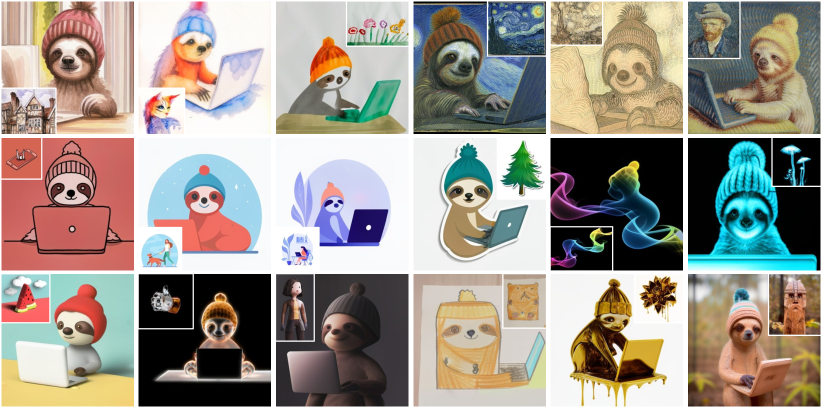
Pre-trained large text-to-image models synthesize impressive images with an appropriate use of text prompts. However, ambiguities inherent in natural language and out-of-distribution effects make it hard to synthesize image styles, that leverage a specific design pattern, texture or material. In this paper, we introduce StyleDrop, a method that enables the synthesis of images that faithfully follow a specific style using a text-to-image model. The proposed method is extremely versatile and captures nuances and details of a user-provided style, such as color schemes, shading, design patterns, and local and global effects. It efficiently learns a new style by fine-tuning very few trainable parameters (less than $1\%$ of total model parameters) and improving the quality via iterative training with either human or automated feedback. Better yet, StyleDrop is able to deliver impressive results even when the user supplies only a single image that specifies the desired style. An extensive study shows that, for the task of style tuning text-to-image models, StyleDrop implemented on Muse convincingly outperforms other methods, including DreamBooth and textual inversion on Imagen or Stable Diffusion. More results are available at our project website: https://styledrop.github.io
Motivation & Objective
- Motivate and enable faithful stylization in text-to-image generation beyond broad or vague prompts.
- Demonstrate that a very small fine-tuning footprint can capture complex style nuances from minimal data.
- Propose an iterative training framework with feedback to reduce overfitting and content leakage.
- Show compositional capabilities to combine style with content and to mix multiple adapters for style and content personalization.
Proposed method
- Use Muse as the base text-to-image transformer with masked visual token modeling.
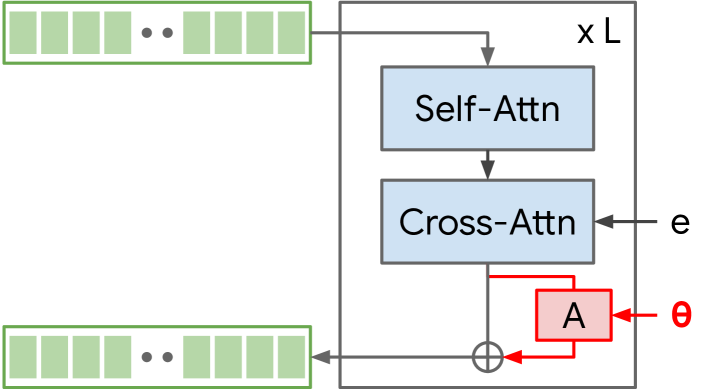
- Apply parameter-efficient fine-tuning via adapters to learn style-specific parameters while keeping base model fixed.
- Construct style prompts by combining content descriptions with explicit style descriptors to promote content-style disentanglement.
- Introduce iterative training with feedback (CLIP-based or human) to select high-quality synthesized images for re-training.
- Enable sampling from two adapters (style and content) to mix style with separate subject representations.
- Provide a sampling equation that blends distributions from style- and content-adapted generators for composite outputs.
Experimental results
Research questions
- RQ1Can StyleDrop capture and transfer arbitrary visual styles from very few reference images?
- RQ2Does adapter-based fine-tuning outperform full fine-tuning or diffusion-based baselines for style transfer in T2I models?
- RQ3How does iterative feedback (CLIP or human) affect style fidelity and content disentanglement?
- RQ4Can StyleDrop enable compositional generation with separate style and content adapters for flexible personalization?
Key findings
- StyleDrop achieves high style fidelity and content-style disentanglement using as few as one reference image.
- Compared to DreamBooth and textual inversion on Imagen or Stable Diffusion, StyleDrop on Muse shows superior style consistency and competitive or better textual alignment according to CLIP and human studies.
- Iterative training with feedback (HF or CF) improves recall (text fidelity) with some trade-offs in style fidelity due to synthetic data drift.
- Descriptive style prompts enable fine-grained style editing and property-level control beyond rare-token approaches.
- Sampling from two adapters allows images that combine a subject in a chosen style without joint optimization of content and style.
Read this paper
Open the full text in the Nubint reader and ask about any passage as you read.
Read this paper on NubintThis review was generated by AI from the original paper. Please check the paper before citing it.