
[Paper Review] StyleRF: Zero-shot 3D Style Transfer of Neural Radiance Fields
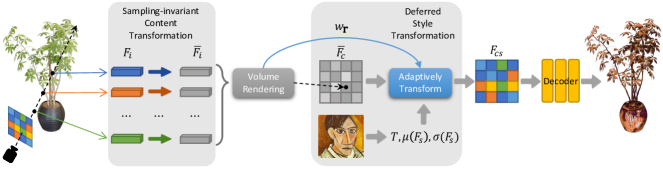
StyleRF proposes a zero-shot 3D style transfer method that performs high-fidelity stylization by transforming features within a neural radiance field's explicit 3D feature grid. It achieves multi-view consistency and high-quality stylization through sampling-invariant content transformation and deferred style transformation on 2D feature maps, enabling generalization to arbitrary unseen styles with superior geometry and visual quality compared to prior methods.
3D style transfer aims to render stylized novel views of a 3D scene with multi-view consistency. However, most existing work suffers from a three-way dilemma over accurate geometry reconstruction, high-quality stylization, and being generalizable to arbitrary new styles. We propose StyleRF (Style Radiance Fields), an innovative 3D style transfer technique that resolves the three-way dilemma by performing style transformation within the feature space of a radiance field. StyleRF employs an explicit grid of high-level features to represent 3D scenes, with which high-fidelity geometry can be reliably restored via volume rendering. In addition, it transforms the grid features according to the reference style which directly leads to high-quality zero-shot style transfer. StyleRF consists of two innovative designs. The first is sampling-invariant content transformation that makes the transformation invariant to the holistic statistics of the sampled 3D points and accordingly ensures multi-view consistency. The second is deferred style transformation of 2D feature maps which is equivalent to the transformation of 3D points but greatly reduces memory footprint without degrading multi-view consistency. Extensive experiments show that StyleRF achieves superior 3D stylization quality with precise geometry reconstruction and it can generalize to various new styles in a zero-shot manner.
Motivation & Objective
- To resolve the three-way dilemma in 3D style transfer: accurate geometry reconstruction, high-quality stylization, and generalization to arbitrary new styles.
- To enable zero-shot 3D style transfer that generalizes to unseen reference styles without retraining.
- To maintain multi-view consistency during stylization while reducing memory and computational costs.
- To achieve high-fidelity 3D geometry reconstruction through explicit volume rendering of a 3D feature grid.
Proposed method
- Represents a 3D scene using an explicit grid of high-level deep features, enabling precise geometry reconstruction via volume rendering.
- Performs style transfer directly in the feature space of the radiance field, improving stylization expressiveness over implicit parameter injection.
- Introduces sampling-invariant content transformation (SICT) using volume-adaptive normalization and channel-wise self-attention to decouple style from batch statistics.
- Defers style transformation to 2D volume-rendered feature maps via matrix multiplication and adaptive bias addition, reducing memory usage while preserving multi-view consistency.
- Uses adaptive bias addition modulated by ray weights to capture global style attributes like color tone.
- Trains directly on $256 \times 256$ patches without sub-sampling, enabling efficient and high-resolution stylization.
Experimental results
Research questions
- RQ1Can 3D style transfer achieve high-fidelity geometry reconstruction while maintaining multi-view consistency during zero-shot stylization?
- RQ2How can style transfer be made invariant to the holistic statistics of sampled 3D point batches to preserve consistency across views?
- RQ3Can deferred style transformation on 2D feature maps achieve equivalent stylization to 3D point transformation while significantly reducing memory and computation?
- RQ4Can the proposed method generalize to arbitrary, unseen reference styles without fine-tuning or pre-training?
- RQ5How does feature-space style transfer in a 3D radiance field compare to implicit parameter-based or optimization-based approaches in terms of quality and efficiency?
Key findings
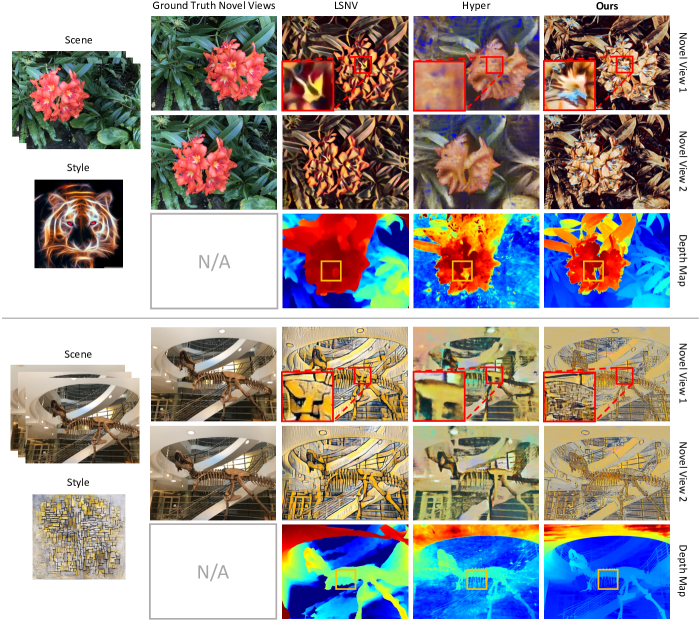
- StyleRF achieves superior 3D stylization quality with precise geometry reconstruction, outperforming existing zero-shot 3D style transfer methods in both quantitative and qualitative evaluations.
- The proposed sampling-invariant content transformation (SICT) eliminates blocky artifacts caused by batch-dependent normalization, significantly improving multi-view consistency.
- Deferred style transformation (DST) reduces memory usage and enables training on full $256 \times 256$ patches without sub-sampling, improving efficiency and resolution.
- Adaptive bias addition in DST enhances stylization quality by preserving global style attributes such as color tone, leading to more natural and accurate style transfer.
- StyleRF enables smooth multi-style interpolation by interpolating scene feature maps, producing harmonious and visually coherent transitions between arbitrary styles.
- The method supports compositional 3D style transfer by applying different styles to segmented regions of a 3D scene using 3D-consistent masks, enabling infinite artistic combinations without retraining.
Read this paper
Open the full text in the Nubint reader and ask about any passage as you read.
Read this paper on NubintThis review was generated by AI from the original paper. Please check the paper before citing it.