
[Paper Review] Sum-Rate Maximization of Uplink Rate Splitting Multiple Access (RSMA) Communication
This paper proposes a sum-rate maximization framework for uplink rate splitting multiple access (RSMA) by jointly optimizing user power allocation and base station decoding order. By transforming the non-convex problem into a rate splitting variable-only optimization, the authors derive closed-form solutions for optimal rate splitting and power allocation, then determine the optimal decoding order via exhaustive search. Simulation results show RSMA achieves up to 83.7% sum-rate gain over TDMA, 22.2% over FDMA, and 10.0% over NOMA.
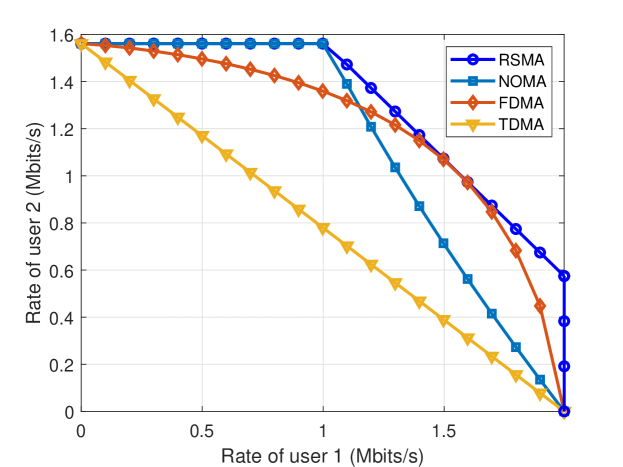
In this paper, the problem of maximizing the wireless users' sum-rate for uplink rate splitting multiple access (RSMA) communications is studied. In the considered model, each user transmits a superposition of two messages to a base station (BS) with separate transmit power and the BS uses a successive decoding technique to decode the received messages. To maximize each user's transmission rate, the users must adjust their transmit power and the BS must determine the decoding order of the messages transmitted from the users to the BS. This problem is formulated as a sum-rate maximization problem with proportional rate constraints by adjusting the users' transmit power and the BS's decoding order. However, since the decoding order variable in the optimization problem is discrete, the original maximization problem with transmit power and decoding order variables can be transformed into a problem with only the rate splitting variable. Then, the optimal rate splitting of each user is determined. Given the optimal rate splitting of each user and a decoding order, the optimal transmit power of each user is calculated. Next, the optimal decoding order is determined by an exhaustive search method. To further reduce the complexity of the optimization algorithm used for sum-rate maximization in RSMA, a user pairing based algorithm is introduced, which enables two users to use RSMA in each pair and also enables the users in different pairs to be allocated with orthogonal frequency. For comparisons, the optimal sum-rate maximizing solutions with proportional rate constraints are obtained in closed form for non-orthogonal multiple access (NOMA), frequency division multiple access (FDMA), and time division multiple access (TDMA). Simulation results show that RSMA can achieve up to 10.0\%, 22.2\%, and 83.7\% gains in terms of sum-rate compared to NOMA, FDMA, and TDMA.
Motivation & Objective
- Address the lack of joint optimization of power allocation and decoding order in uplink RSMA, which is critical for spectral efficiency and user fairness.
- Formulate the sum-rate maximization problem under proportional rate constraints, incorporating discrete decoding order and continuous power variables.
- Transform the original non-convex, mixed-integer problem into an equivalent problem with only rate splitting variables to enable closed-form solutions.
- Derive optimal rate splitting and transmit power allocation for each user under a given decoding order, then determine the globally optimal decoding order via exhaustive search.
- Propose a user-pairing-based algorithm to reduce computational complexity while maintaining high sum-rate performance.
Proposed method
- Formulate the uplink RSMA sum-rate maximization problem with proportional rate constraints, involving user transmit power and base station decoding order as optimization variables.
- Transform the original problem into an equivalent one with only rate splitting variables by eliminating power and decoding order variables through analytical derivation.
- Derive the optimal rate splitting factor for each user in closed form using the Karush-Kuhn-Tucker (KKT) conditions and power constraints.
- For a fixed decoding order, compute the optimal transmit power allocation using the derived rate splitting factors and signal-to-interference-plus-noise ratio (SINR) expressions.
- Determine the globally optimal decoding order via exhaustive search over all possible permutations of user message decoding order.
- Introduce a user-pairing-based algorithm to reduce complexity by enabling RSMA within pairs and orthogonal frequency allocation across pairs.
Experimental results
Research questions
- RQ1How can the sum-rate of uplink RSMA be maximized under proportional rate constraints when both transmit power and decoding order are optimized?
- RQ2What is the optimal rate splitting strategy for each user that maximizes sum-rate under power and decoding order constraints?
- RQ3How does the choice of decoding order impact the achievable sum-rate in uplink RSMA, and what is the globally optimal order?
- RQ4What is the performance gain of RSMA over conventional multiple access schemes (NOMA, FDMA, TDMA) in terms of sum-rate?
- RQ5Can a user-pairing-based algorithm achieve near-optimal sum-rate with reduced computational complexity?
Key findings
- The proposed RSMA framework achieves up to 10.0% higher sum-rate compared to non-orthogonal multiple access (NOMA) under the same power and rate constraints.
- RSMA outperforms frequency division multiple access (FDMA) by up to 22.2% in sum-rate gain, demonstrating superior spectral efficiency.
- The sum-rate gain of RSMA over time division multiple access (TDMA) reaches as high as 83.7%, highlighting its superiority in supporting massive connectivity and high spectral efficiency.
- The optimal rate splitting factor for each user is derived in closed form, enabling efficient computation of power allocation under any given decoding order.
- The exhaustive search-based decoding order selection achieves the global sum-rate optimum, and the user-pairing algorithm significantly reduces complexity while preserving high performance.
- Closed-form optimal solutions are derived for benchmark schemes (NOMA, FDMA, TDMA), enabling direct comparison and validation of RSMA’s superiority.
Read this paper
Open the full text in the Nubint reader and ask about any passage as you read.
Read this paper on NubintThis review was generated by AI from the original paper. Please check the paper before citing it.