
[Paper Review] Super-Trajectory for Video Segmentation
This paper proposes Super-Trajectory (STV), a semi-supervised video segmentation method that groups compact, motion-consistent trajectories into spatiotemporally coherent super-trajectories using a modified density peaks clustering algorithm. By modeling long-term motion and leveraging reverse tracking and object re-occurrence, STV achieves state-of-the-art performance with a 0.736 mean IoU on the DAVIS dataset, outperforming prior methods in handling occlusions, deformations, and appearance variations.
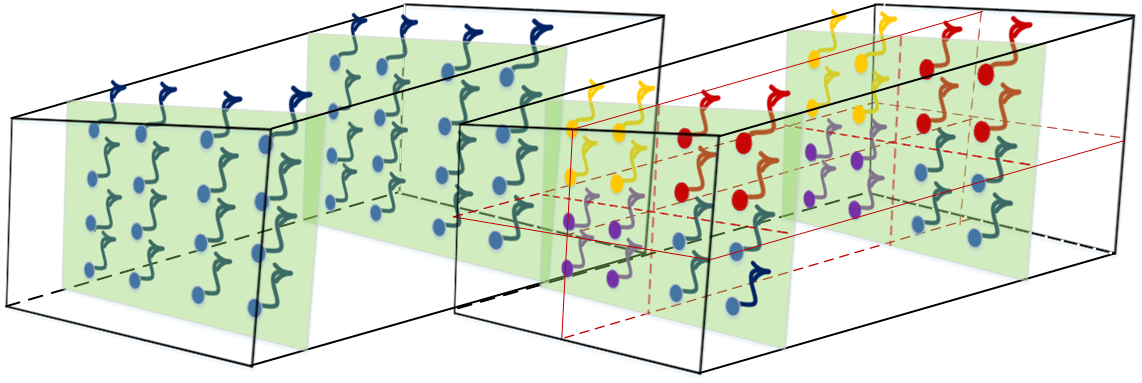
We introduce a novel semi-supervised video segmentation approach based on an efficient video representation, called as "super-trajectory". Each super-trajectory corresponds to a group of compact trajectories that exhibit consistent motion patterns, similar appearance and close spatiotemporal relationships. We generate trajectories using a probabilistic model, which handles occlusions and drifts in a robust and natural way. To reliably group trajectories, we adopt a modified version of the density peaks based clustering algorithm that allows capturing rich spatiotemporal relations among trajectories in the clustering process. The presented video representation is discriminative enough to accurately propagate the initial annotations in the first frame onto the remaining video frames. Extensive experimental analysis on challenging benchmarks demonstrate our method is capable of distinguishing the target objects from complex backgrounds and even reidentifying them after long-term occlusions.
Motivation & Objective
- To address the challenge of accurate video object segmentation under complex conditions such as occlusions, motion blur, and appearance variations.
- To develop a robust video representation that captures long-term motion, spatial proximity, and appearance consistency across frames.
- To improve label propagation in semi-supervised video segmentation by grouping trajectories into higher-level spatiotemporal units.
- To reduce sensitivity to drift and occlusion through a probabilistic trajectory generation model and reverse tracking strategy.
- To outperform existing state-of-the-art methods on benchmark datasets like DAVIS and SegTrack-V2.
Proposed method
- Trajectories are generated using a Markovian probabilistic model that naturally handles occlusions and drifts by modeling position transitions over time.
- A modified density peaks clustering (DPC) algorithm groups trajectories based on local density and distance, enabling robust and intuitive super-trajectory formation.
- Super-trajectories are defined as groups of trajectories with consistent motion, similar appearance, and close spatiotemporal proximity.
- Reverse tracking is applied to exclude points originating outside the frame, reducing camera motion interference.
- Object re-occurrence patterns are exploited to reidentify targets after occlusions, enhancing long-term tracking robustness.
- Segmentation is performed at the super-trajectory level, propagating initial annotations from the first frame using spatiotemporal consistency.
Experimental results
Research questions
- RQ1Can a trajectory-based video representation that groups motion-consistent, spatially proximate points improve segmentation robustness under occlusion and deformation?
- RQ2How does a modified density peaks clustering algorithm compare to classical clustering methods in forming meaningful super-trajectories for video segmentation?
- RQ3To what extent can probabilistic trajectory modeling reduce drift and improve robustness in long-term video segmentation?
- RQ4How effective is reverse tracking and re-occurrence analysis in recovering segmented objects after complete occlusions?
- RQ5Does segmentation at the super-trajectory level outperform pixel-level or patch-level propagation in complex video sequences?
Key findings
- The proposed STV method achieves a mean Intersection-over-Union (IoU) score of 0.736 on the DAVIS 2016 benchmark, outperforming all compared state-of-the-art methods.
- On the SegTrack-V2 dataset, STV achieves an IoU of 0.781, significantly outperforming the second-best method (JOT at 0.718).
- Abllation studies show that the proposed trajectory generation method yields a 0.736 IoU, surpassing LTM (0.718) and DAD (0.654), proving its superiority.
- Parameter analysis shows optimal performance at K=1200 spatial grids and N=8 nearest neighbors, with performance plateauing beyond these values.
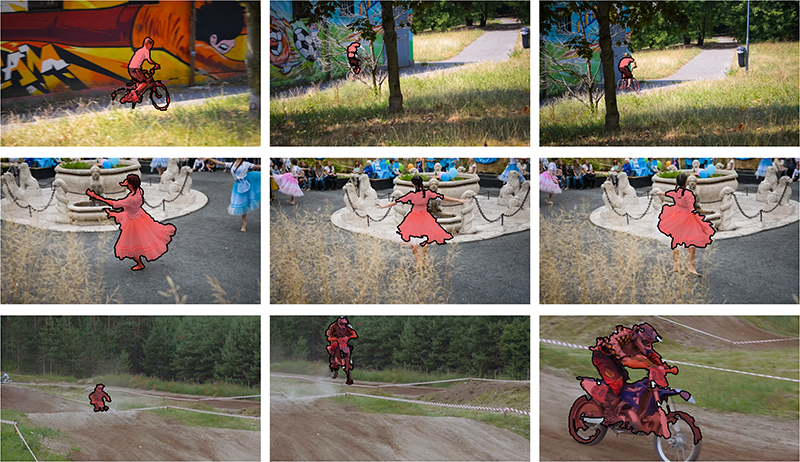
- Qualitative results demonstrate accurate segmentation even in challenging scenarios, including fast motion (e.g., breakdance-flare), large deformations (dog-agility), and long occlusions (libby).
- The method effectively reidentifies objects after occlusions by leveraging spatiotemporal re-occurrence patterns, enhancing long-term tracking stability.
Read this paper
Open the full text in the Nubint reader and ask about any passage as you read.
Read this paper on NubintThis review was generated by AI from the original paper. Please check the paper before citing it.