
[Paper Review] Supermind Ideator: Exploring generative AI to support creative problem-solving
The paper presents Supermind Ideator, an LLM-based tool that uses specialized prompts, fine-tuning, and a structured UI to augment human creative problem-solving with design-move sequences for exploring problem and solution spaces. It includes a formative evaluation with professionals and discusses future extensions.
Previous efforts to support creative problem-solving have included (a) techniques (such as brainstorming and design thinking) to stimulate creative ideas, and (b) software tools to record and share these ideas. Now, generative AI technologies can suggest new ideas that might never have occurred to the users, and users can then select from these ideas or use them to stimulate even more ideas. Here, we describe such a system, Supermind Ideator. The system uses a large language model (GPT 3.5) and adds prompting, fine tuning, and a user interface specifically designed to help people use creative problem-solving techniques. Some of these techniques can be applied to any problem; others are specifically intended to help generate innovative ideas about how to design groups of people and/or computers ("superminds"). We also describe our early experiences with using this system and suggest ways it could be extended to support additional techniques for other specific problem-solving domains.
Motivation & Objective
- Motivate the need for improved creative problem-solving tools that scale beyond traditional methods.
- Demonstrate how generative AI can augment human ideation without replacing human judgment.
- Show how a specialized front end and a design-move taxonomy can structure ideation workflows.
- Illustrate architectural and methodological details for integrating prompts, fine-tuning, and UI with an LLM to support collective intelligence design.
Proposed method
- Use a large language model (GPT-3.5) with specialized prompts and fine-tuning to generate creative ideas.
- Adopt the Supermind Design methodology, including moves like Zoom In/Zoom Out/Analogize and Groupify/Cognify/Technify, plus experimental moves Reflect, Reformulate, and Case examples.
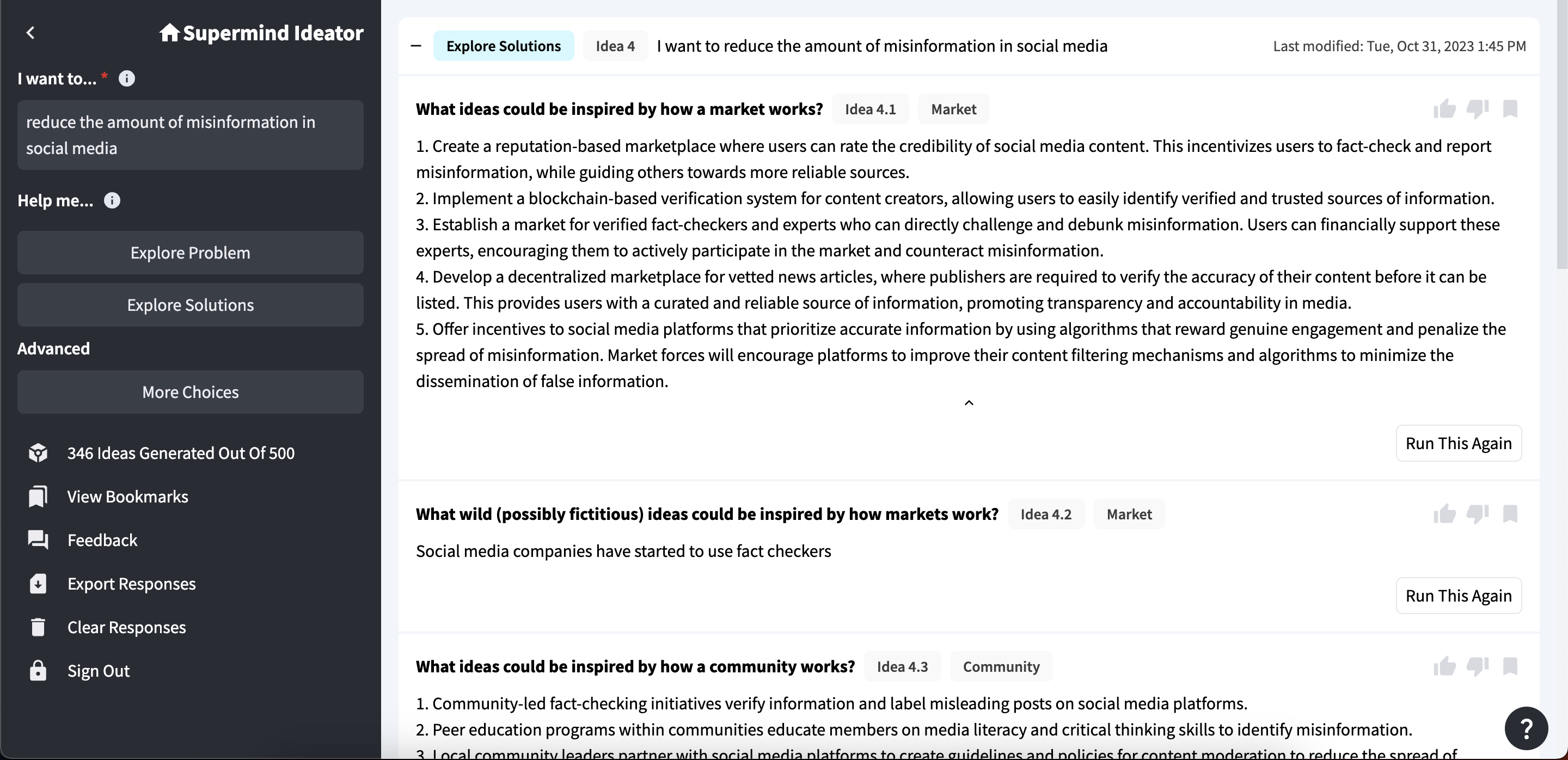
- Design a minimalistic, task-focused UI that supports problem exploration, solution exploration, and advanced move selection.
- Fine-tune the model on a corpus of ~1600 case-study examples aligned to Cognify or Groupify moves to produce outputs resembling real-world practices.
- Label hallucinations as possible (maybe fictitious) ideas to support divergent thinking while avoiding misrepresentation of factual content.
- Provide an API-driven architecture separating UI, API, and LLM to enable extensibility and community extension.
Experimental results
Research questions
- RQ1Can a structured, AI-assisted ideation system improve breadth and depth of ideas for creative problem-solving compared to unaided ideation?
- RQ2How do specialized prompts, fine-tuning, and a move-based interface influence user engagement and perceived usefulness?
- RQ3What are the benefits and limitations of using GPT-generated ideas (including hallucinations) as triggers for human creativity?
- RQ4How can the Supermind Design methodology be operationalized in an AI-assisted tool to design superminds (collectively intelligent groups)?
Key findings
- Participants overall responded positively to the tool and saw potential to help explore multiple dimensions of a problem quickly.
- Users reported that the Ideator could help teams break down client problems and accelerate understanding in unfamiliar domains.
- The interface supported idea capture (bookmarks and ratings) to mitigate idea loss in large outputs and facilitated recombination of fragments.
- Some limitations were noted, such as the system sometimes focusing on upstream efficiency rather than upstream/downstream exploration, suggesting directions for extension.
- The study implies the approach augments rather than replaces human creativity and can scale ideation for professionals with substantial experience.
Read this paper
Open the full text in the Nubint reader and ask about any passage as you read.
Read this paper on NubintThis review was generated by AI from the original paper. Please check the paper before citing it.