
[Paper Review] Supply chain emission estimation using large language models
This paper proposes a novel framework that uses domain-adapted large language models (LLMs) to estimate Scope 3 emissions by classifying financial transaction descriptions into US EPA EEIO commodity categories. The method outperforms traditional NLP techniques and matches expert-level accuracy, enabling scalable enterprise-wide emission estimation to support SDG 13 goals.
Large enterprises face a crucial imperative to achieve the Sustainable Development Goals (SDGs), especially goal 13, which focuses on combating climate change and its impacts. To mitigate the effects of climate change, reducing enterprise Scope 3 (supply chain emissions) is vital, as it accounts for more than 90\% of total emission inventories. However, tracking Scope 3 emissions proves challenging, as data must be collected from thousands of upstream and downstream suppliers.To address the above mentioned challenges, we propose a first-of-a-kind framework that uses domain-adapted NLP foundation models to estimate Scope 3 emissions, by utilizing financial transactions as a proxy for purchased goods and services. We compared the performance of the proposed framework with the state-of-art text classification models such as TF-IDF, word2Vec, and Zero shot learning. Our results show that the domain-adapted foundation model outperforms state-of-the-art text mining techniques and performs as well as a subject matter expert (SME). The proposed framework could accelerate the Scope 3 estimation at Enterprise scale and will help to take appropriate climate actions to achieve SDG 13.
Motivation & Objective
- To address the critical challenge of estimating Scope 3 emissions, which account for over 90% of enterprise emissions but are difficult to track due to data dispersion across thousands of suppliers.
- To develop a scalable, automated method for mapping financial transaction descriptions to standardized commodity categories using NLP, avoiding reliance on manual data collection.
- To evaluate whether fine-tuned foundation models can match or exceed human expert performance in classifying transaction descriptions for emission estimation.
- To demonstrate that financial transaction records can serve as a reliable proxy for supply chain emissions, enabling large-scale decarbonization efforts.
Proposed method
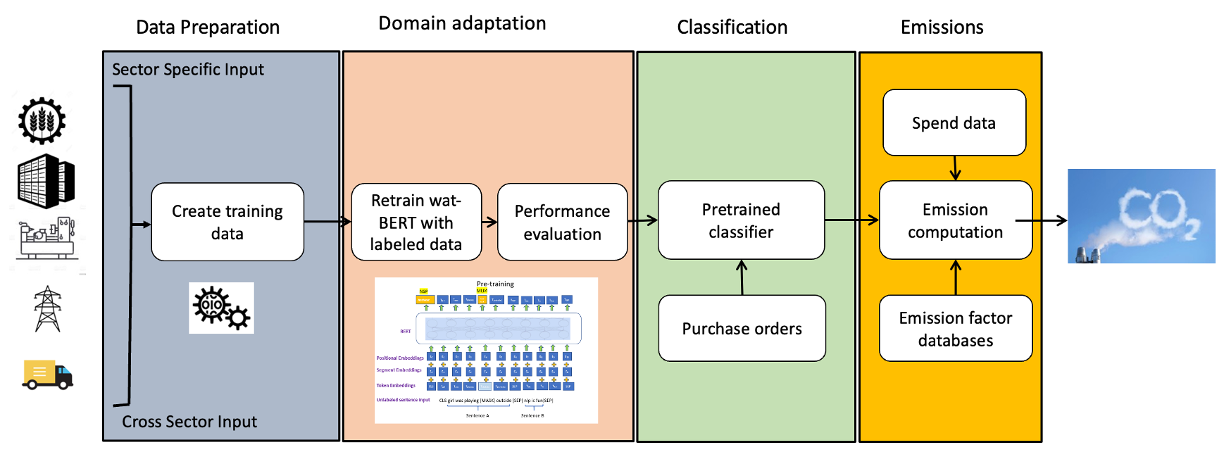
- Fine-tune state-of-the-art large language models—roberta-base, bert-base-uncased, and distilroberta-base-climate-f—on a labeled dataset of financial ledger descriptions for commodity classification.
- Use the United States Environmentally-Extended Input-Output (US EEIO) database to assign emission factors per commodity class, enabling carbon footprint calculation from transaction data.
- Compare model performance against classical NLP baselines: TF-IDF and Word2Vec vectorization followed by text classification.
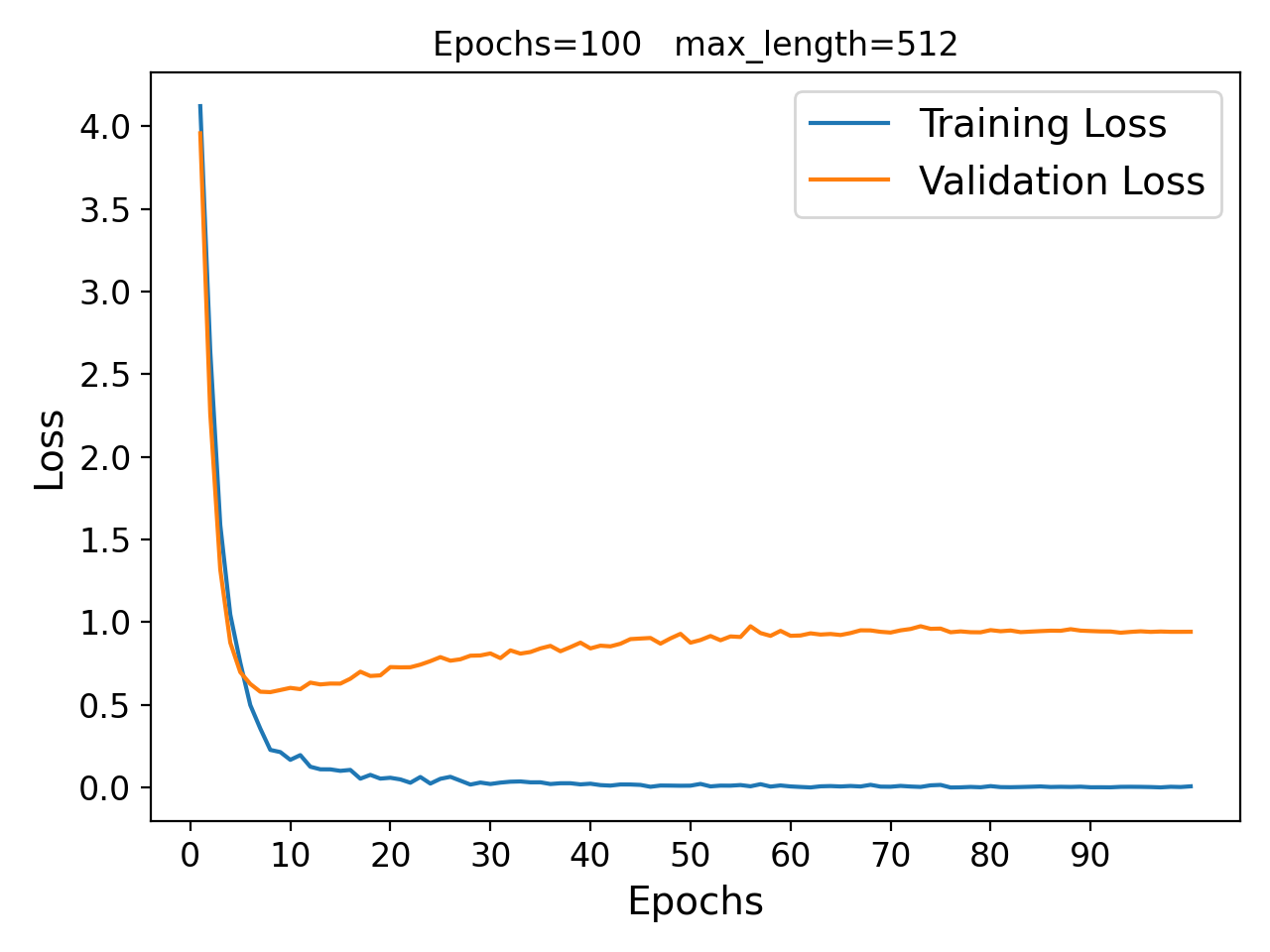
- Apply hyperparameter tuning, particularly learning rate and sequence length, to optimize model convergence and performance.
- Conduct ablation studies using reduced training data (50%) to assess data sensitivity and model robustness.
- Map transaction descriptions to 15 EEIO commodity classes and compute emissions using published emission factors per dollar spent.
Experimental results
Research questions
- RQ1Can domain-adapted large language models outperform classical NLP methods such as TF-IDF and Word2Vec in classifying financial transaction descriptions into commodity categories for emission estimation?
- RQ2How does fine-tuning a foundation model on enterprise transaction data compare to zero-shot classification in terms of classification accuracy for supply chain emissions?
- RQ3To what extent does hyperparameter tuning, particularly learning rate, affect the convergence and performance of fine-tuned LLMs in this context?
- RQ4Can the proposed framework achieve classification accuracy comparable to that of a subject matter expert (SME) in commodity classification for emission estimation?
- RQ5Does the model’s performance degrade significantly with reduced training data, indicating data sensitivity?
Key findings
- The domain-adapted large language model outperformed classical NLP techniques (TF-IDF and Word2Vec), achieving significantly higher F1 scores on the test set.
- Fine-tuned LLMs achieved an F1 score of 82.18% using bert-base-uncased and 81.29% using roberta-base, demonstrating strong performance on the commodity classification task.
- The model trained with a lower learning rate showed smoother convergence and better validation loss, improving generalization and test performance.
- The ablation study revealed that reducing training data to 50% led to a drop in F1 score, indicating that larger datasets improve model robustness and accuracy.
- The framework achieved performance comparable to or exceeding that of a subject matter expert in classifying transaction descriptions into commodity categories.
- Emissions estimation revealed non-intuitive relationships between expenditure and emissions—e.g., Utilities had high emissions per dollar, while Professional Services had low emissions despite high spending—highlighting strategic decarbonization opportunities.
Read this paper
Open the full text in the Nubint reader and ask about any passage as you read.
Read this paper on NubintThis review was generated by AI from the original paper. Please check the paper before citing it.