
[Paper Review] Survey: Image Mixing and Deleting for Data Augmentation
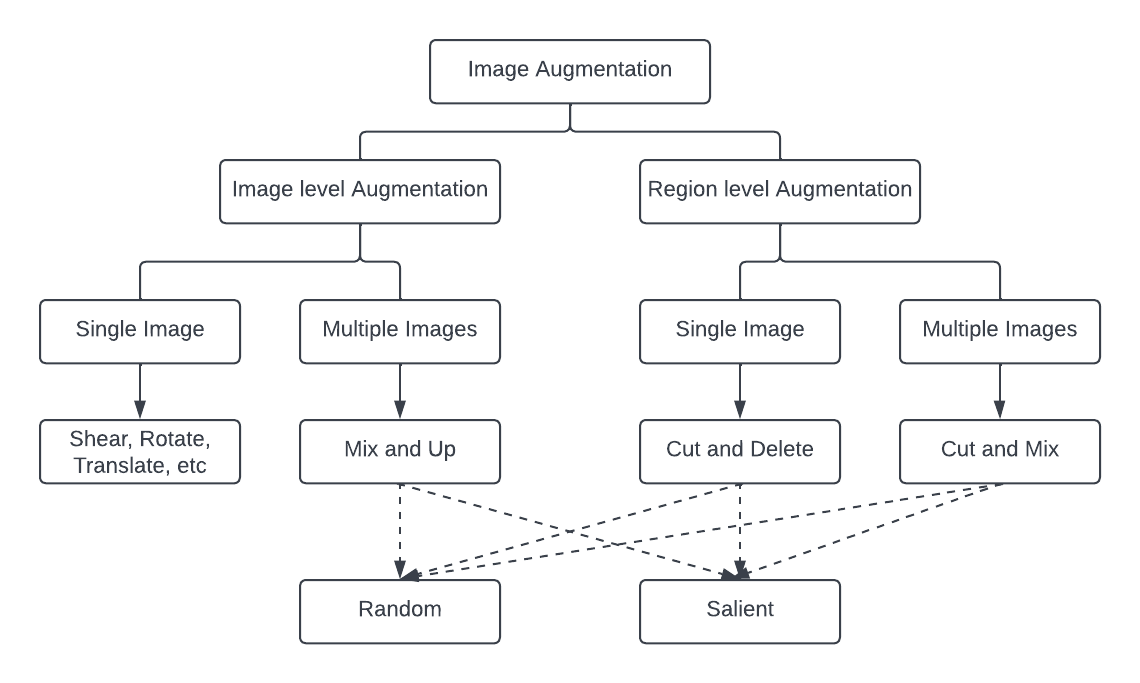
This survey provides a comprehensive analysis of image mixing and deleting techniques for data augmentation in deep learning, categorizing them into Cut & Delete, Cut & Mix, and Mix & Up. It demonstrates that these methods improve model generalization, robustness to corruption, and performance across tasks like image classification and object detection, with minimal computational cost and strong empirical results on benchmark datasets.
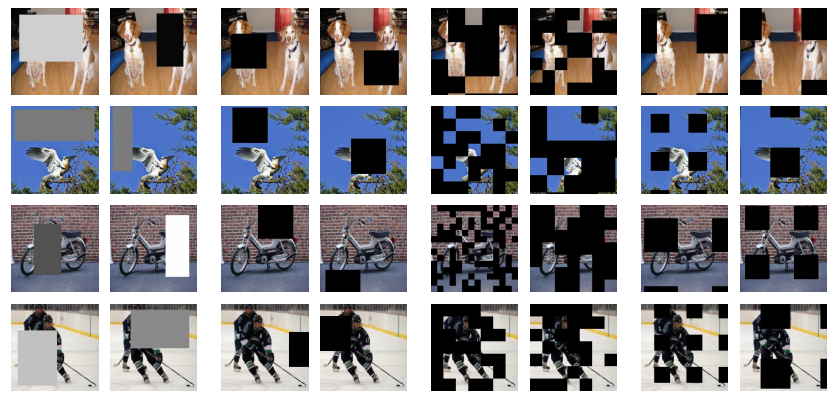
Neural networks are prone to overfitting and memorizing data patterns. To avoid over-fitting and enhance their generalization and performance, various methods have been suggested in the literature, including dropout, regularization, label smoothing, etc. One such method is augmentation which introduces different types of corruption in the data to prevent the model from overfitting and to memorize patterns present in the data. A sub-area of data augmentation is image mixing and deleting. This specific type of augmentation either deletes image regions or mixes two images to hide or make particular characteristics of images confusing for the network, forcing it to emphasize the overall structure of the object in an image. Models trained with this approach have proven to perform and generalize well compared to those trained without image mixing or deleting. An added benefit that comes with this method of training is robustness against image corruption. Due to its low computational cost and recent success, researchers have proposed many image mixing and deleting techniques. We furnish an in-depth survey of image mixing and deleting techniques and provide categorization via their most distinguishing features. We initiate our discussion with some fundamental relevant concepts. Next, we present essentials, such as each category's strengths and limitations, describing their working mechanism, basic formulations, and applications. We also discuss the general challenges and recommend possible future research directions for image mixing and deleting data augmentation techniques. Datasets and codes for evaluation are publicly available here.
Motivation & Objective
- To systematically categorize and analyze image mixing and deleting data augmentation techniques in deep learning.
- To evaluate the strengths, limitations, and working mechanisms of each technique category.
- To identify key challenges and future research directions in saliency-aware and smoothness-enhanced augmentation.
- To provide researchers with a comparative analysis for selecting optimal augmentation strategies.
- To highlight the benefits of these methods in improving model robustness, calibration, and generalization across vision tasks.
Proposed method
- Categorizing image mixing and deleting techniques into three main types: Cut & Delete, Cut & Mix, and Mix & Up based on their data manipulation approach.
- Analyzing each category's working mechanism, including region-level vs. image-level augmentation and use of random or saliency-guided strategies.
- Evaluating techniques using performance metrics on standard benchmarks such as ImageNet, CIFAR-100, and COCO.
- Examining the impact of augmentation on class activation maps (CAMs) to assess model attention and feature learning.
- Proposing future frameworks for end-to-end training of augmentation and classification networks to reduce computational overhead.
- Investigating the use of feature-space mixing (e.g., Manifold MixUp) and saliency-aware mixing (e.g., Co-MixUp, PuzzleMix) for improved image smoothness and structural consistency.
Experimental results
Research questions
- RQ1How do different image mixing and deleting techniques compare in terms of performance, robustness, and generalization across vision tasks?
- RQ2What are the key limitations of existing saliency-guided augmentation methods, particularly regarding structural consistency and computational cost?
- RQ3How do these augmentation strategies affect model calibration, adversarial robustness, and out-of-distribution detection?
- RQ4What theoretical or empirical evidence supports the regularization effect of CutMix and CutOut, compared to MixUp?
- RQ5What future directions can improve the smoothness and realism of augmented images while preserving salient features?
Key findings
- Image mixing and deleting techniques significantly improve model generalization and robustness to image corruptions, occlusions, and adversarial examples.
- Models trained with these methods achieve superior performance on image classification, object detection, and fine-grained recognition tasks compared to baseline models.
- Cut & Mix and Mix & Up methods show strong performance gains, with reported improvements on ImageNet and CIFAR-100, though specific accuracy values are not quantified in the abstract.
- Saliency-aware methods like Co-MixUp and PuzzleMix enhance feature learning but incur higher computational costs due to dual-network training.
- The structural integrity of augmented images often suffers, with irregular edges and broken shapes, especially in region-level augmentations.
- Future work should focus on end-to-end training frameworks and feature-space mixing to improve smoothness and theoretical understanding of the regularization effects.
Read this paper
Open the full text in the Nubint reader and ask about any passage as you read.
Read this paper on NubintThis review was generated by AI from the original paper. Please check the paper before citing it.