
[Paper Review] Sustainability Competencies and Skills in Software Engineering: An Industry Perspective
This study identifies sustainability competencies and skills needed by software engineers from an industry perspective through interviews and focus groups with 28 organizations across nine countries. It reveals that while organizations are increasingly motivated to pursue sustainability for business and societal reasons, they face challenges in implementation due to unclear sustainability concepts and trade-offs with profitability, necessitating targeted education in sustainability mindset, system thinking, technical and soft skills, and business case development for sustainable software engineering.
Achieving the UN Sustainable Development Goals (SDGs) demands adequate levels of awareness and actions to address sustainability challenges. Software systems will play an important role in moving towards these targets. Sustainability skills are necessary to support the development of software systems and to provide sustainable IT-supported services for citizens. While there is a growing number of academic bodies, including sustainability education in engineering and computer science curricula, there is not yet comprehensive research on the competencies and skills required by IT professionals to develop such systems. This study aims to identify the industrial sustainability needs for education and training from software engineers' perspective. We conducted interviews and focus groups with experts from twenty-eight organisations with an IT division from nine countries to understand their interests, goals and achievements related to sustainability, and the skills and competencies needed to achieve their goals. Our findings show that organisations are interested in sustainability, both idealistically and increasingly for core business reasons. They seek to improve the sustainability of processes and products but encounter difficulties, like the trade-off between short-term financial profitability and long-term sustainability goals. To fill the gaps, they have promoted in-house training courses, collaborated with universities, and sent employees to external training. The acquired competencies make sustainability an integral part of software development. We conclude that educational programs should include knowledge and skills on core sustainability concepts, system thinking, soft skills, technical sustainability, sustainability impact and measurements, values and ethics, standards and legal aspects, and advocacy and lobbying.
Motivation & Objective
- To understand industry organizations' interests, goals, and challenges related to sustainability in software development.
- To identify the specific sustainability-related competencies and skills required by IT professionals to achieve organizational sustainability goals.
- To bridge the gap between academic curricula and industry needs by informing the development of education programs focused on sustainable software engineering.
- To address the lack of comprehensive research on industrial sustainability needs for software engineering education and training.
- To support the integration of sustainability into computing curricula by identifying core topics and competencies based on real-world industry demands.
Proposed method
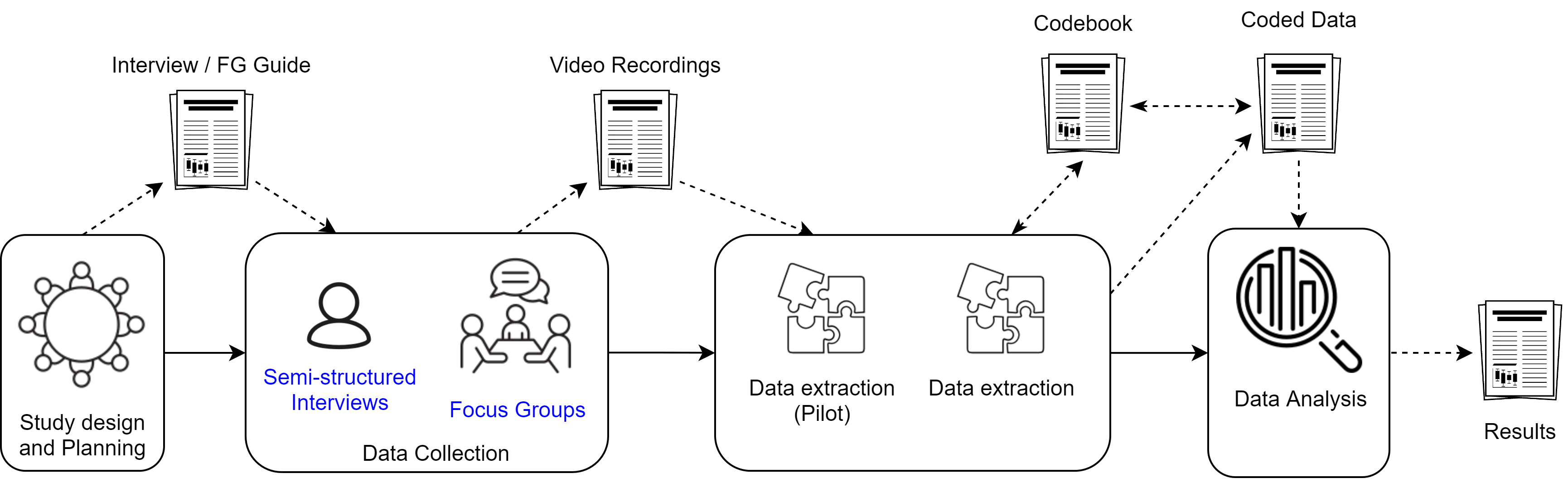
- Conducted qualitative interviews and focus groups with IT professionals from 28 organizations across nine countries.
- Collected data on organizational interests, sustainability goals, implementation challenges, and required skills.
- Used thematic analysis to identify recurring themes in sustainability interests, goals, and skill requirements.
- Mapped identified competencies to sustainability dimensions: environmental, economic, social, technical, and individual.
- Synthesized findings into a comprehensive framework of sustainability competencies for software engineering education.
- Proposed a curriculum framework integrating core sustainability concepts, system thinking, ethics, standards, and business case development.
Experimental results
Research questions
- RQ1What are the interests of organizations with IT divisions regarding sustainability?
- RQ2What sustainability goals do these organizations aim to achieve, and what strategies do they employ?
- RQ3What sustainability-related competencies and skills are required for software engineers to help organizations achieve their sustainability goals?
- RQ4How do organizations currently address the gap in sustainability skills, and what are the limitations of these approaches?
- RQ5What core topics and competencies should be included in software engineering education to meet industry needs?
Key findings
- Organizations are increasingly motivated to pursue sustainability both ideologically and for core business reasons, particularly to improve product and process sustainability.
- A major challenge is the trade-off between short-term financial profitability and long-term sustainability goals, compounded by a lack of clear understanding of sustainability concepts.
- Organizations frequently rely on in-house training, university collaborations, and external courses to address the sustainability skills gap.
- The most critical competencies identified include system thinking, sustainability mindset, technical sustainability, business case development, and ethical decision-making.
- There is a strong need for education programs to integrate sustainability across all dimensions—environmental, economic, social, technical, and individual—beyond just technical aspects.
- Sustainability must be embedded as a core component of software engineering curricula, with a focus on translating environmental and social benefits into measurable economic value.

Better researchstarts right now
From reading papers to final review, dramatically reduce your research time.
No credit card · Free plan available
This review was created by AI and reviewed by human editors.