
[Paper Review] Sustainability in Computing Education: A Systematic Literature Review
This systematic literature review synthesizes 90 studies on sustainability in computing education, identifying conceptions of sustainability, pedagogical approaches, and research quality. It proposes a framework for learning objectives and outcomes, revealing that most research remains limited to experience reports with minimal critical engagement, calling for deeper integration of critical theory and transformative education models.
Research shows that the global society as organized today, with our current technological and economic system, is impossible to sustain. We are living in the Anthropocene, an era in which human activities in highly industrialized countries are responsible for overshooting several planetary boundaries, with poorer communities contributing least to the problems but being impacted the most. At the same time, technical and economic gains fail to provide society at large with equal opportunities and improved quality of life. This paper describes approaches taken in computing education to address the issue of sustainability. It presents results of a systematic review of literature on sustainability in computing education. From a set of 572 publications extracted from six large digital libraries plus snowballing, we distilled and analyzed the 90 relevant primary studies. Using an inductive and deductive thematic analysis, we study 1) conceptions of sustainability, computing, and education, 2) implementations of sustainability in computing education, and 3) research on sustainability in computing education. We present a framework capturing learning objectives and outcomes as well as pedagogical methods for sustainability in computing education. These results can be mapped to existing standards and curricula in future work. We find that only a few of the articles engage with the challenges as calling for drastic systemic change, along with radically new understandings of computing and education. We suggest that future research should connect to the substantial body of critical theory such as feminist theory of science and technology. Existing research on sustainability in computing education may be considered as rather immature as the majority of articles are experience reports with limited empirical research.
Motivation & Objective
- To investigate how sustainability is conceptualized in computing education research.
- To analyze implementations of sustainability in computing curricula, including content, pedagogy, and learning outcomes.
- To evaluate the methodological quality and research maturity of studies on sustainability in computing education.
- To identify gaps in current research, particularly the lack of systemic and critical engagement with structural inequities and planetary boundaries.
- To propose a framework for integrating sustainability into computing education that supports transformative, equitable, and critical learning.
Proposed method
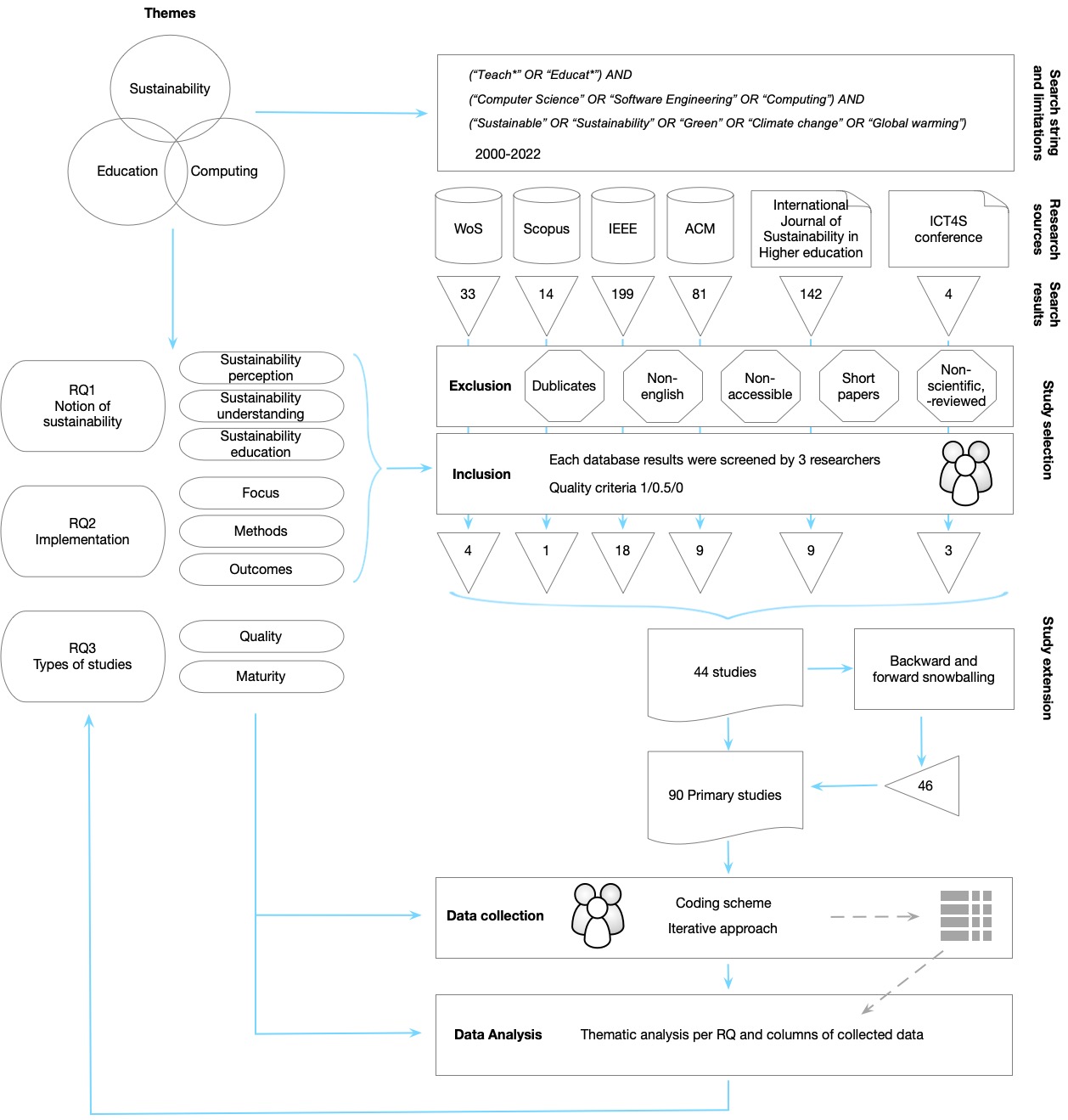
- Conducted a systematic literature review (SLR) using six major digital libraries and snowballing techniques to identify relevant publications.
- Screened 572 publications through PRISMA-compliant selection, resulting in 90 primary studies for analysis.
- Applied inductive and deductive thematic analysis to extract themes on conceptions of sustainability, pedagogical methods, and research quality.
- Developed a conceptual framework mapping learning objectives, outcomes, and pedagogical approaches in sustainability education.
- Used multi-author consensus and weekly meetings to ensure methodological rigor and reduce bias in selection and interpretation.
- Mapped findings to existing curricular standards and frameworks to assess alignment and potential for integration.
Experimental results
Research questions
- RQ1How is sustainability conceptualized in computing education research, and how do these conceptions relate to computing and education?
- RQ2What pedagogical methods and learning outcomes are reported in studies on sustainability in computing education?
- RQ3What is the methodological quality and research maturity of the existing body of work on sustainability in computing education?
- RQ4How do current implementations of sustainability in computing education engage with systemic challenges such as planetary boundaries and social inequality?
- RQ5What role can critical theory and transformative education play in advancing sustainability in computing education?
Key findings
- Only a minority of the 90 studies engage with the systemic, structural, and intersectional challenges of sustainability, such as planetary boundaries and social injustice.
- Most studies are experience reports with limited empirical grounding, indicating that research in this area remains methodologically immature.
- Students report increased awareness, concern, and competence in sustainability, suggesting positive learning outcomes beyond technical knowledge.
- There is a notable lack of connection to critical theories such as feminist science and technology studies, which could deepen understanding of power and equity in computing education.
- The majority of implementations treat sustainability as an add-on topic rather than a transformative lens for rethinking computing and education practices.
- A framework for learning objectives, outcomes, and pedagogical methods was developed, offering a foundation for curricular integration and future research.
Read this paper
Open the full text in the Nubint reader and ask about any passage as you read.
Read this paper on NubintThis review was generated by AI from the original paper. Please check the paper before citing it.