
[Paper Review] SV3D: Novel Multi-view Synthesis and 3D Generation from a Single Image using Latent Video Diffusion
SV3D introduces a novel latent video diffusion model that enables high-resolution, pose-controllable, multi-view synthesis from a single image, leveraging the multi-view consistency of Stable Video Diffusion. It achieves state-of-the-art performance in both novel view synthesis and 3D reconstruction by combining explicit camera control, masked score distillation sampling, and disentangled illumination optimization.
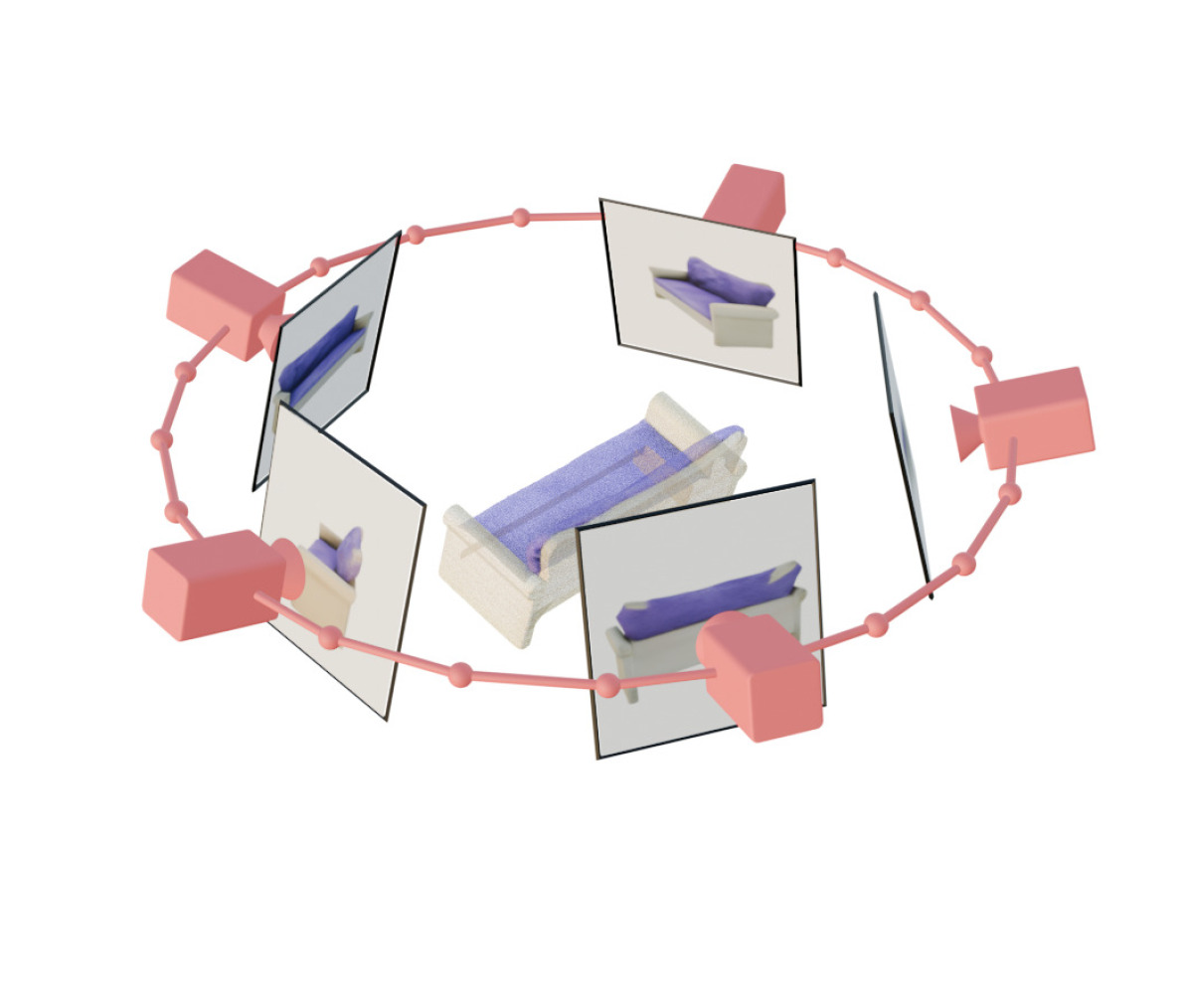
We present Stable Video 3D (SV3D) -- a latent video diffusion model for high-resolution, image-to-multi-view generation of orbital videos around a 3D object. Recent work on 3D generation propose techniques to adapt 2D generative models for novel view synthesis (NVS) and 3D optimization. However, these methods have several disadvantages due to either limited views or inconsistent NVS, thereby affecting the performance of 3D object generation. In this work, we propose SV3D that adapts image-to-video diffusion model for novel multi-view synthesis and 3D generation, thereby leveraging the generalization and multi-view consistency of the video models, while further adding explicit camera control for NVS. We also propose improved 3D optimization techniques to use SV3D and its NVS outputs for image-to-3D generation. Extensive experimental results on multiple datasets with 2D and 3D metrics as well as user study demonstrate SV3D's state-of-the-art performance on NVS as well as 3D reconstruction compared to prior works.
Motivation & Objective
- Address the lack of multi-view consistency in existing image-to-video diffusion models for novel view synthesis (NVS).
- Enable pose-controllable, high-resolution generation of orbital view sequences from a single image.
- Improve 3D object reconstruction quality by leveraging consistent, diverse novel views for NeRF and DMTet optimization.
- Reduce baked-in lighting artifacts in 3D meshes through joint optimization of disentangled illumination.
- Develop a masked score distillation sampling (SDS) loss to enhance 3D reconstruction in occluded regions.
Proposed method
- Adapt the latent video diffusion model Stable Video Diffusion (SVD) for image-to-video generation with explicit camera pose conditioning, enabling controllable orbital view synthesis.
- Introduce three variants: SV3D^u (uniform orbit), SV3D^c (circular orbit), and SV3D^p (dynamic sine-based orbit) to evaluate view diversity and consistency.
- Use SV3D-generated multi-view images as supervision for 3D optimization of NeRF and DMTet representations via photometric and masked SDS losses.
- Propose triangle CFG scaling to stabilize training and improve generation fidelity during 3D optimization.
- Jointly optimize a disentangled illumination model alongside 3D shape and texture to reduce lighting artifacts.
- Apply masked SDS loss to enhance reconstruction quality in regions not visible in the synthesized views.
Experimental results
Research questions
- RQ1Can a latent video diffusion model be effectively adapted for pose-controllable, multi-view synthesis from a single image?
- RQ2Does leveraging the multi-view consistency of video diffusion improve 3D reconstruction quality compared to 2D diffusion-based NVS?
- RQ3How does explicit camera control and dynamic orbit design affect the quality and consistency of generated views?
- RQ4To what extent does masked SDS loss improve 3D reconstruction in occluded regions?
- RQ5Can disentangled illumination optimization reduce lighting artifacts in 3D meshes generated from synthetic views?
Key findings
- SV3D^p with dynamic orbit and masked SDS loss achieves the best 2D metrics on the GSO dataset, with LPIPS of 0.119, PSNR of 17.405, and CLIP-S of 0.877.
- The 3D reconstruction using SV3D^p achieves a Chamfer Distance (CD) of 0.024 and 3D IoU of 0.614, outperforming prior methods including Stable Zero123 and SyncDreamer.
- The use of masked SDS loss improves 3D quality, as shown by a 0.003 reduction in CD and 0.003 increase in 3D IoU compared to training without SDS.
- SV3D^p with dynamic orbit significantly outperforms static orbit and uniform orbit variants, demonstrating the importance of diverse view sampling.
- The disentangled illumination optimization reduces lighting artifacts, leading to more realistic and consistent 3D mesh textures.
- User studies and quantitative metrics confirm that SV3D generates more consistent, realistic, and detailed 3D objects than prior state-of-the-art methods.
Read this paper
Open the full text in the Nubint reader and ask about any passage as you read.
Read this paper on NubintThis review was generated by AI from the original paper. Please check the paper before citing it.