
[Paper Review] SVIT: Scaling up Visual Instruction Tuning
SVIT builds a 4.2 million-instruction dataset for visual instruction tuning and shows SVIT-v1.5 surpassing state-of-the-art multimodal LLMs on multiple benchmarks, using a new coreset data recipe and both full and LoRA fine-tuning.
Thanks to the emerging of foundation models, the large language and vision models are integrated to acquire the multimodal ability of visual captioning, question answering, etc. Although existing multimodal models present impressive performance of visual understanding and reasoning, their limits are still largely under-explored due to the scarcity of high-quality instruction tuning data. To push the limits of multimodal capability, we Scale up Visual Instruction Tuning (SVIT) by constructing a dataset of 4.2 million visual instruction tuning data including 1.6M conversation question-answer (QA) pairs, 1.6M complex reasoning QA pairs, 1.0M referring QA pairs and 106K detailed image descriptions. Besides the volume, the proposed dataset is also featured by the high quality and rich diversity, which is generated by prompting GPT-4 with the abundant manual annotations of images. We also propose a new data recipe to select subset with better diversity and balance, which evokes model's superior capabilities. Extensive experiments verify that SVIT-v1.5, trained on the proposed dataset, outperforms state-of-the-art Multimodal Large Language Models on popular benchmarks. The data and code are publicly available at https://github.com/BAAI-DCAI/Visual-Instruction-Tuning.
Motivation & Objective
- Motivate scaling visual instruction tuning to overcome data scarcity in multimodal models.
- Construct a large, diverse, high-quality VG/COCO-based instruction dataset generated via GPT-4 prompts.
- Propose a data-then-model strategy, including coreset selection for diversity and balance.
- Demonstrate that SVIT-v1.5 outperforms existing MLLMs on standard benchmarks.
Proposed method
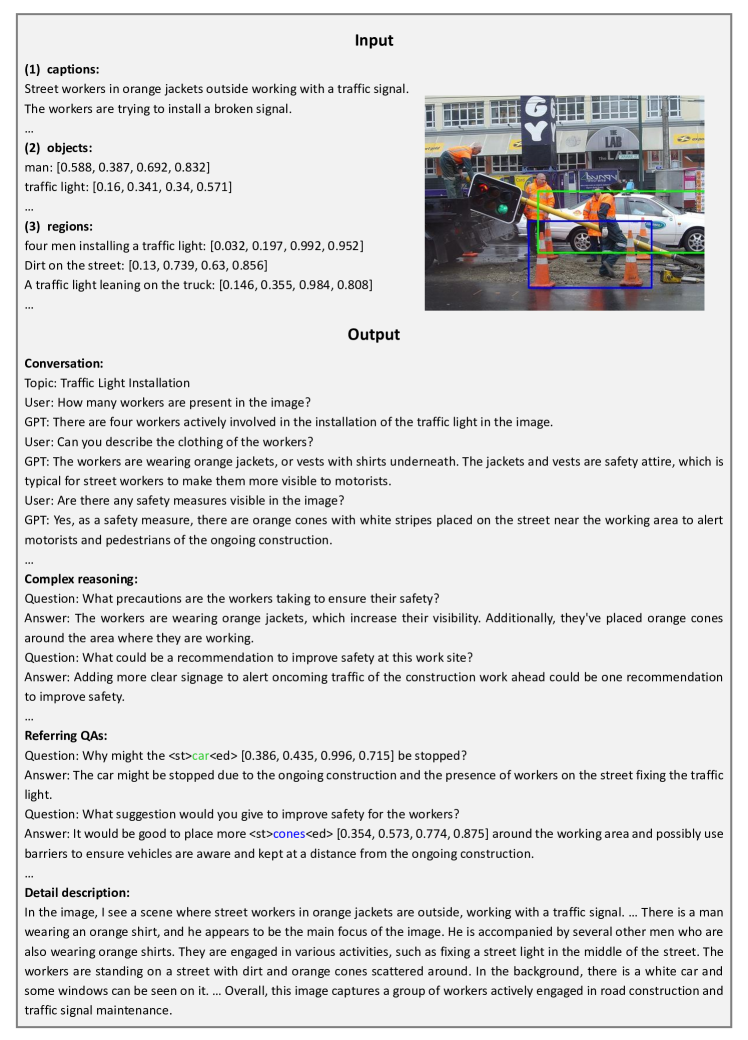
- Construct SVIT from Visual Genome and COCO with rich annotations and GPT-4 prompts to generate four task types: conversation QA, complex reasoning QA, referring QA, and detailed image descriptions.
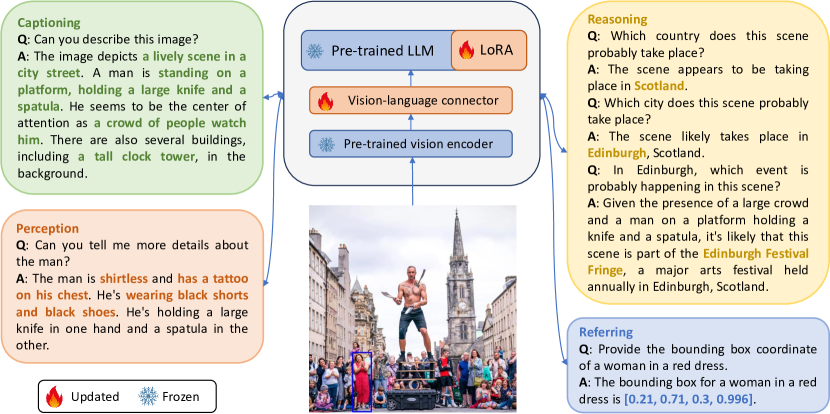
- Use a two-stage training pipeline: pre-training a vision-language connector on image-text pairs while freezing the vision encoder and LLM, then fine-tuning the connector and LLM (full or LoRA) on visual instruction data.
- Introduce SVIT-core-150K as a diversity- and balance-aware coreset via a GPT-4–driven concept overlap filter and Yes/No balance adjustments.
- Build SVIT-mix-665K by replacing a portion of prior data (e.g., LLaVA-Instruct-150K) with SVIT-core-150K to test data efficiency, and scale up to SVIT-train for larger gains.
Experimental results
Research questions
- RQ1How does scaling up high-quality visual instruction data affect multimodal model performance across standard benchmarks?
- RQ2Can a diversity- and balance-aware data subset (coreset) improve instruction-tuning efficiency and effectiveness?
- RQ3What are the gains of full-parameter vs. LoRA fine-tuning when trained on SVIT data?
- RQ4Does increasing the data size (SVIT-train) yield consistent improvements across perception and cognition tasks?
Key findings
- SVIT-v1.5 (Full) outperforms LLaVA-v1.5 and other models on most benchmarks, including strong gains on MME perception and cognition.
- SVIT-v1.5 (LoRA) surpasses LLaVA-v1.5 (LoRA) on MME cognition, showing substantial gains with efficient fine-tuning.
- A diversity-focused SVIT-80K-D improves performance by 20.3 points over randomly selected SVIT-80K.
- Balancing Yes/No questions in training data (SVIT-80K-B) yields a 7.1% improvement on MME over SVIT-80K.
- Scaling SVIT-train (larger data) yields +12.7% total MME score over SVIT-80K, with notable gains in object existence, color, and OCR tasks.
Read this paper
Open the full text in the Nubint reader and ask about any passage as you read.
Read this paper on NubintThis review was generated by AI from the original paper. Please check the paper before citing it.