
[Paper Review] SWE-Bench+: Enhanced Coding Benchmark for LLMs
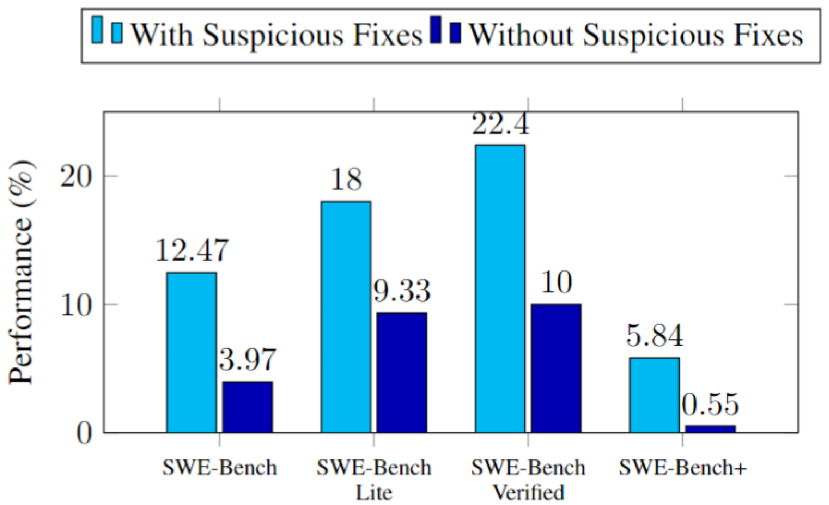
This paper identifies critical data quality issues in the SWE-Bench benchmark, including solution leakage and weak test cases, which inflate LLM performance. To address this, the authors introduce SWE-Bench+, a refined dataset using post-cutoff GitHub issues with no solution leaks, reducing the SWE-Agent+GPT-4 pass rate from 12.47% to 0.55%, thereby establishing a more rigorous evaluation standard for LLMs in software engineering.
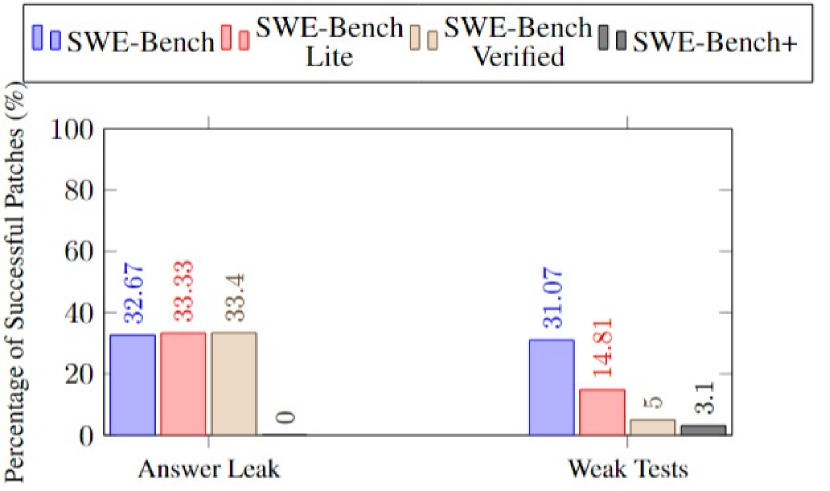
Large Language Models (LLMs) in Software Engineering (SE) can offer assistance for coding. To facilitate a rigorous evaluation of LLMs in practical coding contexts, Carlos et al. introduced the SWE-bench dataset, which comprises 2,294 real-world GitHub issues and their corresponding pull requests, collected from 12 widely used Python repositories. Several impressive LLM-based toolkits recently are developed and evaluated on this dataset. However, a systematic evaluation of the quality of SWE-bench remains missing. In this paper, we addressed this gap by presenting an empirical analysis of the SWE-bench dataset. We conducted a manual screening of instances where SWEAgent + GPT-4 successfully resolved issues by comparing the model-generated patches with the actual pull requests. SWE-Agent+GPT-4 was at the top of SWE-bench leaderboard during the time of our study. Our analysis reveals some critical issues with the SWE-bench dataset: 1) 32.67% of the successful patches involve cheating as the solutions were directly provided in the issue report or the comments. We refer to as solution leakage problem. 2) 31.08% of the passed patches are suspicious patches due to weak test cases, i.e., the tests were not adequate to verify the correctness of a patch. When we filtered out these problematic issues, the resolution rate of SWE-Agent+GPT-4 dropped from 12.47% to 3.97%. We also observed that the same data quality issues also exist in the two variants of SWE-bench, i.e., SWE-bench Lite and SWE-Bench Verified. In addition, over 94% of the issues were created before LLM's knowledge cutoff dates, posing potential data leakage issues.
Motivation & Objective
- To evaluate the robustness and reliability of the SWE-Bench benchmark for LLM evaluation in real-world software engineering tasks.
- To identify and analyze critical data quality issues—specifically solution leakage and weak test cases—that compromise the validity of prior LLM performance assessments.
- To develop a more rigorous benchmark by creating SWE-Bench+, a dataset free from solution leakage and data leakage, using issues created after LLMs' training cutoff dates.
- To validate the new benchmark by measuring the drop in LLM resolution rates, demonstrating that prior results were inflated due to dataset flaws.
- To provide a trustworthy, reproducible evaluation framework for future LLM development in software engineering.
Proposed method
- Conducted a manual patch validation study comparing model-generated patches from SWE-Agent+GPT-4 against gold patches from official pull requests.
- Identified and categorized 8 distinct patterns in model-generated fixes, classifying them as either correct or suspicious based on content and alignment with gold patches.
- Systematically analyzed issue reports and comments to detect 'solution leakage'—where solutions were directly provided in the issue or comments.
- Evaluated test case adequacy by checking whether weak or incomplete test suites allowed incorrect or incomplete patches to pass.
- Created SWE-Bench+ by collecting real GitHub issues created after the LLMs' knowledge cutoff dates and excluding any that contained solution hints.
- Validated the new benchmark by re-evaluating multiple LLM agents (SWE-RAG, AutoCodeRover) on SWE-Bench+ to measure performance drops and confirm reduced pass rates.
Experimental results
Research questions
- RQ1To what extent do solution leaks in the SWE-Bench dataset inflate the reported pass rates of LLMs?
- RQ2How inadequate are the test cases in SWE-Bench, and to what extent do they allow incorrect patches to be marked as correct?
- RQ3What is the true resolution rate of state-of-the-art LLM agents when evaluated on a cleaned, more rigorous benchmark free from data leakage and weak tests?
- RQ4How do performance metrics change when using SWE-Bench+ compared to the original SWE-Bench and its variants?
- RQ5To what extent do existing LLM agents still perform well on SWE-Bench+ after removing dataset artifacts?
Key findings
- 32.67% of SWE-Agent+GPT-4’s successful patches involved 'solution leakage,' where the fix was directly stated in the issue or comments.
- 31.08% of passed patches were based on weak test cases that failed to detect incorrect or incomplete code changes.
- After filtering out instances with solution leakage and weak tests, the resolution rate of SWE-Agent+GPT-4 dropped from 12.47% to 3.97% on the refined SWE-Bench dataset.
- On the final SWE-Bench+ dataset, the resolution rate of SWE-Agent+GPT-4 further declined to 0.55%, indicating a significant performance drop due to improved data quality.
- Other models, including SWE-RAG+GPT-4 (0.73%) and SWE-RAG+GPT-3.5 (0.55%), also showed substantial performance drops on SWE-Bench+, confirming the benchmark's increased rigor.
- The same data quality issues were found to exist in SWE-Bench Lite and SWE-Bench Verified, indicating systemic flaws across the SWE-Bench ecosystem.
Read this paper
Open the full text in the Nubint reader and ask about any passage as you read.
Read this paper on NubintThis review was generated by AI from the original paper. Please check the paper before citing it.