
[Paper Review] Kondo Phase in Twisted Bilayer Graphene -- A Unified Theory for Distinct Experiments
This paper proposes a unified topological heavy fermion (THF) model to explain the gapless phases in magic-angle twisted bilayer graphene (MATBG), where local moments at AA-stacking regions Kondo-screen itinerant Dirac electrons, forming a heavy Fermi liquid with Kondo resonance at ~1 meV. The theory explains diverse experiments—zero-bias peaks, quantum-dot-like STM features, Pomeranchuk effect, and saw-tooth compressibility—by identifying the heavy Fermi liquid as the parent state of unconventional superconductivity.
A number of interesting physical phenomena have been discovered in magic-angle twisted bilayer graphene (MATBG), such as superconductivity, correlated gapped and gapless phases, etc. The gapped phases are believed to be symmetry-breaking states described by mean-field theories, whereas gapless phases exhibit features beyond mean field. This work, combining poor man's scaling, numerical renormalization group, and dynamic mean-field theory, demonstrates that the gapless phases are the heavy Fermi liquid state with some symmetries broken and the others preserved. We adopt the recently proposed topological heavy fermion model for MATBG with effective local orbitals around AA-stacking regions and Dirac fermions surrounding them. At zero temperature and most non-integer fillings, the ground states are found to be heavy Fermi liquids and exhibit Kondo resonance peaks. The Kondo temperature $T_K$ is found at the order of 1meV. A higher temperature than $T_K$ will drive the system into a metallic LM phase where disordered LM's and a Fermi liquid coexist. At integer fillings $\pm1,\pm2$, $T_K$ is suppressed to zero or a value weaker than RKKY interaction, leading to Mott insulators or symmetry-breaking states. This theory offers a unified explanation for several experimental observations, such as zero-energy peaks and quantum-dot-like behaviors in STM, the Pomeranchuk effect, and the saw-tooth feature of inverse compressibility, etc. For future experimental verification, we predict that the Fermi surface in the gapless phase will shrink upon heating - as a characteristic of the heavy Fermi liquid. We also conjecture that the heavy Fermi liquid is the parent state of the observed unconventional superconductivity because the Kondo screening reduces the overwhelming Coulomb interaction (~60meV) to a rather small effective interaction (~1meV) comparable to possible weak attractive interactions.
Motivation & Objective
- To resolve the long-standing puzzle of gapless phases in magic-angle twisted bilayer graphene (MATBG) that defy standard mean-field descriptions.
- To unify disparate experimental observations—zero-energy peaks, quantum-dot-like behavior, Pomeranchuk effect, and saw-tooth inverse compressibility—under a single microscopic framework.
- To establish the topological heavy fermion (THF) model as a unified description of MATBG’s low-energy physics, particularly in non-integer fillings.
- To identify the heavy Fermi liquid as the parent state of unconventional superconductivity by showing effective Coulomb interaction is reduced to ~1 meV via Kondo screening.
Proposed method
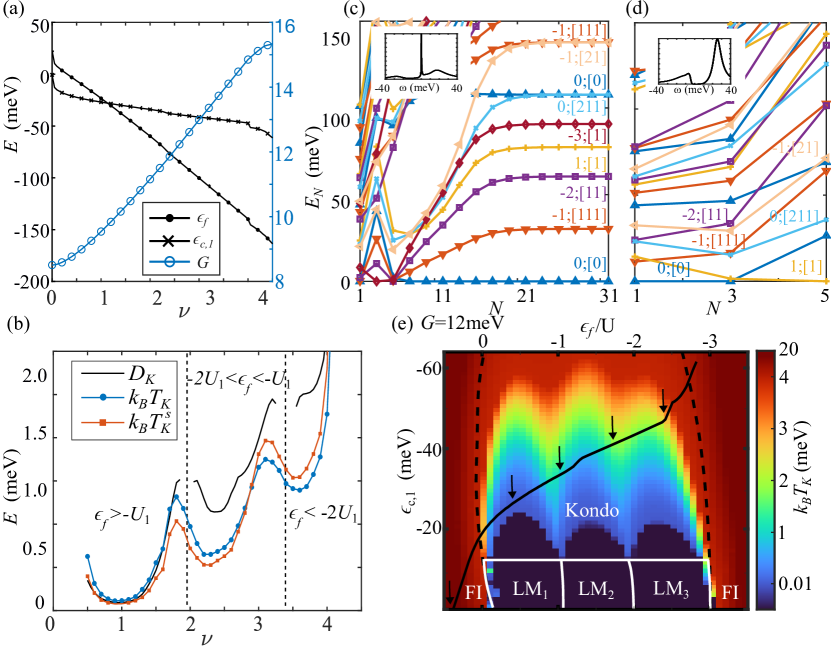
- Employing poor man’s scaling to derive the Kondo temperature $T_{ m K} \sim 1$ meV in gapless phases at non-integer fillings.
- Applying numerical renormalization group (NRG) and dynamic mean-field theory (DMFT) to study the Kondo screening of local moments (LMs) by itinerant electrons.
- Using the topological heavy fermion (THF) model, where effective local $f$-orbitals (LMs) at AA-stacking regions hybridize with Dirac $c$-electrons via Kondo coupling.
- Performing self-consistent calculations of mean-field Hamiltonians $\hat{H}_{U}^{MF}, \hat{H}_{V}^{MF}, \hat{H}_{W}^{MF}, \hat{H}_{J}^{MF}$ to evaluate symmetry-breaking states and RKKY interactions.
- Defining the RKKY energy scale $J_{\rm RKKY} = \frac{1}{4}(E_{\rm AFM} - E_{\rm FM})$ to compare Kondo and RKKY energy scales.
- Analyzing the Fermi surface shrinkage upon heating as a signature of heavy Fermi liquid behavior.
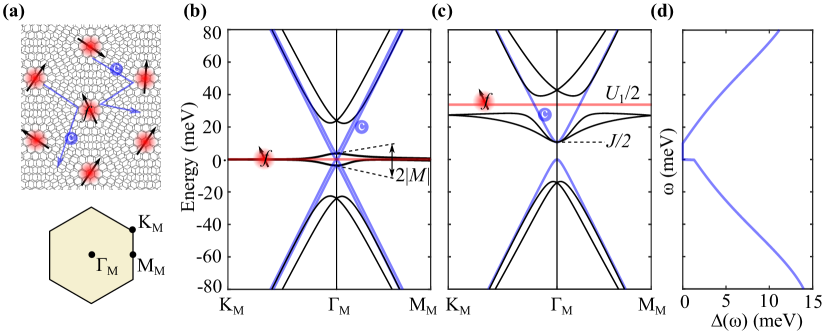
Experimental results
Research questions
- RQ1Why do gapless phases in MATBG exhibit zero-energy peaks and quantum-dot-like behavior not explained by mean-field theories?
- RQ2How does the Kondo effect mediate the transition between heavy Fermi liquid and disordered local moment phases with increasing temperature?
- RQ3What is the role of the RKKY interaction relative to the Kondo temperature in determining the stability of symmetry-breaking states at integer fillings?
- RQ4Can the heavy Fermi liquid state explain the Pomeranchuk effect and saw-tooth feature in inverse compressibility?
- RQ5Is the heavy Fermi liquid the parent state of unconventional superconductivity in MATBG?
Key findings
- The Kondo temperature $T_{\rm K}$ is found to be approximately 1 meV in gapless phases at non-integer fillings, indicating strong Kondo screening.
- Above $T_{\rm K}$, the system transitions into a metallic local moment phase where disordered local moments obey Curie’s law and coexist with a Fermi liquid of itinerant electrons.
- At integer fillings $\pm1, \pm2$, $T_{\rm K}$ is suppressed to zero or below the RKKY interaction scale, leading to Mott insulators or symmetry-breaking states.
- The heavy Fermi liquid state exhibits a Fermi surface that shrinks upon heating, a distinctive signature of Kondo screening.
- The effective Coulomb interaction is reduced from $U \sim 60$ meV to $U^{*} \sim 1$ meV due to Kondo screening, enabling weak attractive interactions to drive superconductivity.
- The theory provides a unified explanation for zero-bias peaks in STM, the Pomeranchuk effect, saw-tooth inverse compressibility, and quantum-dot-like features via the heavy Fermi liquid framework.
Read this paper
Open the full text in the Nubint reader and ask about any passage as you read.
Read this paper on NubintThis review was generated by AI from the original paper. Please check the paper before citing it.