
[Paper Review] Symmetry-via-Duality: Invariant Neural Network Densities from Parameter-Space Correlators
This paper introduces 'symmetry-via-duality,' a method to determine symmetries of neural network densities using correlation functions computed in parameter space, even when the density is unknown or the network is not equivariant. The key contribution is that invariance of these correlators under transformations reveals input and output symmetries, which are validated in both infinite-width limits (recovering Gaussian process results) and finite-width training, showing that symmetry breaking only aids performance when aligned with ground-truth structure.
Parameter-space and function-space provide two different duality frames in which to study neural networks. We demonstrate that symmetries of network densities may be determined via dual computations of network correlation functions, even when the density is unknown and the network is not equivariant. Symmetry-via-duality relies on invariance properties of the correlation functions, which stem from the choice of network parameter distributions. Input and output symmetries of neural network densities are determined, which recover known Gaussian process results in the infinite width limit. The mechanism may also be utilized to determine symmetries during training, when parameters are correlated, as well as symmetries of the Neural Tangent Kernel. We demonstrate that the amount of symmetry in the initialization density affects the accuracy of networks trained on Fashion-MNIST, and that symmetry breaking helps only when it is in the direction of ground truth.
Motivation & Objective
- To develop a method for identifying symmetries in neural network densities when the density is unknown or non-eqivariant.
- To establish a duality framework between parameter-space and function-space descriptions of neural networks for symmetry analysis.
- To demonstrate that symmetries of network densities can be extracted from invariance of correlation functions in parameter space.
- To test the impact of symmetry in initialization on generalization in finite-width networks, particularly on Fashion-MNIST.
- To extend the framework to analyze symmetries during training and in the Neural Tangent Kernel (NTK).
Proposed method
- Leverages parameter-space and function-space duality to analyze symmetries of neural network densities.
- Uses correlation functions of network outputs in parameter space as probes of symmetry, relying on their invariance under transformations.
- Applies the method to detect input and output symmetries in both infinite-width limits (recovering GP results) and finite-width networks.
- Employs lattice field theory analogies to define functional densities on discrete input sets, enabling rigorous interpretation of non-Gaussian processes.
- Uses experimental training on Fashion-MNIST to test the impact of initialization symmetry on test accuracy.
- Analyzes the Neural Tangent Kernel (NTK) and parameter correlations during training to assess symmetry evolution.
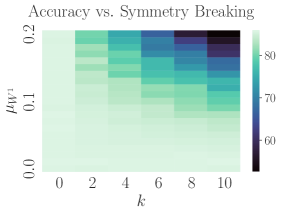
Experimental results
Research questions
- RQ1Can symmetries of a neural network density be determined even when the density is unknown and the network is not equivariant?
- RQ2How do invariance properties of parameter-space correlation functions reveal input and output symmetries of the functional density?
- RQ3What is the role of symmetry in the initialization density for generalization in finite-width neural networks?
- RQ4How does symmetry breaking during training affect performance, and under what conditions is it beneficial?
- RQ5Can the duality framework be applied to analyze symmetries in the Neural Tangent Kernel and parameter correlations during training?
Key findings
- Symmetries of neural network densities are successfully inferred via invariance of parameter-space correlation functions, even without prior knowledge of the density or network equivariance.
- The method recovers known Gaussian process results in the infinite-width limit, validating its consistency with established theory.
- In finite-width networks, the amount of symmetry in the initialization density directly affects test accuracy on Fashion-MNIST, with higher symmetry leading to better performance.
- Symmetry breaking during training only improves generalization when it aligns with the ground-truth symmetry of the data, indicating that inductive biases must be physically meaningful.
- The framework applies to the Neural Tangent Kernel and parameter correlations during training, showing that symmetry properties evolve dynamically and can be analyzed via duality.
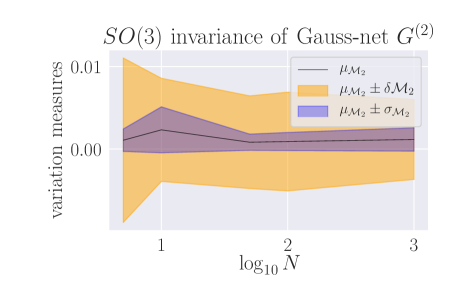
- Numerical experiments confirm that deviations from expected symmetry at low widths are due to finite-sample fluctuations, not fundamental symmetry breaking.
Read this paper
Open the full text in the Nubint reader and ask about any passage as you read.
Read this paper on NubintThis review was generated by AI from the original paper. Please check the paper before citing it.