
[Paper Review] SyncDreamer: Generating Multiview-consistent Images from a Single-view Image
SyncDreamer uses synchronized multiview diffusion with 3D-aware feature attention to generate multiview-consistent images from one input view, enabling improved 3D reconstruction without view-inconsistent outputs.
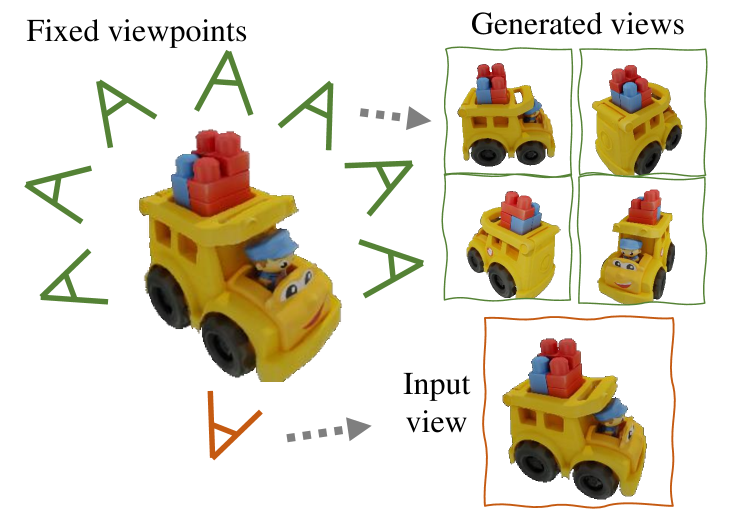
In this paper, we present a novel diffusion model called that generates multiview-consistent images from a single-view image. Using pretrained large-scale 2D diffusion models, recent work Zero123 demonstrates the ability to generate plausible novel views from a single-view image of an object. However, maintaining consistency in geometry and colors for the generated images remains a challenge. To address this issue, we propose a synchronized multiview diffusion model that models the joint probability distribution of multiview images, enabling the generation of multiview-consistent images in a single reverse process. SyncDreamer synchronizes the intermediate states of all the generated images at every step of the reverse process through a 3D-aware feature attention mechanism that correlates the corresponding features across different views. Experiments show that SyncDreamer generates images with high consistency across different views, thus making it well-suited for various 3D generation tasks such as novel-view-synthesis, text-to-3D, and image-to-3D.
Motivation & Objective
- Motivate and enable robust single-view to multi-view 3D reconstruction across arbitrary objects.
- Overcome multiview inconsistency in generated images using a joint multiview diffusion model.
- Leverage a 3D-aware feature attention mechanism to synchronize cross-view information during denoising.
- Initialize from a pretrained 2D diffusion model to preserve generalization across diverse input styles.
Proposed method
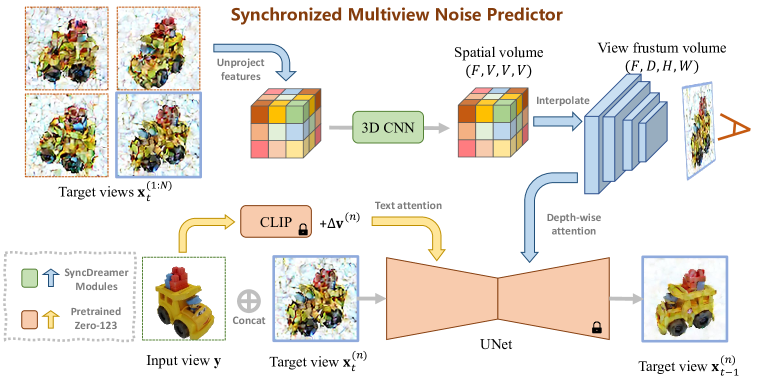
- Extend diffusion models to model the joint distribution of N views by using N synchronized noise predictors.
- Use a shared UNet initialized from Zero123 (Stable Diffusion-based) as the backbone for all views.
- Introduce 3D-aware feature attention that builds a depth-wise attention mechanism over a view frustum derived from a global spatial volume.
- Train with a loss on predicting the noise for randomly selected views in each step, enabling synchronization across views.
- Render a fixed set of viewpoints (N = 16) and train on Objaverse data to learn cross-view consistency.
Experimental results
Research questions
- RQ1Can a diffusion process be extended to jointly model and synchronize multiple views to ensure cross-view consistency from a single input image?
- RQ2How can cross-view information be encoded and propagated during denoising to enforce geometry and color consistency across views?
- RQ3Does initializing from a strong 2D diffusion backbone (Zero123) improve generalization to arbitrary objects and input styles for 3D reconstruction?
- RQ4What is the impact of a 3D-aware attention mechanism on multiview consistency and downstream 3D reconstruction quality?
Key findings
- SyncDreamer achieves higher multiview consistency and reconstruction quality than baselines on the Google Scanned Object dataset.
- On novel view synthesis, RealFusion, Zero123, and SyncDreamer achieve PSNR/SSIM/LPIPS of 15.26/0.722/0.283, 18.93/0.779/0.166, and 20.05/0.798/0.146 respectively, with #Points 4010, 95, and 1123.
- On single-view reconstruction, SyncDreamer attains Chamfer Distance 0.0261 and Volume IoU 0.5421, outperforming RealFusion (0.0819, 0.2741) and Zero123 (0.0339, 0.5035).
- The method supports generating multiple plausible instances from the same input by varying seeds.
- Ablations show the necessity of 3D-aware attention and using Zero123 as backbone for generalization across 2D styles and drawings.
Read this paper
Open the full text in the Nubint reader and ask about any passage as you read.
Read this paper on NubintThis review was generated by AI from the original paper. Please check the paper before citing it.