
[Paper Review] Synth$^2$: Boosting Visual-Language Models with Synthetic Captions and Image Embeddings
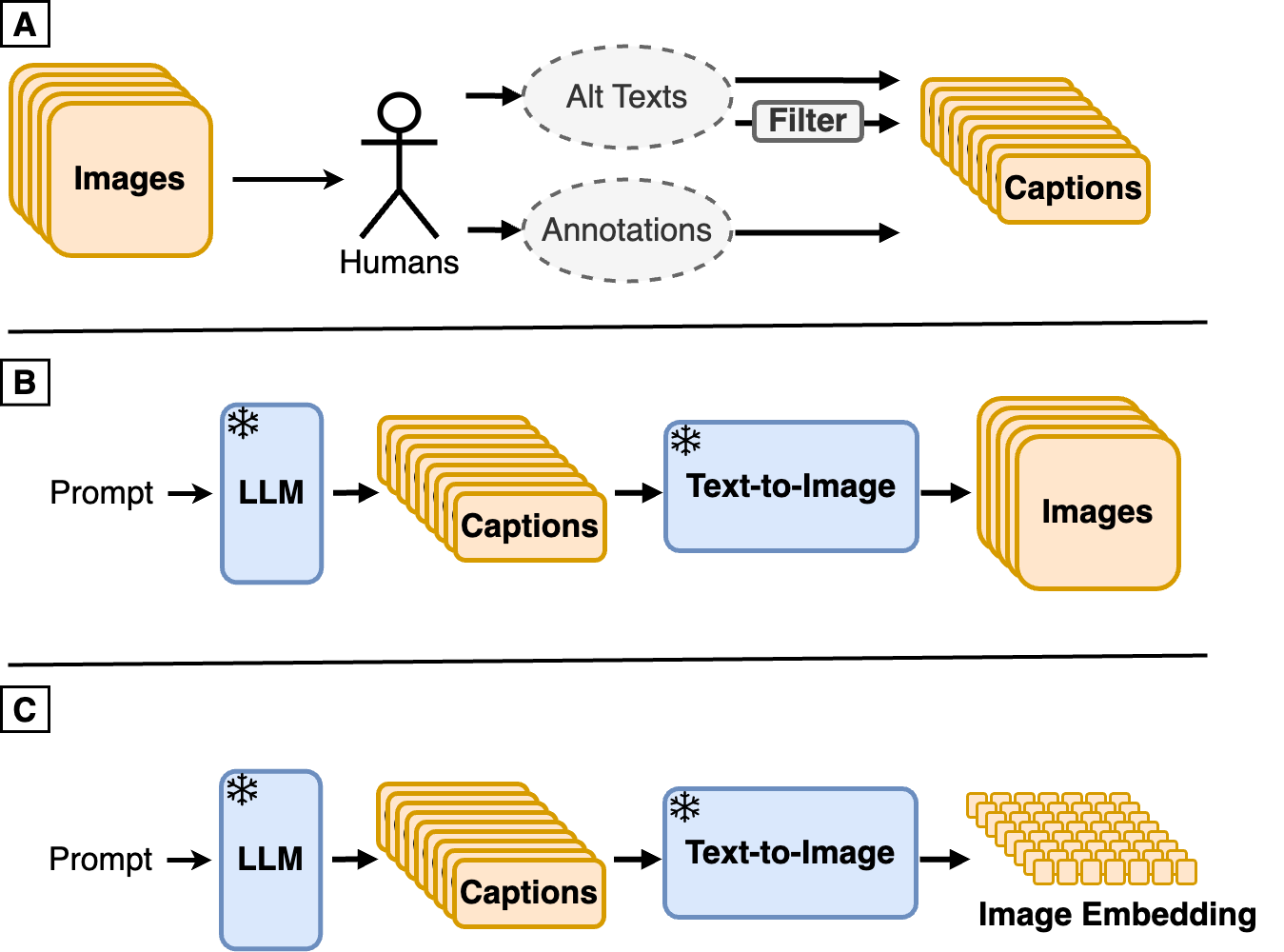
This paper proposes Synth$^2$, a method that generates high-quality synthetic image-text pairs using pre-trained large language models (LLMs) and a text-to-image model to train visual-language models (VLMs). By synthesizing image embeddings directly from LLM-generated captions—bypassing pixel-space rendering—it achieves comparable performance to human-annotated data with only 1/3 of the training steps and a 17% improvement over baselines using synthetic data augmentation.
The creation of high-quality human-labeled image-caption datasets presents a significant bottleneck in the development of Visual-Language Models (VLMs). In this work, we investigate an approach that leverages the strengths of Large Language Models (LLMs) and image generation models to create synthetic image-text pairs for efficient and effective VLM training. Our method employs a pretrained text-to-image model to synthesize image embeddings from captions generated by an LLM. Despite the text-to-image model and VLM initially being trained on the same data, our approach leverages the image generator's ability to create novel compositions, resulting in synthetic image embeddings that expand beyond the limitations of the original dataset. Extensive experiments demonstrate that our VLM, finetuned on synthetic data achieves comparable performance to models trained solely on human-annotated data, while requiring significantly less data. Furthermore, we perform a set of analyses on captions which reveals that semantic diversity and balance are key aspects for better downstream performance. Finally, we show that synthesizing images in the image embedding space is 25\% faster than in the pixel space. We believe our work not only addresses a significant challenge in VLM training but also opens up promising avenues for the development of self-improving multi-modal models.
Motivation & Objective
- To address the bottleneck of collecting high-quality human-annotated image-caption datasets for training visual-language models (VLMs).
- To reduce data curation costs and improve data efficiency in VLM training by leveraging generative models to create synthetic data.
- To enable scalable, customizable, and fair synthetic data generation that avoids knowledge leakage from external pre-trained image models.
- To evaluate the effectiveness of synthetic data in improving VLM performance on downstream tasks like image captioning.
- To demonstrate that training in the image embedding space significantly improves computational efficiency without sacrificing model performance.
Proposed method
- Pre-train a text-to-image model on the same dataset used for VLM training to prevent knowledge transfer from external models.
- Generate synthetic captions using a pre-trained large language model (LLM) to serve as input prompts for image generation.
- Synthesize image embeddings directly from captions using the text-to-image model, bypassing pixel-space image generation.
- Train the VLM using a combination of real human-annotated data and synthetic image-text embedding pairs.
- Operate the entire pipeline in the image embedding space to reduce memory and computational overhead.
- Use controlled image generation to ensure fidelity and fairness in synthetic data, avoiding biases from off-the-shelf models.
Experimental results
Research questions
- RQ1Can synthetic image-text pairs generated via LLMs and text-to-image models effectively improve VLM performance on image captioning tasks?
- RQ2Does generating synthetic data in the image embedding space offer significant computational advantages over pixel-space generation?
- RQ3Can a VLM trained with a mix of real and synthetic data outperform a baseline trained only on human-annotated data?
- RQ4How does the performance of a VLM trained with synthetic data scale with increasing amounts of synthetic data?
- RQ5To what extent do biases in the generative models affect the quality and fairness of the synthetic training data?
Key findings
- The VLM trained with synthetic data achieved a 17% performance gain over the baseline trained solely on human-annotated data.
- Synth$^2$ reached parity with the real-data baseline using only one-third of the training steps, demonstrating superior data efficiency.
- Synthesizing in the image embedding space was 25% faster than pixel-space generation, with a training throughput of 2.08 steps per second compared to 1.66 steps per second.
- The model achieved a CIDEr score of 26.0 on the zero-shot image captioning benchmark, matching the performance of the real-data baseline.
- The method demonstrated that synthetic data generation in the embedding space maintains high-quality outputs while drastically reducing computational overhead.
- Pre-training the text-to-image model on the same dataset as the VLM ensured fair evaluation by eliminating knowledge leakage from external models.
Read this paper
Open the full text in the Nubint reader and ask about any passage as you read.
Read this paper on NubintThis review was generated by AI from the original paper. Please check the paper before citing it.