
[Paper Review] Synthetic Data Generation with LLM for Improved Depression Prediction
The paper presents a chain-of-thought prompting pipeline using an LLM to generate synthetic synopsis and sentiment data from DAIC-WOZ transcripts, augmenting real data to improve depression severity prediction while addressing privacy and data imbalance.
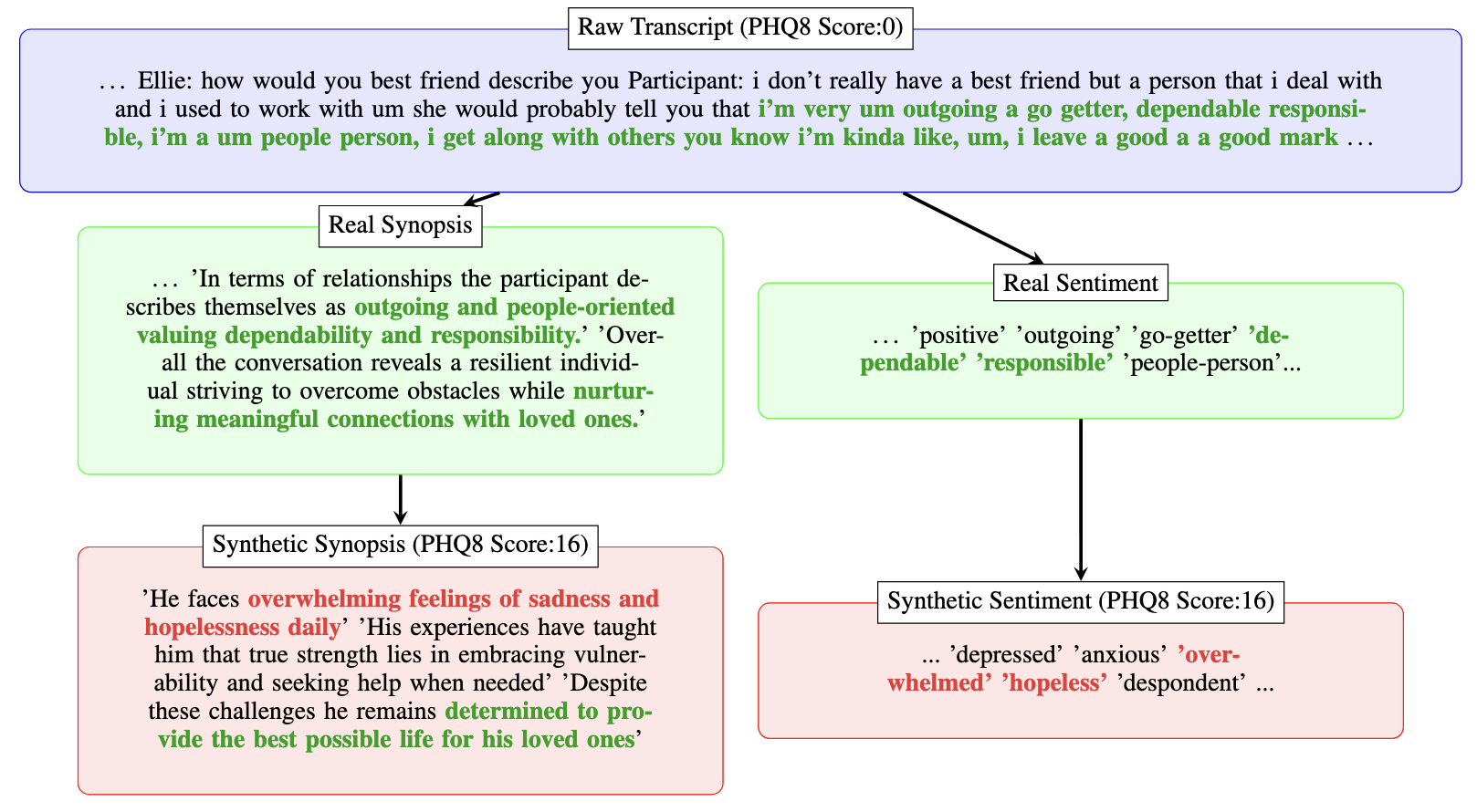
Automatic detection of depression is a rapidly growing field of research at the intersection of psychology and machine learning. However, with its exponential interest comes a growing concern for data privacy and scarcity due to the sensitivity of such a topic. In this paper, we propose a pipeline for Large Language Models (LLMs) to generate synthetic data to improve the performance of depression prediction models. Starting from unstructured, naturalistic text data from recorded transcripts of clinical interviews, we utilize an open-source LLM to generate synthetic data through chain-of-thought prompting. This pipeline involves two key steps: the first step is the generation of the synopsis and sentiment analysis based on the original transcript and depression score, while the second is the generation of the synthetic synopsis/sentiment analysis based on the summaries generated in the first step and a new depression score. Not only was the synthetic data satisfactory in terms of fidelity and privacy-preserving metrics, it also balanced the distribution of severity in the training dataset, thereby significantly enhancing the model's capability in predicting the intensity of the patient's depression. By leveraging LLMs to generate synthetic data that can be augmented to limited and imbalanced real-world datasets, we demonstrate a novel approach to addressing data scarcity and privacy concerns commonly faced in automatic depression detection, all while maintaining the statistical integrity of the original dataset. This approach offers a robust framework for future mental health research and applications.
Motivation & Objective
- Address data scarcity and privacy in depression detection from text by generating synthetic data.
- Develop a two-step synopsis and sentiment analysis generation process conditioned on a depression score.
- Evaluate fidelity, utility, and privacy of synthetic data for improving depression severity prediction.
Proposed method
- Use Meta Llama 3.2-3B-Instruct to generate an initial synopsis and sentiment analysis from original transcripts.
- Apply chain-of-thought prompting to create a synthetic synopsis and sentiment analysis for a new randomly generated PHQ-8 score.
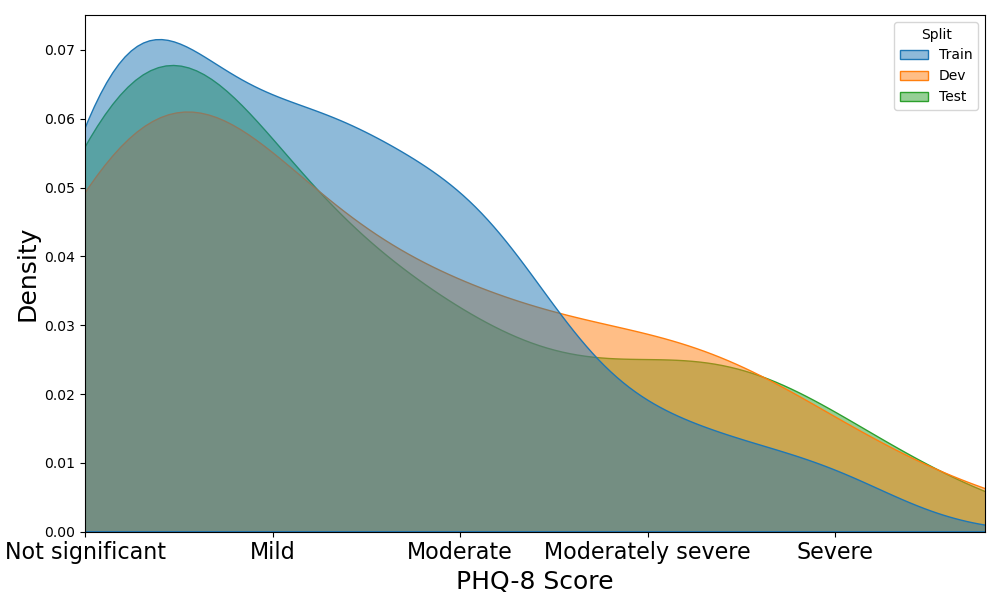
- Balance data distribution by oversampling higher PHQ-8 scores in synthetic data to reduce skew.
- Train models on synthetic data, then integrate with real data to assess performance gains.
- Evaluate privacy via embedding-distance metrics between synthetic and real data; visualize fidelity with PCA of synopsis embeddings.
Experimental results
Research questions
- RQ1Can synthetic data generated via chain-of-thought prompting improve depression severity prediction when added to real data?
- RQ2Do synopsis-based synthetic transcripts preserve key statistical properties of the original data (fidelity) and protect participant privacy?
- RQ3How does the synthetic data affect model training compared to models trained on real data alone?
- RQ4What is the impact of data augmentation with synthetic samples on handling class imbalance in PHQ-8 scores?
Key findings
- Synthetic data alone yields RMSE 4.80 and MAE 4.06 for PHQ-8 score prediction, outperforming some real-data baselines.
- Combining original and synthetic data achieves the best results with RMSE 4.64 and MAE 3.66.
- BERT models trained on combined data outperform Random Forest and GPT-4o baselines in this setup.
- PCA of synopsis embeddings shows overlap between original and synthetic data, with synthetic data expanding into severe depression regions.
- Privacy analysis shows higher average embedding distance for Real vs. Synthetic than Real vs. Real, indicating greater dissimilarity from real data and better privacy protection.
- Synthetic data improves data diversity and helps balance PHQ-8 score distribution, contributing to improved model performance.
Read this paper
Open the full text in the Nubint reader and ask about any passage as you read.
Read this paper on NubintThis review was generated by AI from the original paper. Please check the paper before citing it.